

For Nigeria’s university system, the problem with industrial disputes is no longer simply that they happen. It is that they keep returning, often with remarkably familiar arguments, familiar demands and familiar promises of resolution.
The latest warning from the Academic Staff Union of Universities (ASUU) is therefore bigger than another possible disruption of academic activities, reports Daily Independent.
With branches in 20 universities authorised to issue 14-day ultimatums over the implementation of the 2025 agreement, the development has brought back an uncomfortable feature of Nigeria’s labour relations: agreements are often celebrated when they are signed, but their real test begins afterwards.

And that is where the trouble usually starts.
The federal government and ASUU signed the renegotiated 2025 agreement in January 2026 after years of negotiations.
The agreement was presented as an opportunity to move the university system away from the familiar cycle of confrontation and prolonged strikes.
Government subsequently announced steps towards implementing some of its provisions, including the approved 40 per cent increase in academic allowances.
By June, the Federal Ministry of Education had gone a step further by inaugurating an Implementation Monitoring Committee involving government and ASUU representatives.
On paper, the architecture for stability appeared to be taking shape.
Yet, only weeks later, the industrial relations climate is again becoming tense.
Some state universities have already been affected by strikes, while the latest directive to 20 branches signals the possibility of a wider confrontation if the outstanding issues are not resolved.
This is where the latest development becomes more revealing.
Nigeria has never really had a problem negotiating with ASUU. Governments have sat across the table with the union repeatedly. Committees have been established. Agreements have been signed. Implementation plans have been announced.
What has proven difficult is making the agreements survive beyond the negotiating room.
A collective agreement is supposed to create certainty. Workers should know what they are entitled to, government should know what it has undertaken to provide, and both sides should have a predictable mechanism for dealing with disagreements over implementation.
Instead, Nigeria’s university system has repeatedly produced a different sequence.
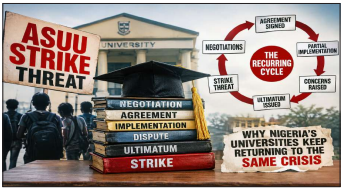
Negotiations become intense. A settlement is reached. Industrial action is suspended or avoided. Attention moves elsewhere. Some provisions are implemented, others encounter delays, and the union begins raising concerns. Eventually, warnings and ultimatums return.
By the time both sides begin another round of negotiations, the original agreement has become the subject of a fresh dispute.
It is expensive for government, which is repeatedly forced to devote administrative and political energy to disputes that should have been settled through an implementation framework.
It is expensive for lecturers whose welfare and working conditions remain uncertain.
But it is perhaps most disruptive for the wider society, which has to absorb the consequences every time an industrial disagreement spills into the academic calendar.
The experience of the 2022 ASUU strike remains difficult to forget. Universities were shut for about eight months during the dispute, leaving students stranded and academic programmes severely disrupted.
The issues were not entirely new. Funding, earned allowances, salaries, university revitalisation and the implementation of previous agreements were all part of the long-running disagreement.
Years later, Nigeria is still discussing many of the same broad questions.
That should prompt a different conversation.
Perhaps the central weakness is not the absence of agreements but the absence of a sufficiently strong culture of implementation.
In industrial relations, trust is built not by signing documents but by keeping commitments.
Once workers begin to suspect that negotiated commitments may not be honoured without additional pressure, the incentive to trust the process diminishes. The union becomes more inclined to use the strongest tool available to it, while government is left responding to pressure rather than preventing it.
That is how a dispute that should have been administrative can eventually become industrial.
The situation is even more complicated because Nigeria’s university system is not a single institution.
There are federal universities and state-owned universities, each operating within different funding and administrative arrangements.
A national agreement may establish broad expectations for academic staff, but its practical implementation can become complicated where state governments have separate responsibilities and financial realities.
That is one reason why the current dispute should not be reduced to a simple Federal Government versus ASUU argument.
There are several layers to the problem.
A federal university may have one set of implementation challenges. A state university may face another. A university management may have obligations of its own, while state governments may be struggling with competing demands on their finances.
For lecturers, however, the distinction can sometimes matter less than the outcome.
If an agreed entitlement has not been received, the fact that the difficulty originated from a funding structure or administrative responsibility does not necessarily make the problem disappear.
That is where clearer responsibility becomes essential.
Every agreement should answer not only what government has promised, but who is responsible for delivering each provision, where the money will come from, when implementation will begin and what happens if a deadline is missed.
Without those details, implementation becomes open-ended.
And once implementation becomes open-ended, another dispute is only a matter of time.
This is why the Implementation Monitoring Committee inaugurated in June could become important if it is allowed to operate as more than another bureaucratic structure.
Its usefulness should not be measured by the number of meetings it holds. The real test is whether it can identify outstanding provisions early, establish responsibility for them and intervene before disagreement develops into an ultimatum.
That would represent a shift from crisis management to dispute prevention.
Nigeria has often waited until labour disputes become serious before attempting to resolve them.
By then, both sides have hardened their positions. Public pressure has increased. Students and parents are anxious. University managements are caught between competing demands, and government is under pressure to produce an immediate solution.
There is also a wider lesson here about Nigeria’s approach to public-sector labour relations.
The ASUU dispute is only one example of a broader challenge in which government and organised labour reach agreements under pressure, but implementation subsequently becomes contested.
When that happens repeatedly, the credibility of collective bargaining itself is weakened.
Workers begin to ask what value an agreement has if enforcing it requires another ultimatum.
Government, on the other hand, may find itself in a difficult financial position when commitments made during negotiations collide with budgetary limitations and other national priorities.
Neither side can simply wish that tension away.
Government cannot sustainably promise what it cannot fund. Labour unions cannot be expected to remain indefinitely silent over obligations that have already been negotiated and agreed.
The solution therefore lies somewhere between fiscal realism and contractual responsibility.
Government needs to negotiate agreements that are financially sustainable and accompanied by realistic implementation schedules. Unions, for their part, need mechanisms that allow genuine implementation problems to be resolved without immediately pushing the system towards a shutdown.
But the responsibility for breaking the cycle cannot be placed on ASUU alone.
For years, strikes have often been treated as though they are the problem. In reality, they are frequently the most visible symptom of a dispute that has been allowed to accumulate.
The disagreement existed before the gates were shut.
That distinction is important because it changes the question from “How do we stop ASUU from striking?” to “How do we prevent disputes from reaching the point where striking becomes the preferred option?”
That is a much harder question, but it is also the one Nigeria needs to answer.
The latest 14-day ultimatum should therefore be seen as a warning beyond the university environment.
It is a warning about the credibility of agreements between government and organised labour.
If an agreement reached only months ago can already produce another round of industrial tension, then the country needs to examine what happens between signing and implementation.
That space may be where Nigeria’s labour relations problem truly lies.
The immediate temptation will be to convene another meeting, make another appeal and negotiate another deadline.
But preventing one strike is not the same as solving the problem.
Nigeria has done the former many times.
What it has yet to demonstrate consistently is that it can make a negotiated agreement durable enough to prevent the next confrontation.
Until that changes, the names of the universities, the dates of the ultimatums and the specific demands may change, but the story itself will remain remarkably familiar.
And that may be the most troubling part of the latest ASUU crisis.