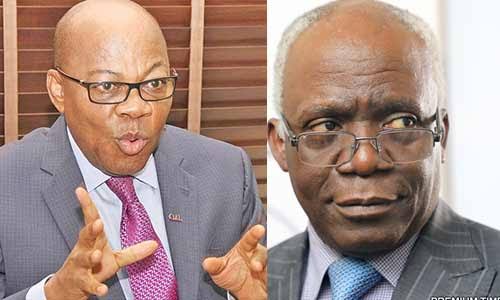
•Agbakoba and Falana
Lagos lawyer, Mr. Femi Falana (SAN), has expressed disagreement with a former President of the Nigerian Bar Association (NBA), Dr. Olisa Agbakoba (SAN), over the constitutionality of the Economic and Financial Crimes Commission (EFCC).
Agbakoba recently wrote a letter to the National Assembly in which he had described the EFCC as “an unlawful organisation” because it was allegedly “unconstitutionally established”.
The ex-NBA president contended that the power under which EFCC was established was beyond the powers of the National Assembly, reports The Nation.
In a letter yesterday to House of Representatives Speaker Tajudeen Abbas, Mr. Falana said: “The Supreme Court has consistently supported the efforts of the ICPC and EFCC in fighting the misma of monumental corruption in the country.”
Alluding to Agbakoba’s letter, dated October 14 and titled: Re: Urgent Legislative Attention on Constitutional Reforms Relating to Law Enforcement Agencies and Anti-corruption Efforts, Falana said: “Even though he did not refer to any particular case, Dr. Agbakoba said that the Supreme Court has knocked the EFCC on many occasions.”
He also noted that the argument of Dr. Agbakoba was anchored on the premise that the establishment law of the EFCC has violated the basic tenets of federalism.
The activist-lawyer urged members of the National Assembly to take advantage of the ongoing constitutional review to end the diversionary debate about the validity of the EFCC Act and ICPC Act by entrenching both commissions into the constitution.
“In other words, if both commissions are constitutionalised, they will be protected and strengthened to fight the menace of corruption and money laundering,” he said.
To support his position, Falana recalled the case of the Attorney-General of Ondo State v Attorney-General of the Federation & Ors (2022) 27 WRN 1.
He said: “The plaintiff (Ondo State government) had challenged the constitutional validity of the establishment of the Independent Corrupt Practices and Other Offences Commission Act, 2000. The Attorney-General of Ondo State was the plaintiff while the Attorney-General of the Federation and the Attorneys-General of 35 states were the defendants.
“In that case, the late Professor Ben Nwabueze and Dr. Agbakoba were the amici curiae while I was privileged to have represented one of the defendants.
“It is on record that several defendants and the amici curiae had argued profusely that the ICPC Act was unconstitutional in every material particular. Both amici curiae urged the court to annul the ICPC Act.
“Upon a critical analysis of the submissions of all counsel including the amicus curiae, the apex court upheld the constitutional validity of the ICPC Act.
“In the leading judgment of the court delivered by Uwais CJN (as he then was) it was held that the National Assembly ‘has the sole power for the establishment and regulation of authorities for the federation or any part thereof so as to promote and enforce the observance of the nation’s responsibility to abolish all corrupt practices and abuse of power which fall under the Fundamental Objectives and Directive Principles of State Policy in Section 15(5)’ of the 1999 CFRN.
“If this is a breach of the principles of federalism, then, I am afraid, it is the Constitution that makes provisions that have facilitated breach of the principles. As far as the aberration is supported by the provisions of the Constitution, I think it cannot rightly be argued that an illegality has occurred by the failure of the Constitution to adhere to the cardinal principles which are at best ideals to follow or guidance for an ideal situation.
“…The provisions of Section 13 thereof apply to ‘all organs of government and all authorities and persons exercising legislative, executive or judicial powers’. The provisions do not distinguish between federal, state or local governments. Again the provisions of Section 14 subsection (4) specifically apply to the ‘government of a state’, a local government council or any agencies of such government or council, and the conduct of the affairs of the government or council or such agencies.” See Olafisoye v. FRN (2004) 4 NWLR (Pt. 864) 580.
“Even though we cannot comment on the merit of the case of Attorney-General of Abia State & 15 Ors v Attorney-General of the Federation pending at the Supreme Court of Nigeria, it is pertinent to refer the members of the National Assembly to the case of Attorney-General of Abia State v Attorney-General of Federation (2024) LPELR -62576 (SC).
“In that case, the plaintiff had argued that the power of the EFCC to prosecute financial crimes did not extend to the management of the accounts of Abia State government. The plaintiff then sought ‘declarations, including a perpetual injunction, toggf prevent the EFCC from taking any such actions, including the freezing of its bank accounts’.
“The defendant (AGF) filed a preliminary objection to the effect that it had been incorrectly sued, because the EFCC was an independent body outside its lawful management and control.
“In upholding the preliminary objection of the defendants, the Supreme Court held that the facts of the case did not disclose any dispute between the plaintiff and the defendants within the meaning of section 232(1) of the Constitution and that there was no complaint against the first defendant (AGF) as representing the Federal Government as all the complaints were against the EFCC.”
Falana said the Supreme Court consequently struck out the case but held that “the plaintiff is at liberty to sue the EFCC, but not in the Supreme Court as the EFCC is neither a State nor the Federation”.
Falana stated that to date, no state government has followed the advice of the apex court by filing a suit to challenge the constitutionality of the EFCC Act in a court of competent jurisdiction.
He recalled that a number of former governors have continued to question the locus standi of the EFCC to arrest, investigate and prosecute them for the criminal diversion of public funds belonging to state governments.
“For instance, in the case of Nyame vs Federal Republic of Nigeria (2010) 3 SC (Pt.1) 78, the Supreme Court held inter alia:
“Sections 6 (m) and 46 of the Economic and Financial Crimes Commission (Establishment) Act vest in EFCC the function and duty of investigating and prosecuting persons reasonably suspected to have committed economic and financial crimes.
“For a person to rush to court to place a clog or shield against criminal investigation and prosecution is a clear interference with the powers given by law and the Constitution to EFCC in the conduct of criminal investigation and prosecution.
“In view of the duty imposed on the State by section 15(5) of the Constitution to ‘abolish all corrupt practices and abuse of power,’ the Supreme Court has held in the case of Shema Vs Federal Republic of Nigeria (2018) 9 NWLR (PT. 1624) 337 @ 398 that ‘In the co-operative federalism practiced in Nigeria, the EFCC is a common agency empowered to investigate and prosecute offenders for both the Federal and state economic and financial crimes and as such it qualifies as ‘any other authority or person’ empowered by section 211 (1) (b) of the Constitution to institute or initiate criminal proceedings. EFCC is the coordinating agency for the enforcement of the provisions of any other law or regulation on economic and financial crimes, including the Criminal Code and Penal Code. The Commission has powers under section 13 (2) of the EFCC Act to prosecute offences so long as they are financial crimes.’
“Instead of ensuring that the EFCC, ICPC and Code of Conduct Bureau serve as “common agencies” of the people of Nigeria in combating the misma of monumental corruption in the country, some state governments have a penchant for terminating grave economies and financial crimes by filing vnolle prosequi applications.
“Others usually rush to either State High Court or Federal High Court to procure frivolous court injunctions to frustrate the prosecution of serving public officers and thereby making a mockery of public accountability and transparency in government,” Falana noted.
Also, a lawyer and former member of the House of Representatives, Kayode Oladele, has Dr. Agbakoba on the legal status of the EFCC.
He described it as “legal sophistry”.
In a rejoinder to Agbakoba’s position on the EFCC, Oladele said: “It is pertinent to state that the Economic and Financial Crimes Commission (EFCC) is a Nigerian law enforcement agency established to investigate and prosecute economic and financial crimes, such as advance fee fraud, money laundering and misapplication and misappropriation of public funds.
“With due respect, Agbakoba SAN’s position is more of legal sophistry rather than legal substance. His position does not represent the correct position of the law as it runs contrary to the long-settled position of the law as handed down by the superior courts of law including the Apex Court in Nigeria.
“It is settled law that Nigeria operates a co-operative federalism as opposed to dualist federalism and under co-operative federalism as practiced in Nigeria, some agencies are common agencies for both the Federal and State Government.”
The lawyer posited that Agbakoba’s position did not have any legal backing “and therefore unsupportable in law and practice”.
He added: “Indeed, the EFCC is a common agency for both the Federal and State Economic and Financial Crimes, and as such, it qualifies as ‘any other authority’ to institute criminal proceedings under section 174(1)(b) and section 211(1)(b) of the 1999 Constitution of the Federal Republic of Nigeria (as amended). “Again, these statutory provisions have been given judicial considerations by the Supreme Court and the Court of Appeal, in line with my position and contrary to Mr. Agbakoba’s views or submissions on this issue.
“EFCC is expressly conferred with powers under sections 6(m), 9(2) and 13(2) of EFCC (Est.) Act to initiate criminal proceedings in any court in Nigeria for any offence bordering on economic and financial crimes, even under the Penal Code.
“The EFCC cannot, therefore, be faulted for initiating the instant charge in the name of Federal Republic of Nigeria.
“This is because the Federal Government of Nigeria is not synonymous with the Federation of Nigeria, or the Federal Republic of Nigeria.”