•CNG
Concerns surrounding the adoption of Compressed Natural Gas as an alternative vehicle fuel in Nigeria have intensified, fuelled by recent incidents that have raised scepticism about its suitability and safety in the country, reports Saturday PUNCH.
Last month, an unsettling explosion involving a CNG-powered vehicle shocked the residents of Benin City, Edo State.
The incident occurred at a NIPCO gas station in the Aduwawa area, where a private vehicle, in the process of refuelling, erupted with a blast that left the vehicle’s trunk—a storage area for the CNG cylinder—twisted and shattered by the force of the explosion.
A video of the aftermath circulated widely, capturing the chaos and horror of the scene.
Three people were left severely injured: a motorist sustained eye injuries, a woman’s abdomen was torn open, and a third victim lost a foot to the explosion’s force.
Swiftly transported to the University of Benin Teaching Hospital, the victims received emergency care, though their injuries highlighted the tragic consequences of what many fear is a risky fuel alternative.
Investigations at the scene uncovered that the explosion was triggered by a cylinder fabricated by an unlicensed welder.
This unapproved modification violated established safety protocols, and the welder involved has since reported himself to the authorities. Responding to public concern, the Presidential Compressed Natural Gas Initiative issued a statement emphasising that only authorised conversion centres should be used to avoid such tragedies.
This explosion wasn’t an isolated event. Earlier in the year, two separate CNG-related explosions in Ogun and Rivers States claimed five lives in total, fuelling ongoing scepticism about the viability of CNG-powered vehicles in Nigeria.
Further compounding public unease, Malaysia recently announced a phase-out of natural gas vehicles, banning new registrations starting from June 2025.
Citing safety concerns, Malaysia’s Transport Minister, Anthony Loke, noted that the limited lifespan of gas cylinders—typically around 15 years—was a factor in the government’s decision.
The Malaysian announcement sparked considerable debate in Nigeria, with many questioning the government’s encouragement of CNG adoption at a time when other countries are turning away from it.
Special Adviser to President Bola Tinubu on Information and Strategy, Bayo Onanuga, attempted to assuage fears, explaining that Malaysia’s phase-out applies to liquefied petroleum gas, not compressed natural gas.
Despite these incidents, a visit to CNG conversion centres in Lagos and Ogun States revealed a steady rise in vehicle conversions, underscoring a complex dynamic: while safety concerns loom large, the promise of a cheaper, more sustainable fuel option continues to attract Nigerian drivers looking to cut fuel costs amid an uncertain economic climate. The Benin explosion and other incidents serve as stark reminders of the potential risks involved, casting a shadow over what was initially viewed as a progressive move towards a cleaner energy future.
At Dana Motors in Isolo, Lagos, one of the six authorised conversion centres designated by the federal government, our correspondent found that while commercial vehicles are converted to CNG at no cost, private vehicle owners must pay conversion fees within the range of N1m. Meanwhile, at the NIPCO CNG filling station in Ibafo, Ogun, there was a steady queue of private vehicles waiting for conversion alongside other vehicles, including fuel tankers, refuelling with compressed natural gas.
One of the newly converted CNG users, Olatoye Samson, shared his early impressions with our correspondent.
Just two weeks into using CNG, the retired secondary school principal expressed satisfaction with the savings he was able to make.
He explained that he drove from Abeokuta to refill at the Ibafo station because the nearest station in Ifo was inaccessible due to poor road conditions.
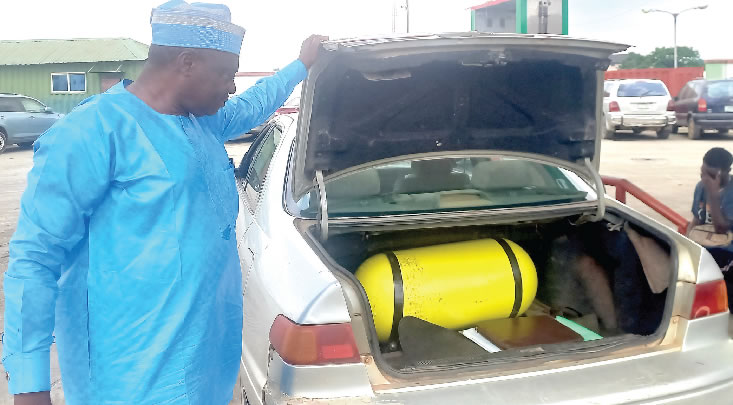
His single-cylinder refill cost N3,107—a fraction of what he would have spent on petrol to fill his 100-litre Toyota Camry.
“Had I been using petrol, I’d have spent around N60,000 on fuel over the past two weeks,” Samson noted. “The country’s economy is biting hard, and with little disposable income, you have to ask yourself, ‘Will I be able to eat and take care of my family if I keep spending so much on fuel?’ That’s why I decided to switch to CNG.”
Samson initially knew little about CNG, but after hearing about the benefits, he opted for conversion, albeit with government support.
“In Abeokuta, I was informed that someone from the government would contact me, which they did. I spent just N70,000, but when I tried to arrange it independently, the cost was close to N1m,” he explained. Since then, he noted, the conversion cost has risen due to currency exchange fluctuations.
“If you can afford it, CNG is worth it in the long run,” he advised, estimating that his two-week CNG bill was about N3,000—compared to the N60,000 he would have spent on petrol.
Samson also appreciated the dual-fuel option, allowing him to switch to petrol if needed, though he typically refuels with gas to ensure he reaches a station without difficulty.
When asked if he was concerned about potential explosions, Samson dismissed the worry. “Life itself is a risk. I’m not afraid of it exploding. I am a son of God; His protection is over me.”
At the station, attendants detailed the conversion costs, which vary depending on the engine.
A four-plug vehicle costs around N800,000, while a six-plug vehicle exceeds N1million.
They pointed out that although CNG has been available in Nigeria for over a decade, its recent popularity has surged due to rising fuel prices and economic pressures.
CNG adoption in commercial transportation
Commercial vehicles have also joined the CNG rave. Tobi Babatunde, a driver on the Mowe–Ketu route, revealed that he spends around N5,000 to refill his cylinder and hasn’t experienced any issues since the conversion was done.
He mentioned that the vehicle, which he acquired through a hire-purchase arrangement, had already been converted to CNG before it was handed over to him.
Another commercial driver, Toheeb Owolabi, who operates along the Mowe–Oworonshoki route with two CNG cylinders, secured under passenger seats, explained that he refuels frequently during trips to avoid running out of gas. Despite CNG’s touted potential to reduce transportation costs, passengers continue to pay the same fares as in petrol-powered vehicles.
Owolabi, however, noted that CNG public buses offered lower fares than standard commercial vehicles.
He said, “Conversion isn’t cheap, and the Federal Government’s free centres take too long for businessmen like me.” He smiled before adding, “Here, I don’t answer to the federal government. Who will feed my family if I wait?”
He pointed out that the free conversion centres were limited in capacity, with lengthy wait times.
“Of 100 buses, how many has the federal tovernment converted? You could leave your vehicle there for weeks. I didn’t have that time, so I took my own money and got it done,” he added, justifying his unchanged fares.
As Nigerians weigh the advantages of CNG amid an uncertain economic landscape, stories like that of Samson and Owolabi’s efforts reflect both the promise and the practical challenges of switching to this alternative fuel.
At a filling station in Lagos, an Abuja-bound truck driver described the logistics of operating with CNG.
His 16-cylinder truck, which costs roughly N190,000 to fill, enables him to travel from Lagos to Okene, where he’ll need to refill, before reaching his final destination in Abuja.
On the return journey, he plans another stop at Okene for refuelling. Interestingly, none of the drivers reported any issues with vehicle speed or performance using CNG.
Across the globe, CNG has been adopted in varying degrees, with countries like Iran, Pakistan, Argentina, Brazil, China, and India integrating it into their transportation systems.
However, these nations face similar challenges to Nigeria’s, including increased vehicle weight due to the cylinder, a lack of familiarity with the technology, and limited infrastructure for refuelling.
A utility engineer, speaking on condition of anonymity, highlighted that the compressed nature of CNG could pose risks.
“CNG is compressed at high pressure—if there’s an accident, it’s like a mini bomb,” he cautioned.
While he acknowledged the potential benefits of CNG, he stressed that regulatory bodies should closely monitor vehicle roadworthiness, especially given that CNG cylinders have expiration dates and may not suit cars regularly used in bumpy areas. He raised the question of long-term affordability, noting that if CNG were both inexpensive and reliable, Western countries might have widely adopted it before turning to electric vehicles.
Nigeria’s initial push for CNG
Nigeria first proposed CNG as an automotive fuel back in 1997, aiming to utilise the country’s natural gas resources, as noted in a Science Direct journal.
The initiative took a significant step forward in October 2023, with the PCNGI launching seven pilot conversion centres across the nation. According to the PCNGI Chairman, Zacch Adedeji, the programme aims to establish a sustainable energy future by leveraging Nigeria’s abundant gas resources while generating employment.
The current focus is on converting public transportation vehicles like buses and tricycles.
Despite this push, the infrastructure remains limited. Only 131 conversion centres operate across 12 states, including Lagos, Ogun, and the Federal Capital Territory.
An oil and gas expert, Ademola Adigun, downplayed fears associated with the shift, likening it to Nigeria’s move from kerosene to gas cylinders.
“When we were moving from kerosene to gas, everyone feared explosions, yet gas is now common and relatively safe with proper management. CNG, too, offers a cheaper alternative,” he added.
Government must lead by example
For another industry expert, Professor Ayo Ayoade, the government must lead by example, advocating a proactive rather than merely promotional approach to CNG adoption.
“Policies should be action-led, not media-driven. Government offices should integrate CNG within their fleets, test the limits, resolve issues, and then roll out to the public,” he said.
Ayoade suggested pilot projects across geopolitical zones to ensure the policy’s viability in various terrains and conditions.
He also raised questions about Nigeria’s readiness, asking whether available infrastructure could support widespread adoption so that drivers aren’t stranded without refuelling options.
According to him, this concern is particularly pressing as other countries advance towards electric vehicles—a trend Nigeria lags in.
CNG and Nigeria’s clean energy future
Experts agree that electric vehicles represent the ultimate goal for clean energy, but they acknowledge Nigeria’s infrastructure may not yet support a full transition.
For now, CNG offers a viable, less-polluting alternative, Ayoade noted, adding that CNG could positively impact food prices by reducing transportation costs, especially for goods moved from northern regions to the south.
Lower transport costs could, in turn, stabilise food prices, an issue heavily influenced by high logistics expenses, he further pointed out.
However, Ayoade criticised Nigeria’s late embrace of CNG, at a time other countries are moving on to electric vehicles.
“The Western world is dumping older technologies here while they transition to electric. We end up subsidising their advancement while lagging ourselves. Tokunbo cars fill our roads, but after 20 years of use here, we can’t send them back,” he lamented.
Nigeria’s exploration of CNG reflects an effort to address immediate economic needs, yet raises broader questions about the country’s energy policy.
As the government pushes CNG forward, experts say the path to a sustainable, affordable, and safe energy solution for Nigeria’s transportation sector remains fraught with challenges, yet holds promise if implemented thoughtfully.