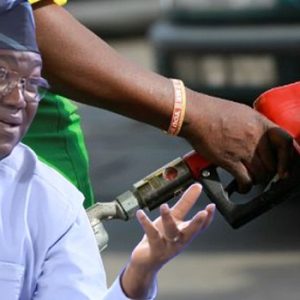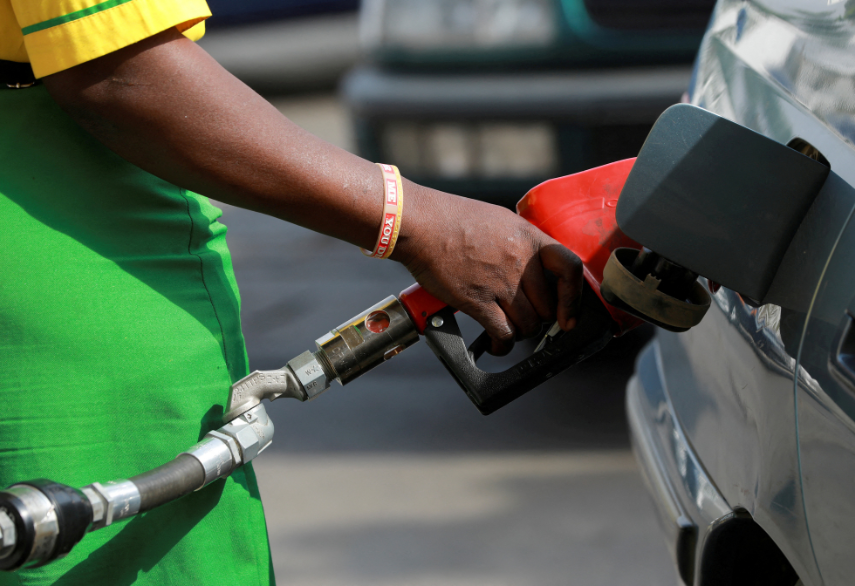
•A fuel attendant
Marketers and some stakeholders in the downstream sector of the oil and gas industry yesterday welcomed the suspension of the 15 per cent ad-valorem import duty on imported Premium Motor Spirit (PMS) and Automotive Gas Oil (AGO), also known as petrol and diesel.
They said the import levy is not feasible until Nigeria attains local sufficiency in refining, reports Daily Trust.
The Nigerian Midstream and Downstream Petroleum Regulatory Authority (NMDPRA) has announced the suspension of the levy.
This was contained in a statement signed by George Ene-Ita, Director of the Public Affairs Department yesterday.
The introduction of the 15% import duty had generated mixed reactions in the downstream industry.
It was seen in one breadth as a measure to protect local refineries while those opposing it said it could trigger fuel price increase as Nigerians would bear the burden of the expected increase.
However the Authority assured the public that there is adequate supply of petroleum products across the country, maintaining volumes within the acceptable national sufficiency threshold during this peak demand period.
“The Authority wishes to use this opportunity to advise against any hoarding, panic buying or non-market reflective escalation of prices of petroleum products.
“It should also be noted that the implementation of the 15% ad-valorem import duty on imported Premium Motor Spirit and Diesel is no longer in view,” the statement said.
According to NMDPRA, there is robust domestic availability of petroleum products—including PMS, AGO, and Liquefied Petroleum Gas (LPG)—sourced from both local refineries and importation, ensuring timely replenishment of stocks at depots and retail outlets nationwide.
“The Authority will continue to closely monitor the supply situation and take appropriate regulatory measures to prevent disruption of supply and distribution of petroleum products across the country, especially during this peak demand period.
“While appreciating the continued efforts of all stakeholders in the midstream and downstream value chain in ensuring a smooth and uninterrupted supply and distribution, the public is hereby assured of NMDPRA’s commitment to guarantee energy security,” the statement added.
‘Why FG backtracked’
The announcement of the import duty had generated mixed reactions in the polity.
Major and independent marketers were divided over the desirability of the levy. The Major Energies Marketers’ Association of Nigeria (MEMAN) specifically said the 15% import duty would trigger an upward rise in prices of the products.
Executive Secretary of MEMAN, Mr. Clement Isong stated that the tariff would have significant impact on pump prices of PMS as well as diesel prices which may sell for about N1,100 and N1,200 per litre respectively while imposing fresh hardship on Nigerians.
The duty was initially announced in a letter titled ‘Re: introduction of a market-responsive import tariff framework on Premium Motor Spirit (PMS) & Diesel,’ and signed by Damilotun Aderemi, the Private Secretary to the President.
The president’s approval followed a request by FIRS Chairman, Zacch Adedeji for the government to apply the tariff to align import costs with domestic realities.
Adedeji said the duty, applied to the Cost, Insurance, and Freight (CIF) value, is expected to increase petrol prices by approximately N99.72 per litre.
“The core objective of this initiative is to operationalise crude transactions in local currency, strengthen local refining capacity, and ensure a stable, affordable supply of petroleum products across Nigeria aligning with Your Excellency’s Renewed Hope Agenda for security and fiscal sustainability,” the FIRS said.
But MEMAN insisted that the 15 per cent tariff is way too high as it is tantamount to placing a ban on fuel import which is not good for energy security.
Isong confirmed that based on the current market trend and today’s landed costs, a 15 % tariff would add N122.46 to PMS (N827.24 to N949.70), pushing pump prices to about N998/L in Lagos and N1,028/L in many upcountry markets; diesel would rise to roughly N1,164-N1,194/L depending on margins.
But the marketers’ comment negated that of the Dangote Refinery, the largest single train refinery in Nigeria which has boasted of its ability to meet the daily consumption by Nigerians.
The facility had said it now delivers 45m litres of premium motor spirit (PMS) otherwise known as petroleum.
Similarly it said the facility also delivers 25 million litres of diesel on a daily basis while reaffirming its commitment to ensuring a steady and uninterrupted supply of the products nationwide.
However, despite assurances from Dangote which also welcomed the measure aimed at discouraging importation and protecting local refineries, the opposition to the import duty continued until yesterday when the proposal was suspended.
A major marketer and CEO of 11PLC, Otunba Adetunji Oyebanji who spoke with our correspondent said, “Personally I believe that there was a lot of push back from a lot of quarters, just as there were many in support.
“As we heard from the international contributors at the recent MEMAN webinar, while not unheard of, value added tax on fuel is usually about 2%.
“Government in originally proposing such a move must have been thinking about the revenue potential. However, it came across as being a tool to protect local refineries, and to some people, a particular refinery.”
He stated that the U-turn must have been informed by the fact that there is inadequate consultation within and outside government as well as the political implications of likely higher pump prices.
He stated that the implication of this is that importation will continue until enough product is available through the local refineries.
“This development will ensure supply is adequate and that prices are moderated since no single entity will have monopoly of supply,” he said.
Speaking with our correspondent, a renowned professor of petroleum economics, Prof. Wumi Iledare, said the reversal is typical Nigerian politics.
“Babangida did the same during the SAP (Structural Adjustment Programme) era — sidelining intellectual advice and elevating political expediency above sound economic reasoning. The pattern continues today.”
He stressed that politicians are often averse to intellectual input when it challenges short-term political interests and unfortunately, politics continues to trump economics, and the nation pays the long-term price.
“Economics and evidence must guide policy; politics should only enable implementation. Until then, we will keep circling around the same structural problems.”
He added that the 15% import duty should have been viewed as a fiscal and market-stabilising instrument, not a political gesture.
“The intent is clear — to protect emerging local refineries, encourage domestic value addition, and gradually align Nigeria’s downstream market with its growing industrial capacity. In economic terms, this policy aimed to reduce import dependence, conserve foreign exchange, and support refinery viability.
“Domestic producers like Dangote Refinery and the rehabilitated NNPC plants need a short breathing space to stabilise operations and recover heavy capital investments. Many countries have used such temporary tariffs to nurture new industries.”
He stated that if governance fails, the duty becomes a protection for inefficiency; if it works, it becomes a bridge to competitiveness.
“The difference lies in transparency, sequencing, and accountability,” he added.
“Of course, prices may rise slightly in the short term — but that’s part of the transition toward long-term efficiency where Nigeria meets its own fuel needs competitively. Let’s keep things in perspective: petrol here sells around N890–N965 per litre, while in Benin N1,800–N1,875, Togo N1,835, Ghana N1,550–N1,995, and Senegal N2,538. Nigeria still remains the lowest-priced market in the sub-region. The task now is ensuring border vigilance and market discipline to prevent arbitrage.”
What suspension means – Paul Alaje
Foremost economist, Dr. Paul Alaje in a chat with our correspondent said it was clear the government did not do its findings before imposing the tariff.
He stated that he welcomed the import duty initially on the ground that Nigeria has local sufficiency in fuel production.
“But NNPCL has said that we don’t have full sufficiency. So we need to reconcile whether we have it or not. If we have it, and we are still importing, I mean, we are introducing the ban, we are simply telling people, buy local, we have sufficiency. But if we don’t have it, that means we want to put pressure on local consumption.”
With the suspension of the duty, he said, “My thoughts would be that maybe the government has realized that we don’t have sufficiency yet. Because if they introduce it, it’s more money in terms of revenue for the government, however, if that burden will be transferred to a final consumer, then it will be a lopsided policy.
“So the government should support local producers to get to sufficiency, like we have sufficiency in cement. But to haste into introducing taxes when we don’t yet have sufficiency, then it’s to take us back to Egypt.
“To that extent, what determines whether it’s a good decision or bad decision is our level of sufficiency in production. And we are not sure. Dangote Refinery says they have reached sufficiency. NNPCL says we don’t have enough.”
He stated that the government should always conduct evidence-based research before introducing any policy.
“In the last 20 weeks, what is the average import per week? If we have reached sufficiency, then where are those people selling their import? Where are they selling their imports? So these are questions. So it goes beyond just consulting. It has to do with objectivism in research. So if we have research, if we have conducted thorough research, we would be able to tell whether or not we have reached sufficiency or not.”
Duty would have caused trade war – Expert
Economic expert, Samuel Caulcrick, stated that the import duty could have triggered trade wars.
He warned that higher import tariffs could lead to increased consumer prices, reduced innovation, limited product choices and the potential for retaliatory trade measures from Nigeria’s trading partners.
Citing a 2019 study on the United States (U.S.) tariffs, which showed that American households paid an additional $3,300 annually due to tariff-induced price increases, Caulcrick said Nigeria could face similar inflationary pressures if it fails to balance protectionism with global competitiveness.
He further noted that protecting “infant industries” without a clear path towards competitiveness could make them complacent and inefficient, trapping the economy in a cycle of dependence on government protection.
He urged the federal government to draw lessons from China’s industrial growth model, which he said combined protectionist measures with foreign investment incentives, export-oriented policies, and technological development, not tariffs alone.
He added: “Tariffs are ultimately paid by domestic consumers and businesses. They face higher prices for imported goods and even for locally produced alternatives that no longer have to compete on price.
“China’s economic rise was not built solely on import restrictions. It actively attracted foreign direct investment, built strong supply chains, and created an export-led manufacturing system that guaranteed global competitiveness.”