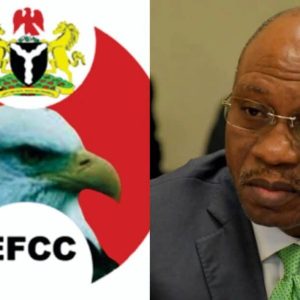
•Tambuwal and EFCC operative
The African Democratic Congress (ADC) has accused the Economic and Financial Crimes Commission (EFCC) of engaging in selective investigations and operating as a political tool for the ruling All Progressives Congress (APC).
The denunciation came as the Commission yesterday detained former governor of Sokoto State, Aminu Tambuwal, over alleged illegal withdrawal of more than N189 billion during his tenure, reports The Guardian.
Last month, Tambuwal was reportedly quoted as saying, “We’re still members of PDP, and we’re going nowhere, but we will work for ADC.”
Tambuwal, who also served as Speaker of the House of Representatives from 2011 to 2015, governed Sokoto from 2015 to 2023.
Sources told our correspondent that the former governor arrived at the EFCC headquarters in Abuja around 11:30 a.m. to face interrogators over the alleged violation of the Money Laundering (Prevention and Prohibition) Act, 2022.
He was said to have been held after the session and will spend the night in detention to provide further explanations on the matter.
EFCC spokesperson Dele Oyewale confirmed Tambuwal’s detention but declined further comment.
In a statement yesterday signed by its National Publicity Secretary, Bolaji Abdullahi, the ADC alleged that the EFCC’s recent actions were eroding public trust in the institution and undermining the real fight against corruption.
According to the ADC, the commission’s pattern of reopening closed cases and targeting opposition figures was “a clear indication” that it was being used to intimidate and silence government critics.
The party cited instances where investigations into allies of the ruling party appeared to “fade away”, while opposition figures were subjected to public scrutiny over decade-old allegations.
The statement warned that such “selective prosecution is the death of justice” and claimed that, in Nigeria today, “one’s guilt or innocence depends on one’s party membership, not evidence.”
The ADC further urged Nigerians, civil society organisations, and the independent media to resist what it described as “a dangerous slide into dictatorship” and to ensure the EFCC remained an impartial anti-graft agency funded by taxpayers, not the ruling party.
“In recent days, several senior members of the opposition coalition have received EFCC summons that are clearly politically motivated. These are not fresh cases arising from new evidence but new files opened in reaction to emergent political affiliations to intimidate key opposition figures,” the statement said.
It added: “The EFCC was created to be a fearless defender of the Nigerian people’s trust, applying the law evenly to all, friend or foe, ruling party or opposition. Today, that vision appears to have been compromised. The Commission now operates like a department of the APC, deployed to fight government critics and opposition figures, thereby achieving what the government cannot achieve through public debate.
“Meanwhile, we have observed how investigations into ruling party allies quietly fade away while opposition figures are dragged before the court of public opinion with sometimes decade-old allegations that have been hastily revived and dressed up as fresh evidence. This is selective prosecution, and selective prosecution is the death of justice.
“It does appear that in today’s Nigeria, one’s guilt or innocence depends on one’s party membership, not evidence. For example, since a certain former governor defected to the APC with his state’s entire political machinery, the EFCC’s investigations into his administration have vanished from public view. Not a question has been asked. Not a document leaked. Not a single update. Yet the same EFCC still somehow find means to reopen old cases against opposition leaders and pursue the stale allegations against them.
“It does not augur well for the EFCC if people think that all you need to point the accusing hands of the Commission in your direction is to stand opposed to the ruling party, and all that it takes for protection is to align with the government. Unfortunately, this is the widely established perception in Nigeria today, which the commission, by its recent actions, including the ongoing surreptitious harassment of opposition leaders, has given credence to.
“The ADC hereby calls on all Nigerians, civil society organisations, and the independent media to resist this dangerous slide into dictatorship and misuse of public institutions to achieve partisan objectives. The EFCC does not belong to the APC. It belongs to the Nigerian people. It is funded by taxpayers, not the ruling party.”