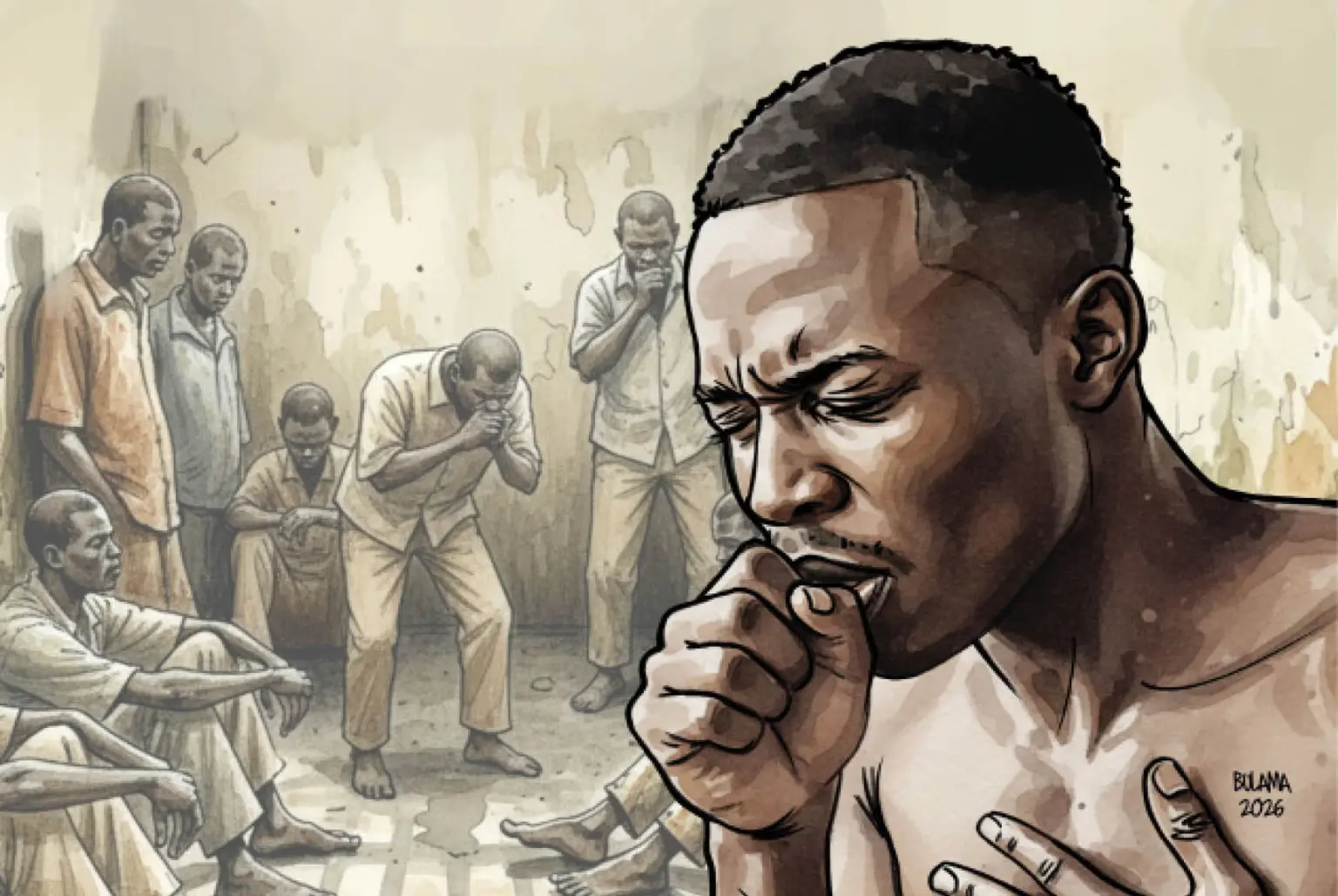
Kala Daniel found himself trapped in awaiting trial for six long months in a Nigerian correctional centre. Initially healthy, Daniel began serious coughing within weeks of his incarceration, only to later learn that he had contracted tuberculosis (TB).
“Three weeks in and I started coughing uncontrollably,” Daniel recalls.
Despite receiving some treatment from the prison’s facility, the medication was insufficient and the symptoms persisted long after his release, he said.
“They gave me some red pills,” Daniel said, describing the medication he took.
Hundreds of inmates, many awaiting trial inside the crowded Suleja correctional facility in Niger State, are left with little more than herbs, Paracetamol and other medicines to fight serious illnesses, including TB, which is quietly spreading in many Nigerian correctional centres, reports Weekend Daily.
Health units within Nigeria’s facilities are reportedly empty or under-equipped, and medicines donated by non-governmental organisations allegedly vanish into opaque channels, leaving inmates to fend for themselves.
Abdul Rasaki (pseudonym), 26, who is currently awaiting trial at the Suleja correctional centre, said he had been battling tuberculosis for over 9 months. Living in a crowded room with more than 25 inmates, Rasaki said he contracted TB within just two months of entry.
Speaking to our reporter through a trusted inside source, Rasaki described the medical treatment as inadequate, leaving him barely able to breathe.
“The illness has been tormenting and causing me much suffering. Doctors said I was beginning to have drug resistance, so they promised to try another regimen. And they won’t allow us to seek help outside. They said the medicine was provided by the government, but it is not helping,” Rasaki said.
Added to his testimony, some ex-inmates insisted that the health system in Nigerian prisons is “not something to write about.”
Warders who spoke in confidence with our reporter from Niger and Kaduna correctional facilities also said that health units meant to serve inmates were often empty. They said medicines were scarce and those who fall ill must rely on prayers or fate.
The World Health Organisation’s 2023 Global Tuberculosis Report underscores the severity of the crisis. The organisation said TB prevalence in prison populations was 10 times higher than in the general population.
Globally, in 2019, an estimated 125,105 people in prisons fell ill with TB. The rate was 1,148 cases per 100,000 persons, yet only 53 per cent of these cases were detected. In other words, nearly half of incarcerated people with TB remain undiagnosed, untreated or unreported, hidden in cells where infection can spread silently.
How inmates self-medicate to survive
With clinics running on little medicine or even empty, many inmates in Kuje and Suleja correctional centres have learnt to treat illnesses on their own – mixing herbs, sharing tablets or bribing warders to smuggle drugs from pharmacies outside the facilities.
Bello Maikudi, who spent a year inside the Kuje Correctional Centre between 2022 and 2023, told our correspondent that he walked into the facility completely healthy, only to fall sick months later. He recalled the struggle with medication while in custody: “There is a clinic inside, but it doesn’t have enough drugs for all of us. The shelves are almost always empty.
“We sometimes get drugs from non-governmental organisations. The drugs are strong for me because there is no adequate food. I fall sick when I take the medication and feel healthy when I do not take it.”
He alleged that because of the intensity of the drugs and lack of proper nutrition, many inmates began hiding their diagnoses and test results to avoid treatment.
“As a result, self-medication became common. Inmates mixed herbs, shared tablets or bribed warders to bring medicines from outside, creating dangerous habits that worsened health outcomes and increased the risk of drug resistance,” he alleged.
A secret source inside the Suleja Correctional Centre attempted to capture the health facility but said doing so openly would expose him to risk as inmates are not permitted to possess mobile phones.
According to him, he was in isolation for TB contraction during the interview and could only safely photograph the condition of the cells, which he said typically housed no fewer than 20 inmates per cell.
A warder from the facility who did not want to mention his name corroborated Maikudi’s claim, saying, “Yes, sometimes we do help some inmates to get things outside the prison but at a higher price. We buy whatever they want.”
The Nigerian law, particularly the Nigerian Correctional Service Act (2019) and the Prisons Act, make it mandatory for inmates to receive health care, including curative and preventive care, as well as humane living conditions.
In cases of serious illnesses, an inmate can be moved to a hospital on the medical officer’s certification.
Nigeria’s inmates data
According to data from the World Prison Brief (WPB), Nigeria ranks as the 7th country with the largest prison population in Africa and 29th in the world, holding an estimated 81,349 inmates across its correctional facilities.
It adds that as at April 28, 2025, Nigerian correctional centres are operating at a 136.7 per cent capacity, indicating severe overcrowding. The total inmate population includes both convicted individuals and pre-trial detainees.
However, data from Nigerian Correctional Service portals indicate that as at November 2025, Nigeria’s prison population is around 79,873 inmates, with a significant majority of 66 per cent being pre-trial detainees. Of this figure, 77,968 are males while 1,905 are females.
The population includes 27,039 males and 507 convicted females, with an additional 50,929 males and 1,398 females awaiting trial.
A recent research by the South Asian Journal of Research in Microbiology indicates high TB rates in specific prisons, with some studies finding prevalence rates like 2.76 per cent in some facilities or over 12 per cent in others, highlighting an ongoing public health concern.
Studies have found a significant prevalence of TB among inmates in different Nigerian correctional centres. For example, one study in Benue State found a 2.76 per cent prevalence, while another in Aba reported a high rate of 2405 cases per 100,000 inmates.
However, it states that the prevalence can vary significantly, depending on the specific correctional centre as shown by studies in different states and facilities.
The research, conducted in May 2025 through samples of 144 inmates within the age range of 21 and above 60 years, was screened for pulmonary tuberculosis. Sputum samples were collected among inmates and were investigated for pulmonary tuberculosis by Gene Xpert/Truenant.
The Gene Xpert system is an automated molecular diagnostic platform primarily used to detect various infectious diseases, most notably, tuberculosis and simultaneously used to identify drug resistance.
According to the research, of the 144 inmates screened, 134(93.06%) were males, 10(6.94%) were females, and the overall prevalence of pulmonary tuberculosis obtained from the study was 2.76 per cent. Tuberculosis infection was higher (4.07%) within the age range of 31-40 years.
The prevalence of the infection during their months of stay in prison showed that inmates with a short period (6-12) months (4.81%) of stay were infected most with this disease. In relation to gender, males had a higher prevalence (5.92%) than females.
Emotional and psychological trauma
After his release, Kala Daniel faced a lingering trauma. He lamented, “I could not go out, could not mingle with people. Constant coughing, shortness of breath and sleepless nights further strained my mental health.”
Even now, Daniel battles the aftereffect of TB. Financial constraints limit his access to quality health care, and his once-active life has been put on hold.
The trauma of both the disease and the unjust imprisonment continues to affect him daily.
A lot of inmates do not have access to proper medical care – CSO
Premium Times reported in 2021 that inmates were poorly fed, with official allocation of N750 (half dollar) per day, barely enough to sustain a person, and only a modest increase from N450 in previous years. These conditions make prisoners especially vulnerable to illnesses like tuberculosis.
According to statistics from a prison advocacy group, Prison Insider, 70 per cent of inmates in Nigerian correctional centres are awaiting trial, meaning that they have been arrested and charged but not convicted, while 26,000 children are in prison, either born to incarcerated parents or detained under unclear legal circumstances.
Joke Aladesanmi of the Centre for Legal Support and Inmate Rehabilitation paints a stark picture of health conditions in Nigeria’s prisons. According to her, the wellbeing of incarcerated persons is yet to be prioritised.
“One thing people forget is that these are human beings. If you look at the prison statistics and the overpopulation in our centres, it may sound like numbers, but behind each number is a person facing serious health risks,” Aladesanmi said.
She highlighted the extreme congestion in many facilities, noting that some prisons built to hold 800 inmates are housing up to 3,000.
She said this made it easier for any disease to find its way into such a crowded space. Aladesanmi specifically mentioned tuberculosis, saying that given the situation and limited access to medical care, outbreaks are unsurprising. “A lot of inmates do not have access to proper medical care,” she said.
Aladesanmi also stressed that this problem is not confined to one location. According to her, urban centres such as Lagos, Kano and Rivers face extreme overcrowding while smaller cities struggle with resource availability.
Aladesanmi, who is also a legal practitioner in Nigeria, emphasised that solutions begin with the government’s prioritisation of justice and public health.
“Many countries still see justice as a liability, and it looks like supporting prisoners is wasting resources. We need to move past that. These are citizens who deserve equal access to government support. If the government is serious about public health, prisons cannot be excluded,” she added.
Stakeholders react
In response to questions about tuberculosis management in Nigerian correctional centres, Dr Adesigbin Clement Olufemi, who serves as the head of the Programmatic Management of Drug-Resistant Tuberculosis (PMDT) Unit at the National Tuberculosis and Leprosy Control Programme (NTBLCP) in Nigeria, acknowledged the severity of the problem while highlighting government measures.
He explained that the NTBLCP had expanded molecular diagnostic capacity, including GeneXpert, Truenat, and TB-LAMP platforms, and deployed mobile X-ray and CAD units to congregate settings, including prisons through partner-supported initiatives.
“TB treatment is provided free of charge, and treatment initiation has been part of prison screening campaigns,” he said
Clement noted that while many prisons nominally have health units, staffing and equipment gaps remained significant. He said implementation relied on interagency coordination between the NTBLCP, the Nigerian Correctional Service (NCoS) and state ministries of health, supported by non-governmental organisations and donor partners.
He also recognised the heightened risk posed by overcrowding and a large pre-trial population, particularly for vulnerable groups, such as women, children and adolescents.
NCoS responds
The Nigerian Correctional Service has a Health and Welfare Directorate responsible for providing both curative and preventive health care to inmates.
In a written response to our reporter dated December 4, 2025 and signed by Dr Stanley S. Otalu, Assistant Comptroller-General of Corrections and the Chief Medical Director of the Henry Akingba Medical and Research Centre, he states that the NCoS is structured in a way that places a high premium on the welfare and health care of inmates.
The Service denied allegations that inmates were required to bribe officials to access medical care, insisting that health care services in custodial centres are provided free of charge.
It described such claims as “anecdotal and unsubstantiated,” adding that the current leadership does not tolerate corrupt practices and would impose sanctions if any such conduct is proven.
“The Service provides medications and medicaments to inmates at no cost. If such prescribed medications are out of stock, the superintendent of the facility procures them for the inmates and subsequently gets reimbursed.” Dr Otalu stated.
He noted that facilities such as the Medium Security Custodial Centre (MSCC), Kuje, served as reference points for prison health care delivery, with doctors, nurses, pharmacists and laboratory scientists deployed to manage inmates’ health needs.
On tuberculosis control, the Service stated that it routinely screened, diagnosed and treated TB and other communicable diseases within custodial centres.
Dr Otalu explained that some facilities were equipped with X-ray machines and laboratories capable of detecting acid-alcohol-fast bacilli (AAFB), the organism responsible for TB, citing MSCC Kuje, Ikoyi and Gusau as examples.
Inmates referred outside for TB test
Addressing concerns about diagnostic capacity, the Service acknowledged that GeneXpert machines were not yet available within custodial centres. However, it said inmates were referred to external health facilities for the test at no cost.
“GeneXpert is not available in any of the custodial centres yet, but inmates are referred to outside facilities to do it at no cost to them,” Otalu stated.
He added that screening for other communicable diseases was done regularly, especially at the point of admission of new inmates.
While acknowledging the challenges, including shortage of health care personnel, Otalu attributed it to a wider national and global trend of medical professionals emigrating.
“The dearth of health personnel is not peculiar to the NCOS, which is a microcosm of the country, but a national and global phenomenon as the ‘tsunami’ of the ‘Japa’ Syndrome does not spare the Service,” he said.
He added that the federal government had approved the recruitment of additional health professionals, including doctors and nurses, a process he said was already underway.
*This report received support from the Thomson Reuters Foundation as part of its global programme aiming to strengthen free, fair and informed societies. Any financial assistance or support provided to the journalist has no editorial influence. The content of this article belongs solely to the author and is not endorsed by or associated with the Thomson Reuters Foundation, Thomson Reuters, Reuters or any other affiliate.