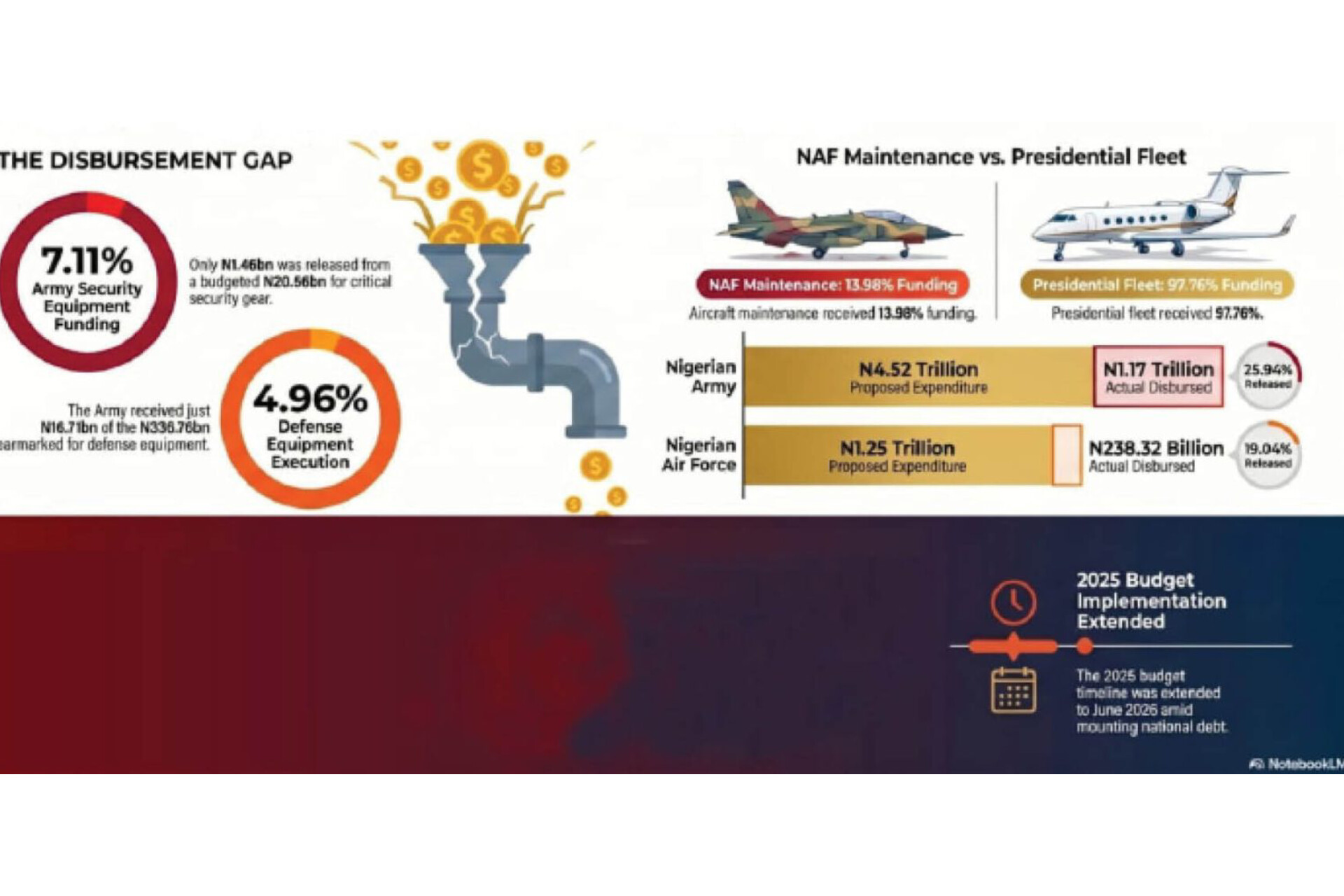
Amid the escalating security crisis across Nigeria, the Nigerian Army and the Nigerian Air Force are grappling with gross underfunding, particularly in the acquisition of security and defence equipment, according to records from the federal government’s Open Treasury Portal.
Details of the 2025 budget performance posted on the portal showed that, of the N20.56 billionn budgeted by the Nigerian Army for the purchase of security equipment, only N1.46 billion, representing 7.11%, was disbursed as of December 31, 2025, reports Daily Trust.
The data for the 2026 monthly budget performance has not been posted on the website managed by the Office of the Accountant General of the Federation.
President Bola Ahmed Tinubu, while signing the N68.32 trillion 2026 Appropriation Bill into law on Friday, extended the implementation of the 2025 budget to June 31, 2026, raising concerns about the government’s continued struggle to fund its expenditures and Nigeria’s mounting debts which hit N159.28trn in December 2025, aside from a fresh $6 billion loan recently approved by the Senate.
Of the N4.52trn total expenditure the army proposed for 2025, N1.17trn or 25.94% was disbursed as of the end of the year. For the Air Force, N238.32bn of its N1.25trn total expenditure was released, representing 19.04%.
The data further showed that of the N336.76bn earmarked for the purchase of defence equipment by the army, N16.71bn was disbursed during the period, representing a paltry 4.96%.
Also, only N5.76bn and N3.89bn were released for the construction/provision of defence equipment and repairs of defence equipment budgeted at N57.59bn and N22.60bn, signifying a budget performance of 10% and 9.07% respectively.
Other critical areas that received low performance include local training, N2bn released out of N18.56bn (10.78%); international training, N2bn disbursed out of N29.80bn (6.71%) and motor vehicle fuel cost, N1.17bn released out of N15.71bn (7.45%).
No amount was released for transport equipment fuel cost with a budget of N21.02bn, aircraft fuel cost budgeted at N12.81bn, promotion, recruitment and appointment worth N384.08 million; construction/provision of military barracks worth N206.97bn and research and development pegged at N100m.
NAF’s aircraft maintenance receives low attention
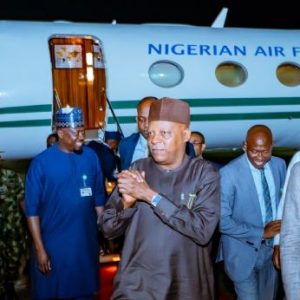
Records on the Open Treasury portal further revealed that N4.85bn or 13.98% of the N34.71bn budgeted for the maintenance of aircraft, which are central to the NAF’s operations, was released as of December 2025. This is a sharp contrast with N20.27bn disbursed for the running of the presidential air fleet, out of the N20.74bn budgeted, marking 97.76% implementation.
Of the N15.75bn budgeted for the purchase of NAF’s security equipment, N5.25bn was released during the period, representing 33.33%. The purchase of defence equipment suffered a major setback with N19.25bn or 6.45% released out of N298.44bn budgeted.
While the N117.90 budget for the rehabilitation/repairs of defence equipment was implemented by 3.99% (N4.71bn), no amount was released for the construction/provision of defence of equipment budgeted at N7.16bn; welfare packages pegged at N28.33m; construction of military barracks estimated at N95.68m; repairs of military/defence barracks, worth N6.76bn and other transport equipment fuel cost estimated N45.03m.
Other vital items that received little attention during the fiscal year included aircraft fuel cost with a total disbursement of N2.23bn (5.07%) out of N43.91bn; motor vehicle fuel cost, N1.71bn released out of N4,41bn (38.72%) and international training, N2.20bn disbursed out of N17.56bn, representing 12.50%.
However, local training, maintenance of motor vehicle/transport equipment, security services and security votes received considerable implementation at 41.56%, 58.28%, 98.10% and 79.65% respectively.
Efforts made last night to get reactions from the military high command on the budget performance were unsuccessful. Repeated telephone calls to the Director, Defence Information, Brigadier-General Samaila Uba, rang out. He was yet to reply to both text and Whatsapp messages sent to him at the time of filing this report.
Human cost amid poor funding
Experts say the funding gap has undermined the efficiency of the Nigerian military in fighting terrorism, banditry and other violent crimes across the country, especially in the northern region.
A report by Beacon Security Intelligence Limited (BSIL) based in Abuja indicated that more than 10,000 people were killed in the country during the budget cycle under review, between January and December 2025.
The security consultant firm revealed that from January 1 to October 31, 2025, 9,514 people were killed across Nigeria. In November that year, it said at least 404 Nigerians were killed, while 363 were abducted. By December, 323 casualties were recorded in the North West and 241 in the North Central, with the North accounting for 91.1% of all recorded fatalities in that period.
In a recent interview with Arise TV, the BSIL Chief Executive Officer, Dr Kabiru Adamu, said the organisation’s latest report showed that over 2,350 Nigerians had been killed and 1,117 abducted in the first quarter of 2026.
Military casualties
A wave of attacks in Borno, Kaduna, Katsina and Benue states during the Easter period claimed 16 lives, including five policemen, and left dozens displaced.
On March 17, at least 25 people were killed in simultaneous explosions at the gate of the University of Maiduguri Teaching Hospital (UMTH), the Monday Market Roundabout and the Post Office in Maiduguri, Borno State.
In the past weeks, Boko Haram and ISWAP terrorists have carried out a series of deadly and coordinated attacks on military formations across Borno State, killing soldiers and civilians.
Senior military officers, including Major U. I. Mairiga, who headed the Mayenti base; Commander of Kukawa base and the 101 Brigade, Lt-Col Umar Faruq; Commanding Officer of the 222 Battalion in Konduga, Lt-Col S.I. Iliyasu; Brigade Commander of the 29 Task Force Brigade Headquarters in Benisheikh, Brigadier General Oseni Omoh Braimah and the Commanding Officer of the 242 Battalion, Monguno, Col. I.A. Mohammed, also paid the supreme price.
The military has also intensified operations in high-risk locations, including the Sambisa Forest, the Timbuktu Triangle, the Mandara Mountains and the Lake Chad Basin. Scores of insurgent commanders and fighters had been killed during operations conducted across multiple fronts, with several major terrorist camps also destroyed.
On the back of the resurgence, the Arewa Consultative Forum (ACF) last Wednesday declared that Nigeria’s worsening insecurity has escalated into a “state of war,” calling on the federal government to urgently reorder national priorities and treat security as the country’s most pressing emergency.
The forum warned that Nigeria stands at a critical crossroads, with the escalating violence posing a serious threat to its unity and future.
It urged the government to act with urgency and clarity by mobilising all available resources and demonstrating strong leadership in tackling the crisis.
Security experts worry over military procurement, funding
Dr Adamu told our correspondent that the implications of the gross underfunding are stark and has an impact on the resurgence in the non-state armed groups. He said the renewed hope agenda of the Tinubu-led administration intends to recruit additional personnel across the security forces, but that goal has not been achieved due to funding.
“I think this is the first time I’m hearing percentages of the budgetary release according to the 2025 budget. Of course if you go back to 2024, you will find out that it has an impact on what is happening at the moment. So the consequences are scaring at us. These groups were able to restructure themselves. They were able to come together again and they are now fighting us even more fiercely than they were doing before. That is very serious,” he said.
The security expert advised that beyond adequate release of funds for the military needs, the procurement process must be sanistised to enhance operational and financial accountability within the system. He added that the National Assembly also needs to up sit up in its oversight function in budgeting and the procurement process.
“I’m part of those people who believe that the war economy has created a conduit through which public funds are being siphoned. We must enhance accountability within the system so that these funds are used for the purposes for which they are used. That means looking at the procurement system. Some of what we hear at the moment is extremely disturbing; political interference in the procurement system of our security forces from people that you don’t even expect; persons who have no business influencing procurement; in the family members of certain highly-placed persons within society.
“So we must do three levels of procurement: immediate concern, for example, our soldiers who are in the battlefront and move around in soft-skin Hiluxes. That is not acceptable. No country would allow its soldiers in the battlefront to be in soft-skin (normal) vehicles which you and I enter. The convention is that military forces in the front line are protected in three types of vehicles: amoured vehicles, MRAPs and others. We must also give them the weapons that they need. And of course their welfare is absolutely important,” he stated.
Dr Adamu identified communication technology as another aspect of the military operations that requires funding, lamenting that security forces communicate via GSM, “which is as vulnerable as shouting in the market where anybody can listen to you.”
“We must address the integrity and confidentiality of communication systems. Lastly is the forward-looking procurement that understands what our threats are in the mmediate and in the future and then we procure weapons in anticipation and to address those threats. Not that we wait until the threat happens and start scurrying around.
“An example is this threat of the use of unarmed aerial vehicles by our enemies. They are currently using unarmed aerial vehicles. They run around from point A to B. We must stop that through an unmanned aerial vehicle system. If you look at what is happening in Iran, Ukraine and Russia, the war is not being done by soldiers on the ground. It is being done by drones.
“And there is enough evidence to show that the bad guys here in Nigeria have already procured drones. So it is absolutely important that in our procurement systems we anticipate these types of threats and buy weapons to forestall them,” he added.
A security consultant and former Director of the Department of State Services, Mike Ejiofor, said the budget performance of the military revealed a deep concern over funding of security agencies.
“To make a budget is different from budget release. Performance of budget is based on release. When you don’t release funds for the budget proposed, how do you expect performance from security agencies, more so when it borders on security which is our greatest challenge.
“Now, non-state actors are having advantage in terms of arms and ammunition and control. The president travels a lot and we cannot jeopardise his safety, but we need to prioritise our security,” he added.
Ndume laments shortage of ammunition, equipment
In a recent interview with journalists in Abuja late March, the Senator representing Borno South Senatorial District, Ali Ndume, complained that the military lacks adequate equipment to fight Boko Haram insurgents.
Reflecting on the Boko Haram attack on Ngose in Borno State, Ndume, who was Chairman of the Senate Committee on Army, commended President Tinubu for declaring a state of emergency on security but urged the administration to step up its game in terms of provision of equipment and boosting the morale of the soldiers.
He said, “What happened in Ngoshe is that the military there lacked the adequate equipment and ammunition, MRAPs. That is why they had to do a tactical withdrawal when the terrorists struck and then reassemble and come back to take Ngoshe. So, if they were adequately equipped, they wouldn’t have been dislodged because the Nigerian Army personnel are very gallant; they are strong, determined young people. Some of them gave up their lives in the process as they stood firmly to fight.
“When you run out of ammunition and don’t have where to take cover, we have to tell government to do something about that, and I stand by my position. I worked closely with the army. When I get information related to intelligence, I share it with them, I discuss it with them, and they always act on it. But as for the lack of adequate equipment and arms, it is still insufficient. The government is doing something, but what I’m saying is that it should do more so that the armed forces and other security agencies will be fully equipped to face this problem that we are having.”
Ndume expressed strong belief that the army would overcome insurgency within the shortest possible time if they have the adequate equipment and ammunition.
“But still, as they are now, they don’t have the adequate equipment or ammunition required for a task force battalion. The task force battalion requirement is known. We have enough soldiers now in Ngoshe, but they don’t have enough equipment to face the challenge. I’ve gone there myself. I’ve seen what they have.
“Their morale is still high, but they are being demoralized because they don’t have equipment. If they have the equipment, they are ready. They don’t have MRAPs, they don’t have gun trucks, they don’t have other arms and ammunition required. If they have all these things, these ragtag terrorists cannot face the Nigerian army. Insurgency can be brought to an end if the Nigerian army is well trained, well equipped, well armed, and well motivated,” he added.
The senator also lamented that there is insufficient fighter jets to support the ground troops, saying, “As I’m speaking to you now, we don’t have enough attack helicopters in all the black spots.”