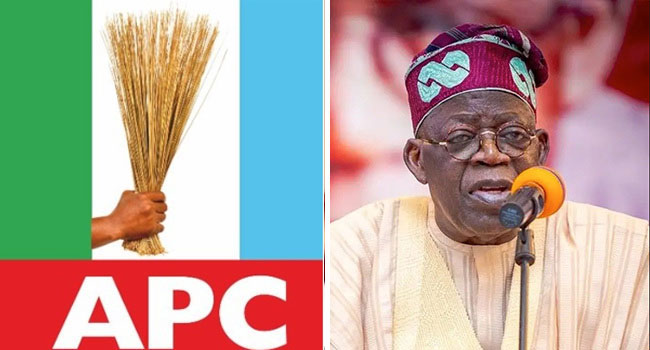
•Tinubu and APC logo
Complaints over the composition of the All Progressives Congress (APC) campaign council for next year’s general election may have unsettled the presidency, forcing it to consider tweaking the council.
From the North, a grassroots group backing President Bola Tinubu’s re-election bid, yesterday, threatened to withdraw its voluntary mobilisation efforts if former Borno State governor, Senator Ali Modu Sheriff, remains in the APC presidential campaign structure, reports The Guardian.

This was as former South-East spokesman for the Tinubu-Shettima Presidential Campaign Council, Denge Onoh, criticised the newly released 223-member campaign council for the 2027 elections, warning that the composition could undermine Tinubu’s re-election bid.
However, Civil Society Organisations (CSOs), lawyers and opposition politicians have dismissed the declaration by the Director-General of the All Progressives Congress (APC) Presidential Campaign Council, Senator Abdul’Aziz Yari, that the ruling party would remain in power beyond 2031, saying political power belongs to the electorate and not any political party.
While dismissing negative reports about the campaign council list, the presidency said “the structure remains in place but will undergo some adjustments”.
The Grassroots Movement for Tinubu Continuity Come 2027, in a formal complaint dated August 25, 2026, addressed to the APC national chairman, said the organisation remained committed to Tinubu’s re-election but could no longer continue its grassroots mobilisation under the present arrangement.
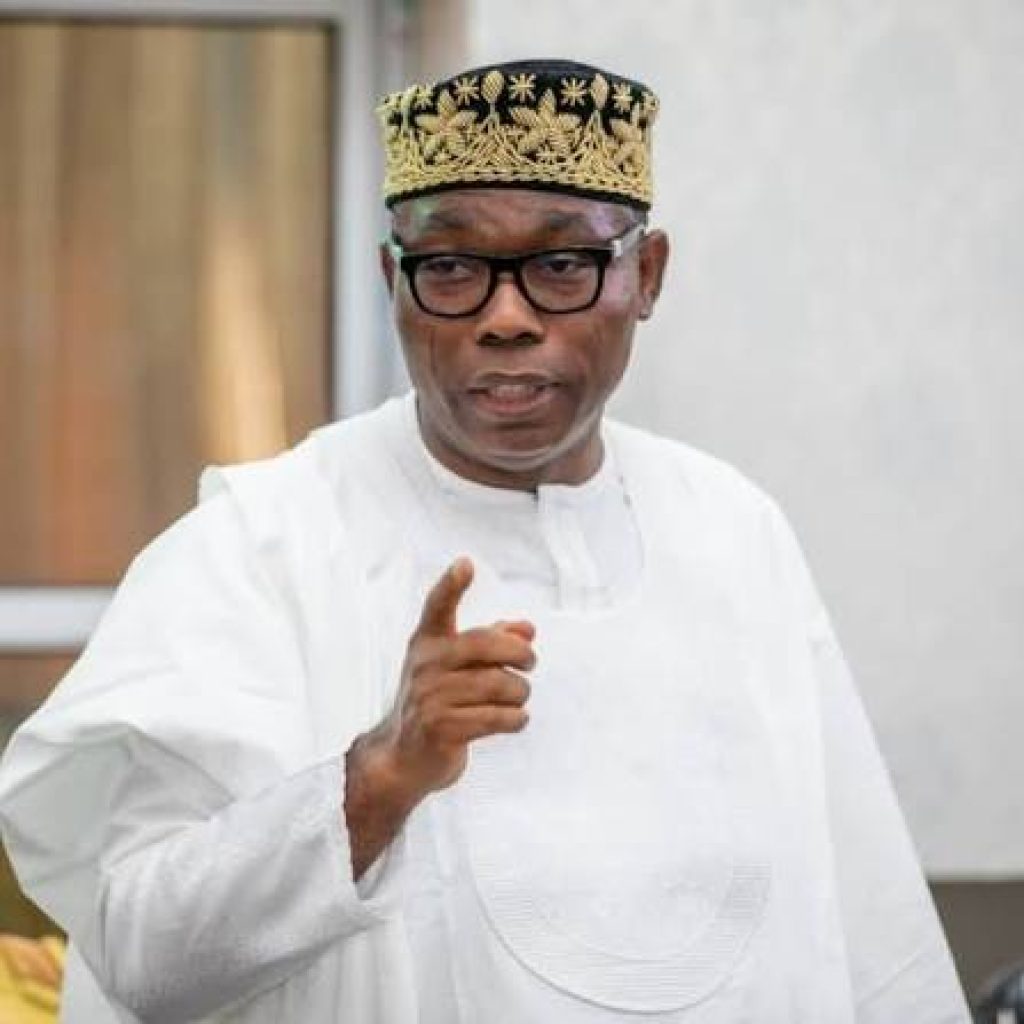
The National Chairman, Sani Zangina, said the group’s objection was specifically to Sheriff’s appointment as the North-East Zonal Campaign Coordinator of the APC Presidential Campaign Council for the 2027 election.
Zangina said: “Our support for the President remains unwavering, but we cannot continue to offer voluntary support under an arrangement that places Sheriff at the forefront of the campaign in the North-East.”
In a statement, he said the group’s concerns were partly based on longstanding allegations linking Sheriff to Boko Haram, arguing that the allegations could affect public perception and undermine the confidence of grassroots supporters in the region.
According to the group, Sheriff’s prominent role in the president’s campaign could, in its view, negatively affect the image of the APC and the morale of supporters working for Tinubu’s re-election.
The development came after the Nigeria Rescue & Renewal Movement (NRRM) expressed concerns over Sheriff’s inclusion in the APC campaign structure.
The grassroots movement went further by issuing a direct warning that it would suspend its voluntary mobilisation for Tinubu’s re-election if Sheriff retained his position.
In a strongly-worded memorandum addressed to the president, Onoh alleged that major APC stakeholders and foundational loyalists from the South-East had been heavily marginalised in the new campaign structure.
He said the list was influenced by “tribalism, personal interests and extreme selfishness”, warning that the development could weaken the President’s support base ahead of the 2027 election.
Onoh contrasted the new council with the structure used during the 2023 presidential election, which he said was more inclusive and accommodated voluntary regional actors who risked their safety and resources to campaign for Tinubu in difficult political environments.
According to him, those who compiled the 2026/2027 list abandoned national cohesion in favour of personal ambition and nepotism.
The former campaign spokesman also raised concerns about the APC’s media and communications structure, saying the present team lacked the experience and political capacity required to confront the opposition in 2027.
“With the strict exception of only two persons who possess genuine fire and strategic depth, the media team completely lacks the political tenacity and intellectual grit to face the opposition’s sophisticated Relations (PR) machinery,” Onoh said, warning that excluding “battle-tested media generals” could expose the campaign to opposition attacks and propaganda.
As a troubleshooting measure, the Special Adviser to President Bola Tinubu on Media and Public Communication, Sunday Dare, during an interview on Channels Television’s ‘Sunrise Daily’, yesterday, said the list “remains valid” because the campaign structure is not yet complete, with several subcommittees still to be constituted.
“As it is with every other list, there’s room for sub-committees. Those subcommittees have not been formed, and so many other names will come into that subcommittee,” he said.
Dare also pointed to an APC statement on the matter, insisting that the party had not withdrawn the list.
“That list has not been withdrawn. The APC has issued a statement to that effect yesterday, that the list stands. But, of course, there will be adjustments. The list is not cast in stone, just like every other list,” he added.
The campaign council, which was announced over the weekend, has Tinubu as chairman, while Vice-President KashimShettima and APC National Chairman, NentaweYilwatda, were named vice chairmen.
The groups warned that while the APC was entitled to aspire to retain power, predicting electoral victories years in advance could create a dangerous impression of political entitlement, undermine confidence in elections, and discourage citizens from participating in the democratic process.
They spoke against the backdrop of Yari’s recent declaration that the APC would continue governing Nigeria beyond 2031.
Executive Director of the Civil Society Legislative Advocacy Centre (CISLAC), Auwal Rafsanjani, described Yari’s position as “an expression of partisan optimism”, insisting that it must not be presented as though future electoral outcomes had already been determined.
Rafsanjani said: “CISLAC considers the declaration by Yari, that the APC will continue to govern Nigeria beyond 2031, as an expression of partisan optimism, but one that must not be presented as if Nigeria’s future electoral outcomes have already been decided and determined.
“In a democracy, however, no political party has a permanent entitlement to power. The authority to determine who governs Nigeria in 2027, 2031 or any subsequent election belongs exclusively to Nigerian voters through credible, competitive, free and fair elections.”
The CISLAC boss warned that such utterances could undermine Nigerians’ confidence in the electoral process, describing it as careless to make statements suggesting predetermined electoral victories ahead of the 2027 general elections.
Rafsanjani urged the APC and other political parties not to overlook the lessons of the recent Osun State governorship election, saying the outcome demonstrated that Nigerian voters could not be taken for granted.