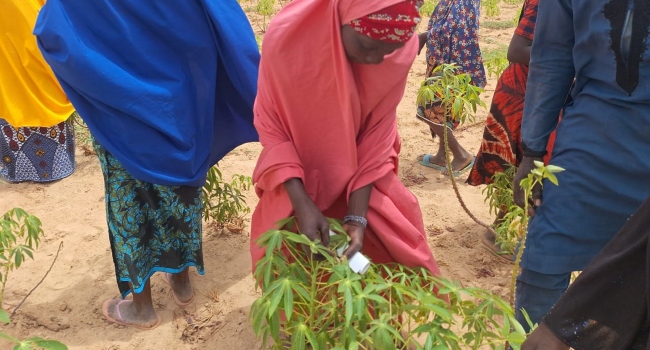
In a bid to tackle crop-related diseases threatening food security in the country, the Central and West African Virus Epidemiology for Root and Tuber Crops has launched a sensitisation campaign for cassava farmers in Kebbi State against a new cassava mosaic virus affecting plantations across Africa.
The sensitisation programme, which took place at Tungar Noma community in Argungu Local Government Area today, Tuesday, May 26, 2025, was aimed at educating farmers on how the virus affects cassava plantations and its dangers to food security, reports Channels TV.
Country Director of the centre, Ibrahim Muhammad, said the organisation, in collaboration with Abdullahi Fodio University of Science and Technology, Aliero, has established six demonstration plots across the North-West and North-East regions to boost cassava productivity and help farmers manage cassava diseases.

“We already have cassava mosaic disease in Nigeria, but there are about 11 other cassava diseases across Africa, especially in East Africa, which are gradually spreading westward,” he said.
“The most dangerous among them is the East African Cassava Mosaic Disease-Uganda variant. The disease is highly devastating because affected farmers may harvest nothing from their farms. It has already been reported in some West African countries, though not yet in Nigeria,” he added.
Umar explained that the engagement with cassava farmers was designed to make them part of the centre’s disease monitoring process, especially in reporting unusual symptoms discovered on their farms.
“We have shared phone numbers and distributed flyers containing pictures of the disease symptoms so that farmers can quickly report any suspicious signs for prompt response,” he said.
He noted that Nigeria remains the largest producer of cassava in the world, warning that if the disease finds its way into the country, the impact could be catastrophic.
According to him, early detection and rapid response remain key to preventing the spread of the virus.
He stated that the sensitisation campaign is already yielding positive results, as some farmers have started contacting the centre through the provided phone numbers whenever they notice unusual symptoms on their cassava plants.