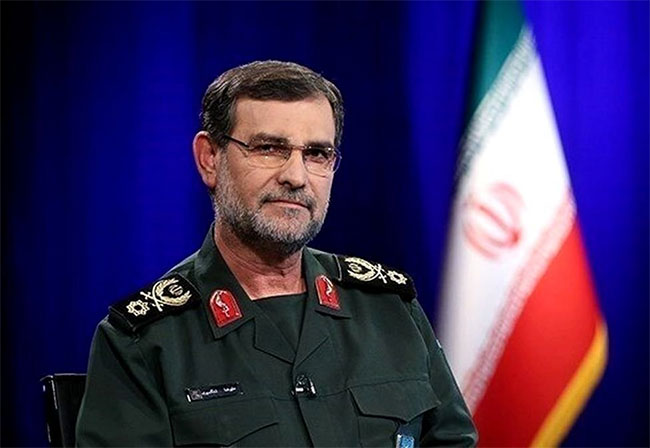
•Late Commodore Alireza Tangsiri
Israel has claimed the killing of Commodore Alireza Tangsiri, the commander of Iran’s Islamic Revolutionary Guard Corps (IRGC) Navy, in a targeted airstrike that Israeli officials say was aimed at dismantling the military architecture behind one of the most disruptive maritime blockades in modern history.
Israeli Defence Minister Israel Katz announced today that an Israeli airstrike had killed Tangsiri, describing it as a “precise and lethal operation” that also eliminated other senior officers of the IRGC’s naval command.

Tangsiri was targeted at the Iranian port city of Bandar Abbas, where he had been meeting with senior IRGC Navy commanders, according to Israeli officials.
Iran has neither confirmed nor denied the claim, reports AFP.
Tangsiri had been “blown up” along with several other senior Iranian naval figures, Katz announced, saying the commander was “directly responsible for the terrorist act of bombing and blocking the Strait of Hormuz.”
The strait, a narrow waterway at its tightest point of just over 30 kilometres, carries enormous strategic weight.
Despite growing pressure, the United States had not managed to break Iran’s grip on the Strait of Hormuz, a waterway through which normally passes a fifth of the world’s oil and gas, sending prices soaring as fears of shortages rippled across the world.
Tangsiri had been increasingly vocal and visible since Israel and the United States launched their campaign against Iran, and was a key figure behind the near-total blockade of shipping traffic in the strait.
As recently as Tuesday, he posted on X that the passage of any vessel through the strait required full coordination with Iran’s maritime authority.
Katz used today’s announcement as a warning to the broader IRGC command, declaring that “the IDF will hunt you down and eliminate you one by one.”
The killing is the latest in a series of high-profile Israeli assassinations of Iranian leadership figures. Since the start of the United States-Israeli war on Iran on February 28, Israel has announced the assassination of several top Iranian officials, including Supreme Leader Ali Khamenei and security chief Ali Larijani.
The broader conflict has now claimed more than 2,000 lives across the Middle East. Israeli and American strikes have killed more than 1,200 people in Iran according to the Iranian Red Crescent Society, at least 1,000 have been killed in Lebanon, 17 in Israel, and 13 U.S. service members have lost their lives.
On the diplomatic front, tensions remain high. Iran responded to a U.S. ceasefire proposal with a counterproposal demanding a halt to assassinations, guarantees against future conflict, compensation for war damages, an end to fighting across all fronts, and recognition of Iran’s authority over the Strait of Hormuz.
Meanwhile, the U.S. President Donald Trump warned that Iran must accept defeat “before it is too late,” as thousands more American forces headed toward the Middle East.
White House Press Secretary Karoline Leavitt cautioned that Trump would “unleash hell” on Iran if a deal was not reached.
Whether Tangsiri’s elimination will loosen Iran’s stranglehold on the strait or harden Tehran’s resolve remains to be seen but the strike signals that Israel intends to systematically dismantle Iran’s war command, one official at a time.