The Director of the University of Chicago Medicine Comprehensive Cancer Centre and Fellow of the Nigerian Academy of Science, Prof. Kunle Odunsi yesterday said one in four people will develop cancer in their lifetime.
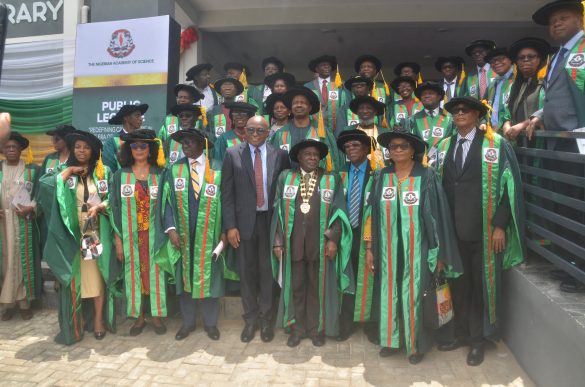
Prof. Odunsi said this at the public lecture, induction of new Fellows and public opening of the NAS-T.Y Danjuma Science Museum and Library organised by the Nigerian Academy of Science in Abuja, reports Daily Independent.
Odunsi, who is also the Abbvie Foundation Distinguished Service Professor of Obstetrics and Gynaecology, University of Chicago, however, said cancer is preventable and there better chances of cure from the disease.
“About one in four people will develop cancer in their lifetime, that is what the statistics show. You will find that the older one gets, the higher the chances. Most cancers develop in people who are of older age, but nowadays we are seeing a lot of cancers develop in young people.
“This is where genetics is very important, for us to know who is at risk, so we can put them under intense surveillance and, if possible, intercept before the cancer has spread too much.”
Speaking on “Redefining cancer care in the era of immunotherapy and precision oncology: Implications for reset, treati, and policy in Nigeria,” the don emphasized the importance of prevention and improved treatment options in tackling cancer.
According to him, while prevention remains the first line of defence, it is inevitable that some people will still develop the disease, making effective treatment essential.
He noted that although standard treatment options are available, they are currently expensive and beyond the reach of many patients, making access to quality cancer care a major challenge in the country
“There are standard treatment options, which right now are very expensive, very difficult for many patients to afford. There are very little infrastructure, for example, for radiation therapies. There are only about 10 radiation therapy centres in Nigeria, rhat is insufficient for the population and size of this country.
“We need to develop infrastructure, and then we need to make sure drugs are available. Standard drugs need to be available, whether they are chemotherapy drugs.
“But more importantly, the field is changing very rapidly. There are new drugs. They are called precision drugs that is based on a patient’s genetic profile. So having cancer is no longer a death sentence.
“In fact, in the United States, survival from cancer has improved significantly. There are some cancers where we see 100 per cent cure. Some cancers are still difficult, but there’s tremendous progress going on. Nigeria should not be left behind as this progress in cancer care continues to evolve.”
On screening and early detection, he explained that screening methods vary depending on the type of cancer.
According to him, colon cancer screening through colonoscopy is recommended from around age 50 and should be repeated every 10 years, while individuals at higher risk may require more frequent screening.
“Pap smear screening should be performed for women. Mammography, also in women, should be started around the age of 40 to 45 and should be done annually. For men, there’s a need to be screened for prostate cancer, either through clinical examination, but the one that is even more precise is a blood test. So there are screening tests for some of the common cancers that affect men and women.
“If we do these things, you can prevent cancer from spreading, catch it before it spreads, and therefore provide better chances of cure,” he added.
The President of the Nigerian Academy of Science, Prof. Abubakar Sambo said the newly inaugurated museum and library had officially been opened to the public, although efforts were still ongoing to fully populate it with exhibits.
According to him, “We have started populating it with historical items regarding science and development in our country.
“What we have is a very good starting point, but it will be increasing.”
On the induction of the new Fellows into the academy, the NAS president said they were expected to uphold the academy’s mandate of promoting science and technology in Nigeria.
“The new fellows are supposed to abide by our own rules and regulations. That is to promote scientific culture in the highest way in Nigeria. We encourage Nigerians to go for science and technology, especially the youth, and then to advise authorities to adopt science and technology projects, especially in the education sector,” he added.
The newly inducted Fellows are Prof. Omotayo Arotiba, Prof. Festus Okoye, Prof. Olufunmilayo Fawole, Prof. Kemi Amodu, Prof. meka Oguzie, Prof. Martins Emeje, Prof. Ibrahim Abubakar, and Muktar Aliyu.