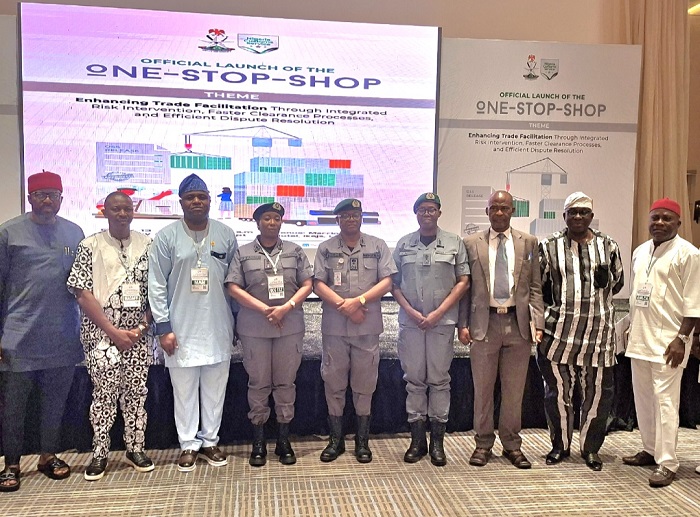
•Controller-General of the Service, Adewale Adeniyi (C) during the formal launch of the One-Stop-Shop (OSS) Initiative of the Service
As part of efforts to enhance seamless operations and ease trade facilitation for importers and exporters, the Nigeria Customs Service (NCS) has announced plans to go fully paperless by the second quarter of this year, in a move aimed at eliminating delays, reducing cargo dwell time, and ensuring that only legitimate goods are cleared for free circulation in the country.
The announcement was made in Lagos yesterday by the Controller-General of the Service, Adewale Adeniyi, during the formal launch of the One-Stop-Shop (OSS) Initiative of the Service, reports The Nation.

The OSS platform, he said, targets a 48-hour clearance window, lower compliance costs, stronger revenue assurance, and enhanced transparency.
The theme of the event was “Enhancing trade facilitation through integrated risk intervention, faster clearance process and efficient dispute resolution.”
Speaking at the well-attended event, he said the paperless initiative, starting with core clearance, documentation, and approvals, is scheduled for rollout by the end of the second quarter of this year.
Adeniyi recalled last year’s launch of the Authorised Economic Operator programme and said the OSS reflects the Service’s commitment, under the leadership of President Bola Ahmed Tinubu, to predictable, transparent, and accountable border processes that enhance investment and competitiveness.
He described the OSS as a smarter, technology-driven approach to cargo clearance that will enhance accountability, efficiency, transparency, and inter-agency collaboration.
The One-Stop-Shop initiative, according to Adeniyi, who was represented by the Deputy Comptroller-General in charge of Enforcement, Timi Bomodi, is a central platform for intelligence gathering and coordination and also houses all documents within the NCS, ensuring a more efficient and coordinated approach to Customs operations, valuation, and other Customs activities at the ports.
Adeniyi added that the platform brings all relevant Customs Units under one operational roof, allowing joint review, examination, and decision-making at a single point of contact.
The OSS, he assured, would eliminate bureaucratic bottlenecks that often delay cargo release, ensuring that every flagged declaration is handled transparently and collaboratively.
He noted that delays at ports were often caused not by the time taken for inspections but by fragmented procedures, overlapping checks, and idle waiting times.
He said national assessments, Nigeria’s Trade Policy Review at the World Trade Organisation, and the Service’s Time Release Study all highlighted these bottlenecks as increasing trade costs and weakening confidence.
To tackle these challenges, Adeniyi explained that the OSS centralises valuation, processing centres, intelligence, enforcement, compliance monitoring, and gate operations into a single workflow. Digital tracking, automated alerts, joint inspections, and shared dashboards replace multiple fragmented interventions, making all actions traceable, accountable, and coordinated.
“Multiple checkpoints are collapsed into one decision space, with interventions that are collective, fully auditable, and aligned with institutional responsibility.
“This will reduce physical interfaces, improve processing speed, and strengthen audit controls,” Adeniyi said.