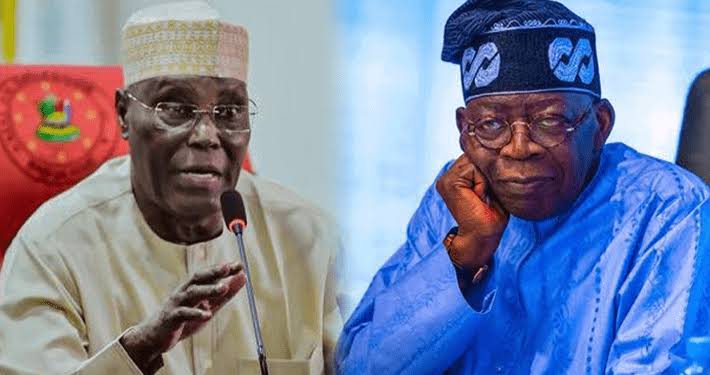
•Atiku and Tinubu
Former Vice President Atiku Abubakar has expressed concerns over a recent report published by the International Monetary Fund (IMF) stating that a whopping amount of N8.8 trillion in public expenditures was unrecorded by the federal government of Nigeria.
The statement personally signed by the former vice president and made available to The Frontier yesterday, stated as follows (unedited):
My attention has been drawn to a deeply troubling report by the International Monetary Fund, published on July 1, 2026 by Reuters, which reveals that the Tinubu-led APC administration failed to record public expenditures amounting to approximately 2 percent of Nigeria’s Gross Domestic Product in recent official budgets.
At the current valuation of Nigeria’s economy at approximately ₦441.5 trillion, this figure translates to a staggering ₦8.8 trillion in public funds spent entirely outside the statutory framework of Nigeria’s official budget documents, unaccounted for, unaudited, and hidden from the Nigerian people.
I view this revelation with the gravest alarm and call upon all Nigerians – the media, civil society, the National Assembly, and every democratic institution in this country – to set aside every distraction and direct their full attention to what is, by any reasonable standard, the most consequential act of fiscal impunity in Nigeria’s recent democratic history.
A pattern of conduct, not an isolated incident, the IMF’s latest Article IV consultation, articulated by its resident representative in Nigeria, Christian Ebeke, confirmed that this staggering discrepancy arises from large-scale government projects executed entirely off-budget. Let us be absolutely clear about what this means: The Tinubu administration is awarding multi-trillion naira contracts, moving massive public capital, and commissioning infrastructure projects entirely beyond the reach of the Auditor-General, the nation’s procurement laws, and the legitimate oversight of the National Assembly. It is a parallel fiscal universe, one governed by executive whim, shielded from the constitutional accountability that the Nigerian people are owed.
This conduct follows a pattern that is unmistakably familiar to anyone who has studied the fiscal governance of Lagos State under Bola Ahmed Tinubu as Governor. For years, Tinubu operated what has become widely known as the Alpha Beta arrangement, a revenue management structure under which between 10 and 30 percent of Lagos State’s internally generated revenue disappeared into private pockets before it was ever captured in the official budget. Revenues were siphoned at the point of collection, before they could be subjected to legislative appropriation, public scrutiny, or statutory accountability.
The money simply vanished upstream, and what arrived in the treasury was already a fraction of what Lagosians had paid.
What the IMF has now documented at the federal level is that same Lagos playbook, replicated at national scale and with national consequences. The man who perfected the art of the off-budget economy in Lagos has brought that “Beta” form to Abuja, and the price is being paid by 220 million Nigerians.
This shadow economy does not operate only through unrecorded expenditures. It also operates through illegal extractions. We draw the attention of Nigerians to the ₦800 billion that has been illegally deducted from the statutory allocations of state governments, funds belonging to the federating units of this republic, unlawfully withheld and diverted without the authorisation of the National Assembly, without a court order, and without any constitutional basis whatsoever.
State governments across Nigeria under the aegis of the Progressives Governors Forum have had their allocations raided to fund projects and purposes that have never been disclosed to the Nigerian public.
We state clearly and without equivocation that this ₦800 billion, combined with the ₦8.8 trillion in unrecorded federal expenditures, points unmistakably to the construction of a massive, multi-source political war chest being assembled ahead of the 2027 general elections.
When a government operates a secret treasury of this scale at precisely the moment it needs to purchase electoral outcomes, the conclusion is not difficult to reach.
The Tinubu administration is not reforming Nigeria’s economy. It is financing its own political survival with money that belongs to the Nigerian people.
The recent public controversy over the ₦1.3 billion inserted into the 2026 Federal Budget for the so-called Presidential Foreign Intervention Promotion Council, an agency the administration itself was forced to acknowledge did not exist, is now rendered far less surprising in this broader context.
When a government can move ₦8.8 trillion in public money entirely outside its own official bookkeeping, the boundary between what exists and what is a phantom, between what is appropriated and what is stolen, ceases to have any practical meaning.
The ghost agency and the shadow budget are not separate scandals. They are two expressions of the same governing philosophy: that public money belongs to those in power, to be deployed as they see fit, beyond the reach of the law and the knowledge of the public.
The moral obscenity at the heart of this scandal demands to be named plainly. For three years, the Tinubu administration has subjected ordinary Nigerians to an unrelenting programme of economic austerity without precedent in our democratic era.
The removal of the fuel subsidy, executed without preparation, without social safety nets, and without honest public accounting of the savings, detonated the cost of living across every stratum of Nigerian society.
The Naira has been serially devalued, wiping out the purchasing power of workers, traders, small business owners, and pensioners. Interest rates have been driven to levels that have effectively shut small and medium enterprises out of the credit market, strangling the productive base of the economy and accelerating unemployment at a time when Nigeria’s youth population is growing faster than any other demographic on earth.
Nigerians have been told, repeatedly and firmly, that the treasury is empty, that there is no alternative to the pain being administered, and that sacrifice today is the price of prosperity tomorrow. The government has borrowed at punishing interest rates on international markets, adding to a debt burden that will constrain the fiscal choices of Nigerian governments for a generation, all the while telling the public that every kobo of expenditure is being carefully accounted for and prudently managed.
The IMF has now exposed that narrative as a big fat lie. While the poor were told to bleed, the government maintained access to a ₦8.8 trillion shadow treasury, entirely outside public view, entirely beyond legislative oversight, and entirely at the disposal of those who hold executive power.
The interest rates crushing Nigerian businesses, the weak Naira destroying Nigerian savings, and the economic stagnation hollowing out Nigerian households are not the unavoidable consequences of global headwinds.
They are, at least in part, the direct result of a government that has removed from the productive economy ₦8.8 trillion that should have been transparently appropriated, competitively allocated, and deployed in ways that create jobs, reduce the cost of capital, and strengthen the naira. This explains why contractors are owed and civil servants are not paid their salaries.
I wish to place this figure in concrete human terms. In the 2023 presidential election, I presented to Nigerians a comprehensive economic recovery programme anchored on a $10 billion stimulus package, an intervention designed to recapitalise the productive economy, restore exchange rate stability, reduce the cost of borrowing for Nigerian businesses, and create millions of jobs across the agricultural, manufacturing, and technology sectors.
Critics and supporters of the Tinubu administration dismissed that proposal as ambitious, even unrealistic, asking where the resources would come from.
The IMF has now answered that question. ₦8.8 trillion, the equivalent of approximately $5.5 billion at current exchange rates, was available. It was not unavailable. It was not non-existent. It was simply being spent in the dark, by unaccountable hands, on undisclosed purposes, beyond the reach of the Nigerian public and their elected representatives. Had that money been transparently appropriated and deployed as part of a structured economic stimulus programme, Nigerian businesses would not be drowning in 35 percent interest rates. The naira would not be trading at levels that make the importation of basic inputs prohibitively expensive for manufacturers. Unemployment would not be at the catastrophic levels that are fuelling insecurity, emigration, and social despair across every geopolitical zone of this country.
The poverty of Nigerian citizens today is not fate. It is policy, or more precisely, it is the consequence of the absence of transparent, accountable, productive economic policy, replaced by the private management of public resources for political purposes under the Tinubu-led APC administration.
I hereby demand the following immediate actions from all relevant institutions:
One, the National Assembly must convene emergency investigative hearings on the IMF’s findings without further delay.
The revelation of ₦8.8 trillion in unrecorded public expenditures is a constitutional emergency, not a matter to be managed through ministerial press conferences or diplomatic qualifications.
Two, the Auditor-General of the Federation must be immediately empowered and directed to conduct a full, independent audit of all off-budget expenditures referenced in the IMF’s Article IV consultation, and those findings must be published in their entirety and placed in the public domain without redaction.
Three, the Federal Government must provide a full and transparent public account of every Naira spent outside the official budget, identifying every project, every contractor, every procurement process followed, and every individual who authorised and benefited from these transactions.
Four, the Federal Government must immediately restore to state governments the ₦800 billion unlawfully deducted from their statutory allocations and provide a complete account of how those funds were deployed.
Five, the Economic and Financial Crimes Commission, the Independent Corrupt Practices and Other Related Offences Commission, and every relevant law enforcement and anti-corruption agency must open formal investigations into both the unrecorded expenditures and the unlawful deductions from state allocations, independent of any political direction from the Presidency.
Six, Nigeria’s civil society, the professional community, the business sector, and the international community, particularly the international financial institutions whose credibility is implicated when their findings are ignored, must respond to this disclosure with the urgency it demands.
A government that governs in secret spends in secret. A government that spends in secret does not govern, it plunders. The Tinubu administration has been exposed, not by its political opponents and not by partisan advocacy, but by the International Monetary Fund, the most authoritative multilateral financial institution in the world, whose Article IV consultations carry the full weight of international economic credibility. The evidence is on the record. The figures are not in dispute.
The only question that now confronts every Nigerian citizen, every elected representative, and every democratic institution in this republic is whether we will summon the collective will to demand accountability, or whether we will allow ₦8.8 trillion in unrecorded public expenditure, built on the same architecture of fiscal concealment that defined Lagos under Tinubu to become the accepted, unremarkable condition of governance in Nigeria.
We will not accept it. And we call on every Nigerian who believes in the integrity of the public treasury, the sovereignty of the Nigerian people over their own resources, and the future of this republic to refuse to accept it as well.
Atiku Abubakar
Presidential candidate of the African Democratic Congress and Vice President of Nigeria, 1999-2007
Abuja
04 July 2026.