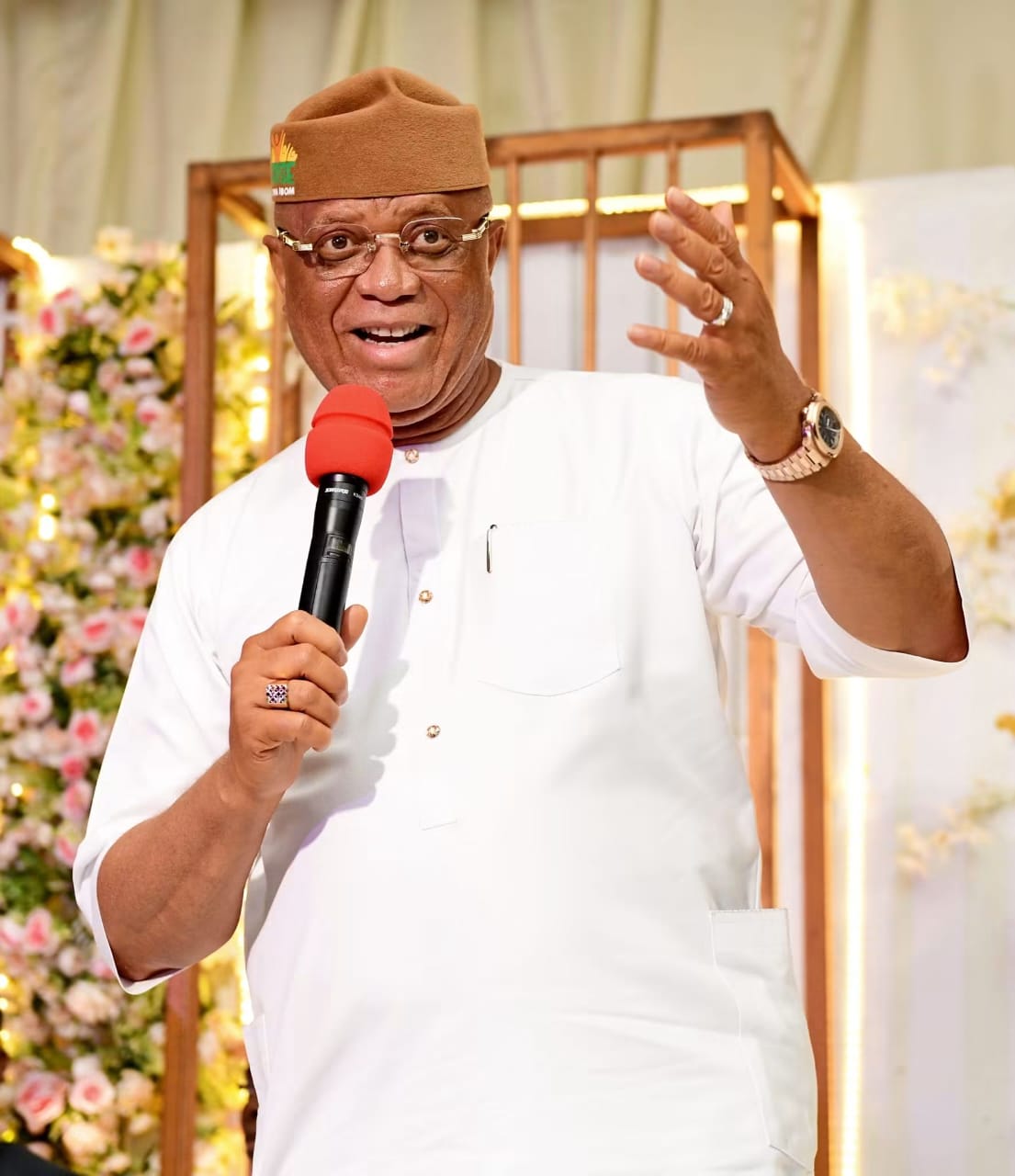
•Governor Umo Eno
By every measure, history has an uncanny sense of humor. It delights in over turning human assumptions, humbling prejudice, and rewarding virtues that the world too often overlooks, even despises.
Again and again, it reminds us that greatness does not always emerge from privilege beginnings. More often, it is forged in obscurity, refined by discipline, and unveiled only when time has completed its silent work.
The invitation extended to Akwa Ibom State governor, our cherished Governor Umo Eno, to deliver the Centenary Lecture of the Prestigious Yoruba Tennis Club is, on the surface, another item in the nation’s social calendar. In reality, it is something far more profound.
It is a national recognition of the enduring power of character. It is an affirmation that, despite the cynicism of our age, integrity, humility, and purposeful leadership still command respect. This announcement awakened memories that stretch back to several decades.
During my early years with UAC PLC, then an Assistant Manager, I encountered a young Umo Eno at Betola Machine Tools Limited in Lagos, where he was working at that time. There was nothing flamboyant about him. He spoke softly, carried himself with uncommon humility, and approached life with the quiet confidence and contentment of a man who believed that tomorrow belonged to those willing to prepare for it.
There were no flashing lights around him. No political entourage. No public acclaim. Only industry, simplicity, and an unmistakable sense of purpose. Society has an unfortunate habit of judging people by the circumstances of their birth rather than the content of their character.
Some, perhaps with little appreciation of the hidden possibilities that reside within every human being, may have derisively described him as a “local boy.” Such labels often reveal more about those who coin them than about those upon whom they are placed.
Time, that immortal representation of God’s mysteries, remains the fairest judge.
Today, that same young man has become the democratically elected Governor of Akwa Ibom State, presiding over one of Nigeria’s most transformed subnational. This is not a hyperbole.
More significantly, he has become a voice considered worthy of addressing one of Nigeria’s oldest and most distinguished institutions – the Yoruba Tennis Club – as it marks one hundred years of existence.
The Yoruba Tennis Club founded on July 15, 1926, in Onikan, Lagos Island, and originally named Orelodun Tennis Club (“Friendship is Good”); it is the premier, exclusive, traditional, and oldest indigenous social club in Nigeria.
This journey by a ‘barracks boy’ to this historic Club therefore deserves some reflection.
Civilizations endure because they occasionally pause to celebrate excellence wherever it is found. Institutions such as the Yoruba Tennis Club do not lightly choose those who stand before them to interpret the challenges of democracy and the demands of good governance.
Their invitation is not merely ceremonial; it is symbolic. It reflects confidence that the speaker possesses not only political authority but also intellectual substance, moral credibility, and practical experience worthy of national conversation.
Perhaps the greatest lesson in this unfolding story is that leadership is less about noise than values. The loudest voices do not always leave the deepest footprints.
The men and women who ultimately shape society are often those who quietly build competence, nurture relationships, and remain faithful to principles long before recognition arrives.
Governor Umo Eno himself acknowledged that, during his early years in Lagos, he could never have imagined returning one day to deliver the Centenary Lecture of such an esteemed institution. That confession is itself instructive. It reminds us that destiny often travels roads invisible to those walking them. And it does so very quietly to further reveal the very essence of God.
For Nigeria’s younger generation, this moment should resonate beyond politics. It should reaffirm the timeless truth that one’s origin is never one’s limitation. Humble beginnings do not diminish great possibilities.
It was Anietie Usen, the multiple award winning journalists and author who wrote in his best seller book, VILLAGE BOY, that “To be raised in poverty and hardship is never a disadvantage, but an advantage”.
The distance between obscurity and significance is bridged not by pedigree but by preparation; not by arrogance but by humility, modesty, and service. In a society increasingly tempted to celebrate instant success, Governor Eno’s journey offers a healthier philosophy – that authentic greatness matures quietly before it announces itself.
As he ascends the podium of the Yoruba Tennis Club to speak on “Democracy and the Imperative of Good Governance: Renewing Hope in Challenging Times,” he carries with him more than the mandate of the people of Akwa Ibom State. He carries the testimony that grace still visits the humble, that character still matters, and that history still reserves its highest honors for those who first learn to serve.
The “barracks boy” has become the national voice. Not because fortune smiled upon him overnight, but because time, character, and providence combined to perform their quiet alchemy.
And perhaps that is the finest lesson of all.
Congratulations to a People’s Governor!
*Mr. Owoh is a management consultant