

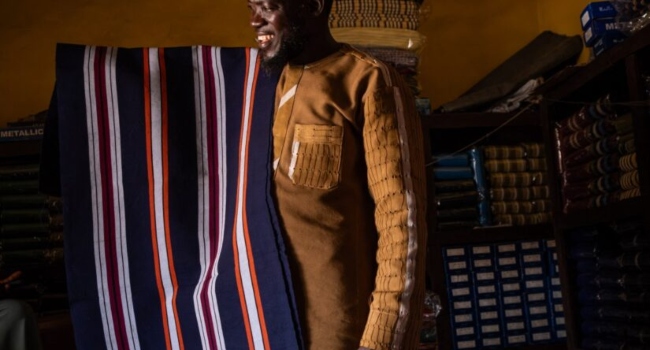
•An aso-oke dealer displays finished aso-oke
The Manufacturers Association of Nigeria (MAN) has called for stakeholder engagement over the Senate’s proposal to ban the import of textile materials.
MAN’s Director-General, Segun Ajayi-Kadir, suggested this during an interview on Channels Television today.

“I want to appeal to the National Assembly: let us not go down this route the same way again. The failure of policy in Nigeria has principally been due to a lack of stakeholder engagement. You cannot shave a man’s head in his absence,” he said on Wednesday’s edition of the breakfast show.
“We pass resolutions, introduce policies, and enact laws that do not substantially reflect what is happening on the ground. That is why well-intentioned moves fail to achieve their objectives.
“We need stakeholder engagement. We need to bring all the existing textile industries to the table and ask them, ‘When, how, and where can you scale?’ We have an idea of the national demand, and we know the reasons why they are operating below 30% of installed capacity. The question is, does the government have the political will to do what it takes to help them deliver?”
Yesterday, the Senate asked the federal government to ban the importation of textile materials in a bid to boost local production and revive the country’s struggling textile industry.
It urged the federal government, through the Ministries of Agriculture and Trade and Investment, to take urgent steps to resuscitate textile manufacturing across the country, particularly along the Kaduna-Kano industrial corridor, citing its potential to create jobs and address rising youth unemployment and insecurity.
Textile Revival Beyond Resolutions
Reacting to the development, Ajayi-Kadir said the country can meet its textile needs, but believes revival of the industry has to go beyond “passing” resolutions.
“It needs to be actively supported by measures that we have consistently recommended but have not yet been implemented,” the MAN chief said.
“For instance, are we going to enforce the patronage of made-in-Nigeria textiles within the government? When the National Assembly passed this resolution, how many of them were wearing made-in-Nigeria garments? If you look closer, how many of us are driving cars assembled in Nigeria?
“If you legislate a ban on textile imports, it must go hand-in-hand with the diligent implementation of Executive Order 003 and a ‘Nigeria First’ mindset. Are we going to enforce it from the Presidency to the National Assembly, the military, uniformed agencies, and even schools? Are we ready to enforce a ‘Nigeria Day’ where everyone is obliged to wear what is made in Nigeria?
“Is the government going to do its bit? Are we going to reject textile, garment, or uniform items in the budget unless they show a direct connection to local production? Are we going to muster what it takes to effectively implement the 30% Common External Tariff (CET) on imports from third countries? Are we going to secure our borders so that the ban does not come to naught?
“A major conversation needs to take place for us to be serious about enforcing an import ban. It is not just by fiat.”