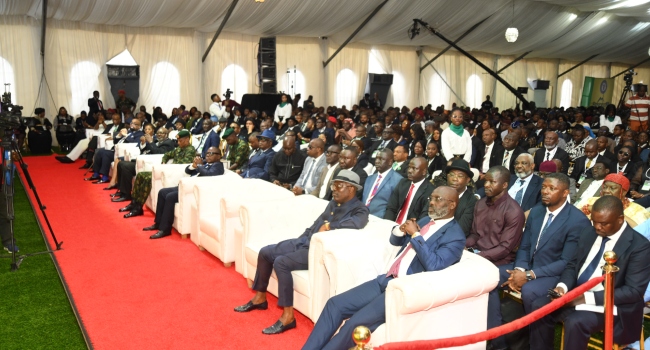
The Nigerian Bar Association’s (NBA) Annual General Conference (AGC) 2026 opened in Port Harcourt with a resounding call for the strengthening of judicial institutions and the rule of law, as legal luminaries, government officials, and dignitaries converged under the theme, “Beyond Limits”.
Declaring the conference open, Rivers State Governor Siminalayi Fubara thanked the outgoing NBA President, Afam Osigwe, for returning the AGC to Port Harcourt following the lifting of the state of emergency in the state and assured the gathered lawyers of their continued safety throughout the conference, reports Channels TV.
Speaking on the theme of the judiciary’s role in a democratic society, Governor Fubara noted that courts are not merely venues for resolving disputes but serve as a refuge for the common man.

“This means that judges must consider the overall impact of their judgement on the society,” he said, adding, “we expect that our judges should not be mere conformists if they’re to be the custodians of the rule of law.”
He stressed that public confidence in the judiciary is strengthened when judges demonstrate the courage to hold government, and even governors, accountable, assuring that his administration was “ready to partner with the NBA to enhance the rule of law in the state.”
In his address, Osigwe recalled that Port Harcourt was originally selected to host the 2025 AGC.
“But when the unfortunate state of emergency was declared and a sole administrator installed, we felt it was against the democratic system to host it here but promised that once democracy was restored, we’d be back,” he said.
“When the governor was reinstalled, we decided it was time to return.”
Reflecting on the conference theme, Osigwe lamented that 66 years after independence, Nigeria’s hope of becoming a beacon for Africa remains unrealised, noting that “diversity which was supposed to be our strength has turned out to become our biggest weakness as we have embraced tribalism, parochialism, among others.”
He maintained, however, that Nigeria still possesses the potential to achieve the dreams of its founding fathers, urging lawyers to “push through our limitations and go beyond our comfort zones”, stressing that “it’s not enough to criticise; we must give constructive suggestions to the government.”
He added that it remains the legal profession’s duty to society “that justice rolls down as a river and the rule of law must be the foundation of society.”
Delivering the keynote address, former President of Liberia, George Weah, said “Beyond Limits” was not merely a slogan but “a way of life, because what is true for one man can be true for another man.”
He stressed that “in every serious nation is an independent judiciary protected by a fearless judicial bar,” warning that threats to democracy do not come only from the barrel of a gun in the night or a defeated leader’s refusal to hand over power, but from a situation where “the judicial institutions might be weakened and unable to carry out their own duties.”
Weah stated that “democracy doesn’t end on election night; it is tested every single day,” insisting that “democracy cannot survive on strong men but on strong institutions.” He described the rule of law as “a practical guarantee that the citizens’ rights do not depend on who is in office but on the enforcement of the law,” warning further that threats to democracy also come from “governments that call themselves democratic but hold sway by corruption, budget manipulation and pressuring judges.”
He added, “We Africans are not short of brilliance; we’re short of the infrastructure that makes brilliance available to us.”
In her address, the Chief Justice of Nigeria, Kudirat Kekere-Ekun, represented by the Chief Judge of Nigeria, described the conference theme as thought-provoking, noting that “it invites us to reflect on the boundaries” within which the legal profession operates, guided by judicial ethics.
She said such limitations “must continually be examined”, particularly as “technology is transforming legal research while AI is raising new questions both for the bar and the bench.”
She disclosed that “at the Supreme Court we’ve launched new procedures that attempt to modernise the application of justice,” expressing hope that “the Supreme Court’s impetus will provide a beacon for those courts yet to adopt technology.” She maintained that “judges must be independent and have unwavering commitment to ethics,” while stressing that “the measure of our success will be found in the experience of the citizen who seeks justice before the court.”
Also speaking, the Shehu of Borno described the work of the legal profession as important to traditional institutions in enthroning dignity and the rule of law, noting that “the NBA has a responsibility not only to defend the rights of citizens but also to contribute to the strengthening of critical institutions in the country.”
He said “the law must protect the vulnerable and provide dispute resolution without fear or favour,” commending the NBA for “providing this platform for the cross-pollination of ideas” and encouraging younger lawyers “to see the legal profession as an avenue for service to humanity.”
In his remarks, the President of the Uganda Law Society, Isaac Semakade, said “people have the rights not to be normal, and as long as the activities don’t adversely affect anyone, they should be left to do their thing.” He added that “anybody accused of any wrongdoing must be given the right to dignity and defense.”
Representing the Chief of Army Staff, the General Officer Commanding 6 Division, Maj. Gen. Everest Okoro, said the conference theme “speaks to the courage, resilience, and determination to the commitment to building a more secure Nigeria.”
He noted that “national security extends beyond the battlefield; it also depends on the rule of law, justice and protection of human rights,” adding that the Nigerian Army “will work closely with the bar, the bench and all other institutions to pursue a more just Nigeria.”
In a goodwill message, the Chief Judge of Rivers State, Simeon Amadi, charged the incoming NBA president to “exceed and go beyond their predecessors,” and urged the bar to “accept technological advancement as AI disrupts legal practice.”