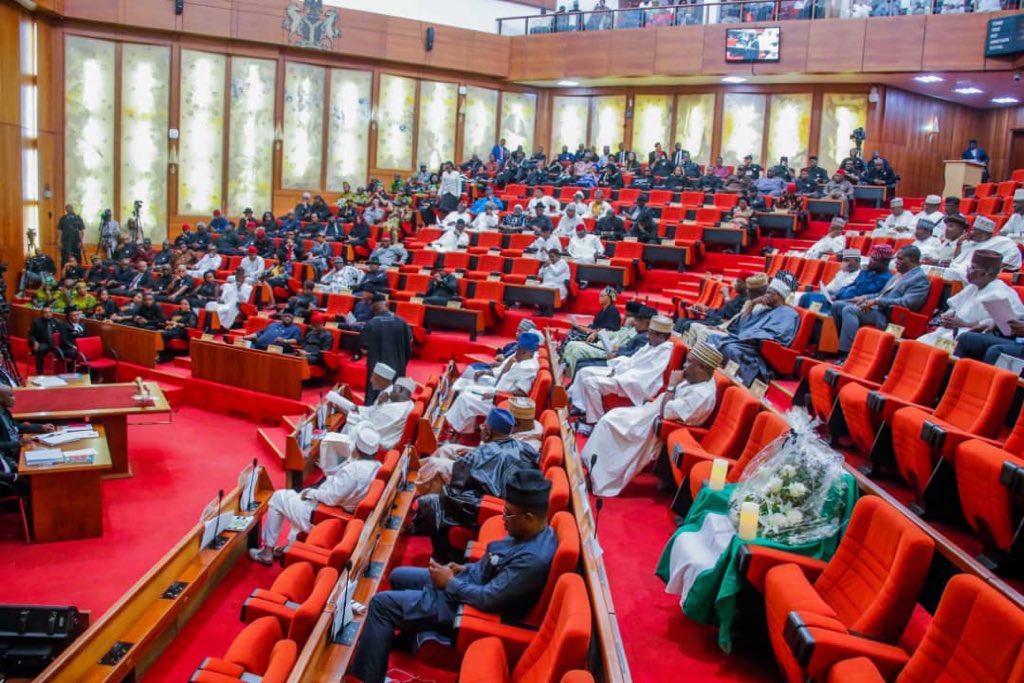
•Nigerian Senate
A major restructuring of the insurance industry is imminent with yesterday’s passage of a bill by the Senate to amend the laws and refocus the sub-sector in line with current realities.
The bill, passed by the Red Chamber after considering the report of the Committee on Banking, Insurance and Other Financial Institutions, upgrades the minimum capital for re-insurance firms to a minimum of N35 billion, reports The Nation.
Apart from re-insurance, the proposal known as the 2024 Nigerian Insurance Industry Reform Bill, puts non-life insurance capital base at N15 billion and life assurance at N10 billion.
The current minimum capital limits of the three classes are N10 billion for re-insurance firms, N2 billion for life and N3 billion for non-life insurance organisations.
Many of the 67 companies might be unable to raise the funds, creating the possibility of mergers, acquisitions and outright extinction of some firms.
Managing Director/CEO of Stanbic IBTC Insurance AkinJide Orimolade confirmed last night that the N15 billion proposed capital base for non-life business would likely result in merger and acquisition.
Another CEO, who spoke on condition of anonymity because “I don’t know the content of the Bill yet” said he feared job losses.
He said on the flip side, it could lead to an inflow of foreign capital to acquire some of the companies.
According to him, in this instance, there will be prospects in the industry.
The sector’s regulator, the National Insurance Commission (NAICOM), yesterday declined to speak on the Bill.
An official said: “It is premature to comment on it or speak about its likely implication because the House of Representatives has not passed the bill, let alone the President signing it.”
Chairman Senate Committee on Banking, Insurance and Other Financial Institutions Adetokunbo Abiru, during plenary yesterday, presented the report on the proposed law on the floor.
Abiru explained that the hike in capital base for insurance companies had become necessary given the depreciation in the value of the Naira.
He gave other reasons to review the law, including the Finance Act 2022 which redefined the composite of the capital; inflation, international competitiveness, African Continental Free Trade Agreement (AfCFTA) competitiveness, capital flight due to over-reliance on foreign insurance, emerging risks such as cyber insurance, and consumer credit insurance.
According to him, the bill which was read for a second time on July 18, seeks to consolidate various existing legislations regulating insurance businesses in the country.
The committee chairman listed the legislation to include the Insurance Act 2003, the Marine Insurance Act, the Motor Vehicles Third Party Insurance Act, the National Insurance Corporation Act, and the Nigerian Reinsurance Corporation Act.
According to him, another major objective of the bill was to enable Nigerians to have a better future and give the nation a robust legal and regulatory framework that would see the insurance sector contributing positively to the economy.
He said to make Nigeria Africa’s financial hub and one of the 20 largest economies in the world, there was the need to evolve effective risk-based supervision in the regulatory system.
He said the existing rule-based supervision, enabled by the current laws in the insurance sector, had become obsolete.
Abiru stated that during the public hearing, stakeholders made far-reaching presentations in support of the passage of the bill.
He said there was a need to upscale the industry’s potential to compete globally, adding that the current insurance legislations do not resonate with the current dynamics and evolving needs of the Nigerian insurance industry.
“All these legislations have surpassed a two-decade mark and they lack provisions that can adequately address contemporary challenges and support growth and innovation within the industry,” said the committee chairman.
According to him, the outdated laws have led to some regulatory inefficiencies in the insurance industry.
“These have also hampered the industry’s ability to successfully compete on a global level,” he explained.
Abiru implored his colleagues to pass the bill for a comprehensive legal framework to regulate insurance initiatives.
Senator Jimoh Ibrahim, an investor in the sector, unsuccessfully put up a spirited battle to prevent the Bill’s passage.
Dr. Ibrahim noted that the provision for N35 billion as a minimum capital requirement for reinsurance business as contained in the bill was not in order, given the current economic situation.
He urged the Senate to consider maintaining the status quo of N10 billion for reinsurance businesses in the interest of the industry.
“We only have one re-insurance company. Meeting the capital is impossible.
“As a matter of fact, 20 per cent of that will be deposited in the Central Bank of Nigeria (CBN) forever. This increase will lead to the death of some firms,” Ibrahim argued.
His motion that the status quo be retained was, however, not seconded by any senator during the clause-by-clause consideration.
The bill was thereafter passed.
Deputy Senate President Barau Jibrin, who presided over the plenary, commended the Abiru-led committee for a job well done.
Barau said: “When we have the concurrence by the House of Representatives and the assent of Mr. President, the law will help shape our economy for the better.
“Economies change at all times. It is, therefore, incumbent on the authorities of every nation to recraft their legislation to go in tandem with contemporary realities. And this is what has been done by the passage of this legislation.
“The intent is to restructure the insurance ecosystem to accommodate contemporary happenings within our economy.’’
For the bill to become law, the House of Representatives will have to pass it along the lines of the Senate and the President will give his assent.