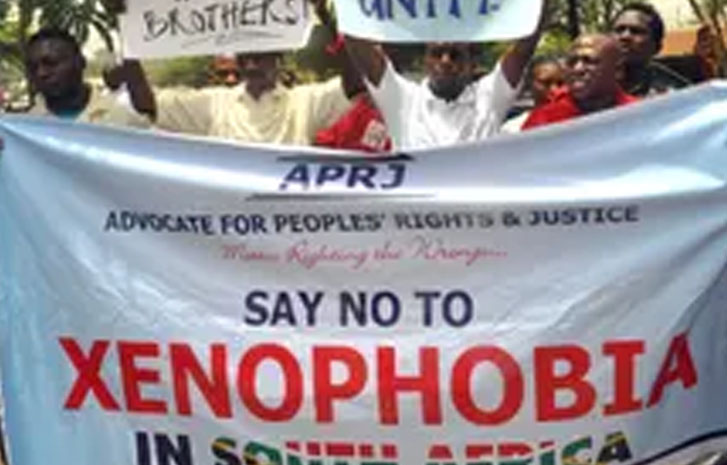
Pan-Africanist dreams of enforced Pan-African unity and brotherhood as promised by Kwame Nkrumah are questioned by many commentators, citing instances of repeated xenophobic violence in South Africa as proof that Pan-African unity is not what Africans desire.
The late Kwame Nkrumah of Ghana and the late Nelson Mandela of South Africa both believed that Africa should be a continent of no boundaries where people from all African nations could live and work freely.
But rather than a borderless Africa free of prejudices, South Africa has seen the emergence of waves of threatening xenophobic violence lately.

For instance, last month’s protests have resulted in the deaths of at least 7 people and have led thousands of businesses to shut down, forcing thousands of migrants from other African countries to flee to neighbouring countries.
The ongoing diplomatic standoff between South Africa and its African neighbours may potentially derail attempts to create the world’s largest free trade zone in the near future, ruining the idea of Pan-African unity altogether.
The vision of a united Africa has long governed the interactions between Africa and the rest of the world. This vision is rooted in the principles of Pan-Africanism and is backed by contemporary agreements such as the African Continental Free Trade Area.
But now, this dream has been put at risk by a very serious diplomatic and humanitarian crisis.
Lately, there has been a noticeable rise in xenophobic attacks in South Africa against migrants from Nigeria, Ghana, and other African countries. This has led many people to leave their homes, and there was an unprecedented response from two of the most powerful West African countries.
The issues are so serious that even Bola Ahmed Tinubu, the current president of Nigeria, refused to meet with a delegation from South Africa. At the same time, Ghana stopped a visit by the president of South Africa. Thus, the issue that was originally about immigration within South Africa has quickly transformed into diplomatic problems in the region.
Now, considering the consequences of these brutal attacks and the diplomatic crisis, there is a question about African unity and cooperation. Both Nigeria and Ghana are outraged over the situation – Nigeria states it does not approve of the killing and the attacking of its nationals. At the same time, Ghana laments the death of one of its citizens in the protests.
To enhance the safety of people involved, emergency programs are launched aimed at delivering migrants to their home countries. Nigeria has already returned about 1,500 of its people on commercial flights, and Ghana has brought back more than 900 of its nationals.
However, there are still thousands of migrants waiting to depart in temporary camps at the borders of South Africa, which is the major economy of Africa – people are living in terrible conditions and want to get out. When the meeting began, Ambassador Enikanolaiye made his dissatisfaction known, opening up about the issues his administration was having. Ambassador Enikanolaiye welcomed the South African officials warmly, stating, “We are pleased to have brothers from South Africa.” But although his tone was nice, it was evident that there was concern and urgency in the air.
Echoing his earlier statement, he told one of the participants that President Bola Ahmed Tinubu requested this meeting to discuss the recent spate of incidents of Afrophobia in South Africa.
These events had left Nigerians and Africans reeling. The fact that this meeting was taking place meant that Nigeria was sending a message loud and clear from Abuja – the time for mere condolences was over. In fact, Nigerian lawmakers had already begun taking a tougher approach and had called for the cancellation of the licenses of the South African companies operating in Nigeria.
The same chill has descended upon the capital of Ghana, Accra. The country has decided to cancel President Ramaphosa’s planned visit, originally scheduled for August 2026. The decision came amid fears that the visit could lead to public unrest in Accra.
Felix Kwakye Ofosu, the spokesperson for the government of Ghana, notified the press about the decision to postpone the meeting.
He stated, “We have suggested to them that they should postpone the visit in light of the current climate of xenophobia with respect to the fact that they are not favourable to foreigners.”
Pretoria made efforts to clarify the situation about the diplomatic crisis between Ghana and the Republic of South Africa. They have emphasized that the meeting was always planned to be a routine session of the South Africa–Ghana Bi-National Commission and not the official visit as President Ramaphosa initially intended.
South Africa’s presidential spokesperson, Vincent Magwenya, is trying to downplay the significance of the crisis between the two countries and assures that South Africa remains open to further cooperation with Ghana through diplomatic channels and will try to find a date that fits both parties. “We will find a date which will work for both parties,” says Magwenya.
South Africa is facing some serious troubles. There are big discrepancies in wealth in the state, unemployment is very high, and crime is a serious problem.
Occasionally, foreigners face accusations in connection with these problems, but the government disagrees with this stance, claiming that the real culprit is illegal migration. They are convinced that if they manage to sort out law enforcement and immigration issues, everything will be back to normal; however, the reality is more complicated.
The issues facing South Africa are rooted in the country’s history and its socio-economic structures. The government must consider how to solve the problems and make long-term plans that address the root causes, including job creation, reducing inequality, and providing equal access to socio-economic opportunities. The process of solving these problems is arduous but the only possible way to establish an equitable and peaceful society.
Minister Ronald Lamola’s statements regarding the visit of the Nigerian delegation in the city of Abuja indicate South Africa’s firmness in fighting against intolerance, in any form it may appear.
When it comes to immigration issues, Lamola insisted that South Africa will protect its sovereignty as well as its citizens from becoming victims of crimes committed by illegal immigrants and their actions. He is sure that the law will be enforced as a sign of South Africa’s stand.
It seems that a new change is appearing in African politics and that Nigeria is joining Ghana to fight against the phenomenon called “Afrophobia”.
In popularising their ideas, they got the help of their fellow politicians from West Africa. They are likely to make this issue one of the points on the agenda for the next meeting of the African Union. They argue that Africans are being persecuted too much – which is contrary to the principles of free movement and economic integration in Africa. It is a significant issue as it affects the ability of African nations to cooperate and develop their economies.
The African Union has laid down specific provisions for the free movement of people among nations, but the practice of targeting African nationals undermines the stated objectives.
Nigeria and Ghana are demanding that this issue be put on the agenda of the meeting and have the backing of several West African countries supporting their position. It could be a significant step toward a more united and prosperous Africa.
Finally, the xenophobic crisis in South Africa is no longer merely the internal problem of the country, but has transformed into a serious test for Pan-African solidarity.
The diplomatic steps that the governments of Nigeria and Ghana made exemplify a zero-tolerance policy pursued by the countries, which are no longer prepared to pay either the human or economic costs of anti-migrant violence.
Now, when the African Union was about to respond to the crisis, it could not be more serious. If the leading countries of the continent cannot find common ground between the sovereign right to rule the country the way they deem it right and the obligation to protect the lives of Africans, then the concept of borderless Africa will never be transformed into reality.
Why did the crisis emerge?
The economy of South Africa is undergoing severe difficulty. Inequality in South Africa is amongst the highest in the world. Statistics South Africa reported that the rate of unemployment in the first quarter of 2026 was 32.7%. Unemployment amongst youth alone was slightly below 45%. In informal settlements where there are no services available, and infrastructure is poor, migrants have become scapegoats of the failure of the state to provide basics.
While some advocates of tightening migration regulations allege that those undocumented migrants flooding the country are vanquishing hospitals, schools and the informal labour market, President Cyril Ramaphosa observes this pressure and pretends to seek stability in the country.
“We should never allow the legitimate concerns of our communities regarding illegal migration to breed prejudice against our fellow Africans,” he stated during his Freedom Day speech in April 2026. He also warned against “trampling to dust the African fellowship that made our freedom possible.”
The anti-immigrant campaigns are a betrayal of Pan-Africanism for numerous people across the continent. Recently, Nigeria, Ghana, and Malawi have started programs for their citizens returning voluntarily to their respective countries based on concern for them in South Africa, where violence against foreigners is on the rise.
The African Union has been urging governments to find solutions to this issue.
“We condemn the killings in the strongest terms possible,” the Chair of the African Union Commission, Moussa Faki Mahamat, said, demanding that South African authorities punish the offenders and act against any outbreak of violence in the country.
The Uncertain Future of Integration
The South African crisis is not just about racism and race relations, but is also related to the African Continental Free Trade Area (AfCFTA), which will be the world’s largest free trade area based on the number of signatories. The success of AfCFTA depends on how well Africans manage to behave in a business-like manner.
There would be no integration and free trade in Africa as a solution for poverty unless there is a guarantee for safe entry of Africans from other countries into South Africa.
“Economic integration also necessarily implies trust and communication between people,” says one of the documents from the Nkafu Policy Institute.
“In case of being threatened with violence and discrimination in other African countries, there can be no regional economic integration.”
The South African government is in a difficult position. It has pledged to uphold the Constitution by ensuring the rule of law and safeguarding all individuals within its territory. Nevertheless, a huge political challenge remains for it — the obligation to demonstrate that in the current sluggish economic realities it puts its citizens first.
Last month, South Africa’s Minister of International Relations and Cooperation, Ronald Lamola, said: “Leading with a Pan-African heart means that we will continue to respect the right of people to move.” “At the same time, migration has to be based on principles of cooperation, compassion, and continental responsibility,” he further stated.
According to Lamola, the African Union has to deal with the “push and pull factors” that force people to leave their homelands where there is neither law nor economic activity.
In conclusion: The Crossroads of Unity
The menace of xenophobic violence looms over South Africa, frightening other African nations. South African xenophobia indicates a huge underlying problem concerning the disparity between Pan-African statements and economic reality.
Therefore, South Africa’s experience is a warning for the continent. If the agreements signed in Addis Ababa are to mean anything, something must be done to improve social cohesion in such areas as Soweto or Alexandra.
The time ahead requires South Africa to resolve its imploding economic model without losing its moral authority earned during the anti-apartheid struggle. As for the rest of Africa, Project Africa should realize that unity is not something we received with independence; this is something we must work hard to achieve and preserve.
*Emmanuel Elegbenosa Aitanu serves as the CEO of EEA & GOA Investment Ltd, where he plays a pivotal role in steering the company’s strategic direction across diverse investment sectors, including cryptocurrency, real estate, and agricultural ventures.