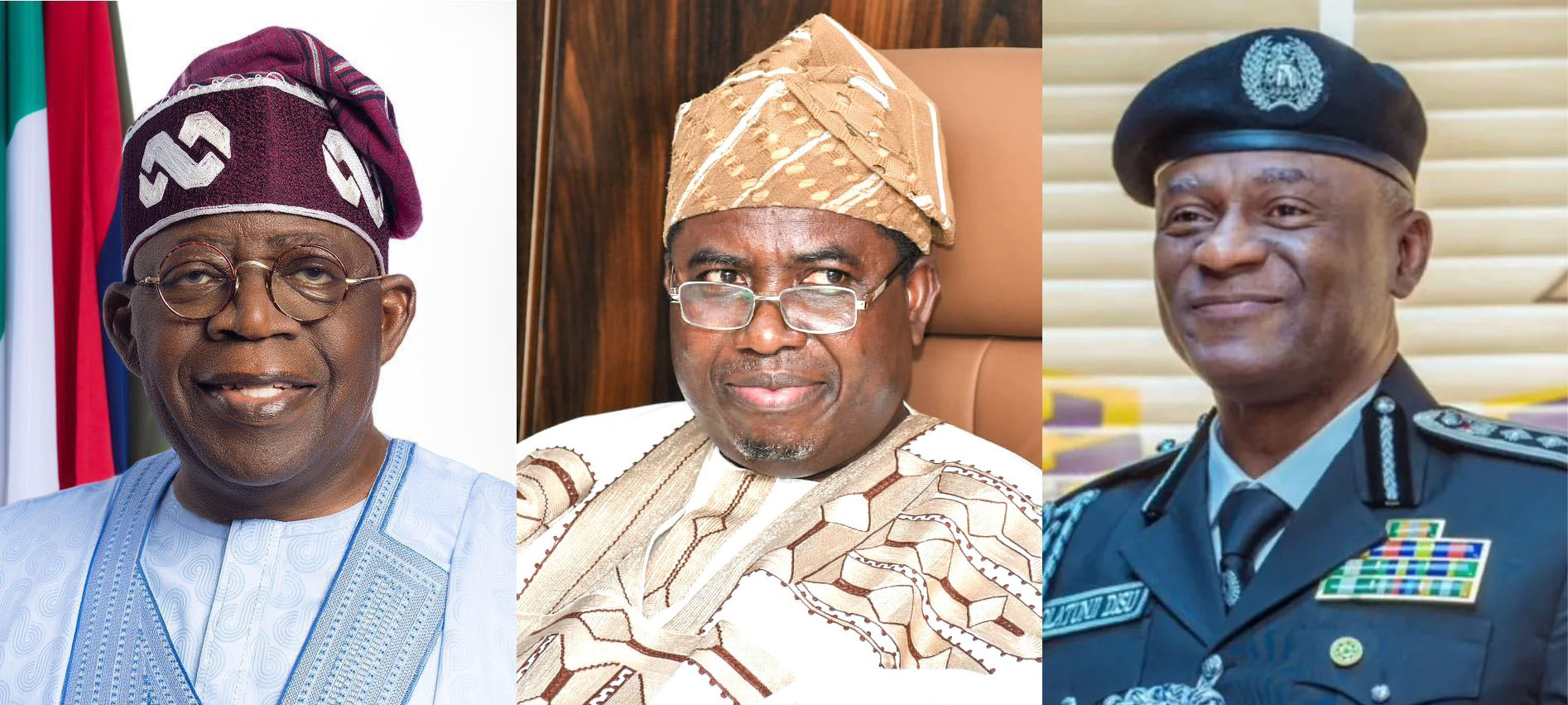
•Tinubu, Prof Joash and IGP Tunji Disu
As Nigeria prepares for the 2027 general election, the real battle for political power is increasingly being fought far beyond the ballot box. From governors’ lodges and private boardrooms to digital platforms, a new class of power brokers — party financiers, campaign strategists, influencers and traditional leaders — is shaping decisions on candidates and alliances long before voters have their say.
This growing informal influence raises urgent questions about the health of Nigerian democracy and whether power still ultimately flows from the people, reports Saturday Independent.

When Nigerians cast their votes in 2027, many will believe they are deciding the country’s political future at the ballot box. But long before election day arrives, crucial decisions about candidates, alliances and campaign strategies may already have been shaped in governors’ lodges, private meetings, traditional palaces, boardrooms and, increasingly, on digital platforms.
The face of political power in Nigeria is changing. While political parties remain the formal vehicles for contesting elections, analysts say the country’s political landscape is increasingly influenced by actors who operate beyond party secretariats.
Governors, political financiers, campaign strategists, social media influencers, traditional rulers, religious leaders and pressure groups have emerged as major players in determining who gets nominated, who receives political backing and, in many cases, who eventually governs.
Their growing influence is redefining how politics is played in Africa’s largest democracy.
Perhaps no group illustrates this transformation better than state governors. Although elected to administer their respective states, governors have become dominant figures in national politics, exerting considerable influence over party structures, legislative politics and presidential calculations.
A 2024 academic study on the Nigeria Governors’ Forum argues that governors have evolved into “pivotal arbiters” in Nigerian politics, leveraging their collective strength to influence policy decisions, negotiate with the federal government and shape the country’s political direction.
The study concludes that the Forum has become one of the country’s most influential political institutions since the return to democratic rule in 1999.
Their influence extends far beyond their constitutional responsibilities. Governors are widely regarded as key stakeholders in determining party leadership at the state level, influencing candidate selection for legislative offices and mobilising political structures during elections. Their control of state political machinery often makes them indispensable during coalition negotiations and party conventions.
For Dr. Mohammed Wakil, lawyer, former Leader of the House of Representatives and former Minister of Power, this concentration of influence reflects a deeper institutional challenge.
“Nigerian parties focus on building powerful individuals rather than powerful institutions,” he said.
“Consequently, our parties remain similarly amoebic in shape and ideology, with almost the same dramatis personae in all the parties.”
His observation goes beyond criticism of political parties. It suggests that political influence has increasingly become concentrated around influential personalities whose networks often transcend party boundaries.
As politicians move across parties, many of the structures that support them — including loyal supporters, financiers and local political organisations —move with them.
Yet governors are only one part of a broader network of power brokers.
Political consultants and campaign strategists, once largely unknown to the public, have become increasingly influential in designing campaign messages, analysing voter behaviour, conducting opinion polling and coordinating election- day operations.
Modern political campaigns rely heavily on data, media management and targeted communication, giving professional strategists a more prominent role than ever before.
The digital revolution has also produced a new generation of political influencers. Social media personalities, content creators and online commentators now shape public conversations in ways that traditional political actors cannot easily ignore.
Political narratives are increasingly contested on platforms where millions of Nigerians consume news, debate policies and mobilise support, reflecting a broader shift in how political communication is conducted.
Traditional rulers and religious leaders also continue to wield significant moral and social influence within their communities.
Although many avoid open partisan politics, their opinions often carry considerable weight during election periods, particularly in areas where communal trust in traditional institutions remains strong.
Political scientist Richard Joseph’s concept of prebendal politics remains relevant in explaining why informal networks continue to matter in Nigeria.
Access to political office has often been linked to patronage, elite bargaining and personal networks as much as to formal party structures.
While democratic institutions have become more established since 1999, informal centres of influence continue to shape political outcomes behind the scenes.
As political activities gradually intensify ahead of another election cycle, one question is becoming increasingly important: have Nigeria’s real centres of political power shifted away from party headquarters to a wider network of influential actors who now determine the country’s political direction long before voters cast their ballots?
The influence of Nigeria’s new political power brokers extends beyond election campaigns. Increasingly, they shape who emerges as candidates, how parties resolve internal disputes and, in some instances, the policy direction of governments after elections.
Political scientist Prof. Jibrin Ibrahim argues that one of the biggest weaknesses of Nigeria’s democracy lies in the nature of its political parties. According to him, many parties are controlled by powerful individuals rather than their members, weakening internal democracy and making them vulnerable to the influence of governors and political godfathers.
He has consistently maintained that citizens must reclaim their parties if democracy is to truly serve the public interest.
His position resonates with the views of many democracy advocates who believe that the growing concentration of political influence in a few hands has reduced the ability of ordinary party members to shape decisions.
Instead of competitive internal debates on policy, candidate selection is often determined through elite negotiations, endorsements and political bargaining.
The Centre for Democracy and Development (CDD) has also warned that the quality of elections is closely linked to the character of the political class. At one of its governance colloquiums, Prof. Jibrin Ibrahim observed that credible elections depend not only on electoral laws but also on the integrity of political actors, arguing that weak political culture remains a major obstacle to democratic consolidation.
Yet political influence today is no longer exercised only in meeting rooms.
The rapid growth of digital media has created a new class of political actors whose influence is measured not by the offices they hold but by the audiences they command. Social media influencers, content creators and digital campaign teams increasingly shape public opinion, frame political narratives and mobilise supporters within minutes. Political parties now devote substantial resources to digital communication because they recognise that online conversations often spill into mainstream political discourse. Emerging research also highlights the growing impact of digital platforms and AI-driven communication on political messaging and public engagement.
Business leaders and political financiers remain another important layer of influence. Electioneering in Nigeria is expensive, requiring enormous resources for logistics, mobilisation, publicity and organisation.
While campaign financing is regulated by law, analysts note that individuals and interest groups capable of providing significant financial support often enjoy privileged access to political leaders and strategic decision-making.
Traditional rulers and religious leaders continue to command enormous respect in many communities. Although the Constitution expects traditional institutions to remain above partisan politics, their moral authority and community influence often make their endorsements highly sought after during election periods.
Likewise, respected clerics can shape public conversations, encourage peaceful participation or call for issue-based campaigns, demonstrating that political influence is not always exercised through formal office.
For Dr. Mohammed Wakil, however, the central challenge remains institutional.
“Nigerian parties focus on building powerful individuals rather than powerful institutions,” he argues. “Consequently, our parties remain similarly amoebic in shape and ideology, with almost the same dramatis personae in all the parties.”
His observation reflects a broader concern that as long as institutions remain weak, influence will continue to revolve around individuals rather than enduring democratic structures.
The emergence of these new power brokers is not entirely negative. Skilled campaign professionals can improve voter communication. Civil society organisations have strengthened election observation and civic education. Digital platforms have expanded political participation, particularly among young Nigerians. Governors, through collaborative platforms, have also contributed to national policy discussions on issues affecting the federation.
The challenge is ensuring that influence is exercised transparently and remains accountable to the electorate. Democracy functions best when political power ultimately flows from the people through credible institutions rather than through informal networks operating beyond public scrutiny.
As preparations for the 2027 general election gather pace, the question is no longer whether new power brokers exist. They clearly do. The more important question is whether their growing influence will strengthen democratic governance or further concentrate political power away from ordinary party members and the electorate.
The answer will shape not only the next election but also the future of Nigeria’s democracy. Elections may still be won at the polling unit, but the battle for political influence increasingly begins long before the first ballot is cast — and often far from the public eye.