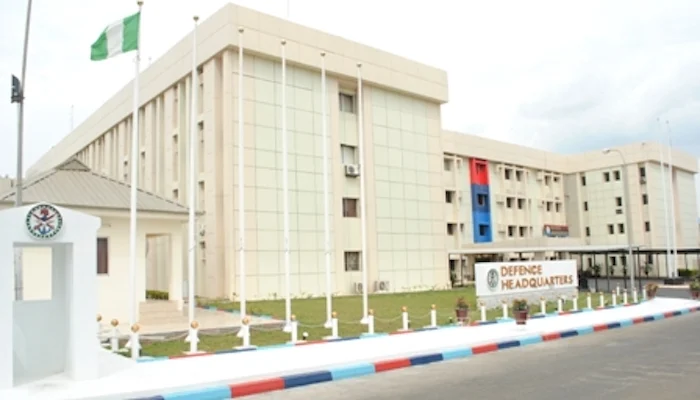
•Defence Headquarters
On October 18, 2025, the Sahara Reporters reported that some military officers ranging in rank from captain to brigadier general were arrested by the Defence Intelligence Agency for allegedly holding secret meetings to topple the government.
The online news medium also linked the cancellation of the October 1 Independence Day parade to the alleged plot.

At the time, the former Director of Defence Information, Brigadier General Tukur Gusau, said the publication was intended to create tension and distrust among Nigerians, adding that the matter was strictly a disciplinary issue handled internally.
He, however, said, “The ongoing investigation involving the 16 officers is a routine internal process aimed at ensuring discipline and professionalism are maintained within the ranks.” He further disclosed that an investigative panel had been duly constituted, and its findings will be made public.
Last week, the military authorities eventually confirmed that some military officers and their civilian collaborators had plotted to overthrow the Bola Tinubu administration in October last year.
While providing an update on the development, the new Director of Defence Information, Major General Samaila Uba, said a comprehensive investigation had been conducted in line with established military procedures and that the alleged coup plotters would face the music before a military tribunal.
The Minister of Defence, General Christopher Musa, has equally said that the alleged coup plotters “are going to face court-martials as usual. The process will be free and fair, and they will be allowed to engage their own legal counsel to defend their action”. It does appear that the Federal Government believes, rather erroneously, that the coup plot is a military affair.
Even though I am involved in the ongoing campaign against unconstitutional change of governments in Africa, I am compelled to point out that the alleged coup plotters cannot be tried by a court martial or any other military tribunal under the current democratic dispensation. Since the military officers implicated in the coup plot had wanted to remove an elected President from office, it is a grave crime that must be tried under the Criminal Code Act.
It is pertinent to state that the alleged coup plotters can only be tried under section 41 of the Criminal Code Act which stipulates that anyone who forms an intention to depose the President, during his term of office, or to overawe the government by criminal force, and manifests such intention by an overt act, is guilty of a felony and liable to life imprisonment.
Those who are mounting pressure on the Federal Government to have the alleged coup plotters tried by a court-martial should study the case of Umoru Mandara vs Attorney-General of the Federation (1984) 4 S.C 8. In that case, the appellant was tried at the Federal High Court, Lagos, on a four-count charge of treasonable felony, incitement to mutiny, and attempting to cause disaffection. At the end of the marathon trial, the defendant was convicted and sentenced to a 15-year jail term. But the Supreme Court quashed his conviction on the ground that the Federal High Court lacked the jurisdiction to have tried the appellant.
The Constitution has conferred jurisdiction on the Federal High Court to try treason and allied offences.
However, with the overthrow of President Shehu Shagari on December 31, 1983, the Constitution was suspended and modified while the country was ruled by decrees and edicts promulgated by the head of state and governors, respectively.
Some of the obnoxious decrees were hurriedly enacted to deal with perceived political opponents.
For instance, when the military president, General Ibrahim Babangida, discovered that General Mamman Vatsa and the other military officers could only be sentenced to life imprisonment under section 41 of the Criminal Code Act, the Treason and Other Offences (Special Military Tribunal) Decree 1 of 1986 was promulgated.
The Treason Decree provided the death penalty for treason and treasonable felony. Even though the alleged coup plotters had been arrested in December 1985, they were tried under the Treason Decree that was promulgated on January 6, 1986. Thus, they were convicted by a military tribunal and executed in a premeditated manner. Contrary to General Babangida’s claim that he killed Vatsa, his close friend, because his hands were tied by the law, this claim is completely misleading. Major Gideon Orkar and his colleagues, who attempted but failed to assassinate General Babangida and dismember Nigeria on April 22, 1990, knew the consequences of their action under the applicable law.
Hence, Nigerians were not surprised when the coup plotters were tried, convicted, sentenced to death and executed under the Treason Decree.
The next group of alleged coup plotters were arrested in May 1992. The five suspects were charged with conspiracy and treasonable felony under section 41 of the Criminal Code Act. Since they were civilians, they were arraigned before a Chief Magistrate Court in Gwagwalada in the Federal Capital Territory. The allegation was that they had embarked on a ‘Babangida Must Go’ campaign throughout Nigeria. The late Chief Gani Fawehinmi and I were among the five defendants. Since we were held incommunicado, we appeared for ourselves and our comrades.
While praying for our bail, Fawehinmi said that it was an irony that Babangida and his comrade-in-arms, who ought to have stood trial for overthrowing the Shehu Shagari government in December 1981, have turned to charge us with treasonable felony for campaigning against the criminal manipulation of his political transition programme. On my own part, I submitted that section 41 of the Criminal Act provides for the formation of an intention to remove the president from office during his term of office.
I concluded that since the General had no fixed term of office, the law was not to protect a military dictator but an elected President who has a maximum term of eight years.
Upon confirming that we had planned to use the case to put the serial coup plotters in power on trial, the prosecutor abandoned our trial. Hence, the charge was dismissed for want of diligent prosecution, while we were discharged. Thereafter, Babangida promulgated the Treason and Treasonable Offences Decree No 29 of 1993, which empowered the former military junta to set up military tribunals to try coup plotters.
The military and civilians, including journalists who were arrested for planning the phantom coup d’etat of 1995, were tried in camera under the Treason and Treasonable Offences Decree.
The trial of the civilians by the military tribunal could not be justified in law. In Media Rights Agenda v. Nigeria (2000) AHRLR 5, the commission determined that the arraignment, trial and conviction of civilians by a Special Military Tribunal presided over by serving military officers, violated the basic principles of fair hearing guaranteed by article 7 of the Charter, as well as the duty to guarantee the independence of the courts under article 26.63.
Citing its Resolution on the Right to a Fair Trial and Legal Aid in Africa, the commission stated that military courts “should not, in any circumstances whatsoever, have jurisdiction over civilians. Similarly, Special Tribunals should not try offences that fall within the jurisdiction of regular courts”.
It is on record that the Treason and Treasonable Offences Decree No 29 of 1993 was one of the anti-democratic laws that were repealed by General Abdulsalami Abubakar to pave the way for the restoration of civil rule in the country with effect from May 29, 1999.
However, based on the decision of Justice Dolapo Akinsanya of the Lagos High Court which sacked the Interim National Government headed by Chief Ernest Shonekan on November 10, 1993, the authors of the 1999 Constitution inserted section 251(2) thereof to the effect that: “The Federal High Court shall have and exercise jurisdiction and powers in respect of treason, treasonable felony and allied offences.”
Another reason why the alleged coup plotters cannot be tried in a court-martial is the alleged involvement of some civilians in the plot. Since the indicted civilians are not subject to service law, they cannot be tried in a military court. Even in the case of Chief Moshood Abiola vs The Federal Republic of Nigeria (1995) 1 NWLR (Pt.370) 155, the defendant was charged with treasonable felony at the Federal High Court. Similarly, in the case of Ameh Ebute vs State (1994) 8 NWLR (Pt 360) 66, the defendants, including Senator Bola Tinubu (now President), were charged with treason at the Federal High Court.
The illegal practice of prosecuting civilians in military courts has just been stopped by the Supreme Court of Uganda in the case of Dr Kizza Besigye & Another vs Attorney General and Another (Miscellaneous Cause 31 of 2025) [2025] UGHCCD 29 (24 February 2025). In that case, Dr Kizza Besigye and Haji Obeid Lutale were brutally abducted from Nairobi, Kenya, on November 16, 2024, transferred to Uganda, and illegally detained at Makindye military barracks. They were arraigned before the General Court Martial on November 20, 2024, for charges including security offences and possession of firearms. They challenged the legal competence of the trial. On January 31, 2025, the Supreme Court held that military courts lacked jurisdiction to try civilians and ordered officials to halt all ongoing military trials of civilians and transfer them to the country’s civilian court system.
In view of the foregoing, the case file of the alleged coup plotters should be forwarded to the office of the Attorney-General of the Federation without any further delay. Upon the receipt of the case file, the Attorney-General should study it and file a charge of treasonable felony at the Federal High Court pursuant to section 251(2) of the 1999 Constitution.
The military authorities who have threatened to try the alleged coup plotters in a military court should be advised to appreciate that the plot to sack a civilian regime is not a military affair. In any case, the decree for the trial of coup plotters being relied on by the military officers, has been repealed, while treasonable felony is not one of the offences listed in the Armed Forces Act.
*Falana, SAN, a constitutional lawyer and human rights activist, writes from Lagos