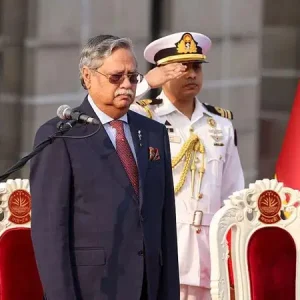


•An escapee Chibok girl with children (left) and Borno Governor Zulum (center)
It has been nearly a year since 26-year-old Rabiat left the Boko Haram enclave she was held in for close to a decade.
In her home in Maiduguri, the northeast Nigerian city at the heart of 15 years of fighting by the armed group, the mother of three ruminated on life as a free woman, reports Al Jazeera.
Rabiat, whose name has been changed for her safety, was one of 276 girls abducted by Boko Haram fighters from their school in the town of Chibok on the night of April 14, 2014, in what was Nigeria’s most high-profile mass abduction case.
About 90 of them are still missing. Fifty-seven escaped as they were being carted off to the group’s base in the vast, ungoverned Sambisa Forest 60km (40 miles) southeast of Maiduguri.
From 2016 to 2017, 108 were rescued by the Nigerian military or freed through prisoner swaps while about 20 more, including Rabiat, returned in the past two years.
Like many others who have escaped harrowing conditions in Boko Haram hideouts, the girls-turned-women now face a different type of challenge: the struggle to restart their lives when so much has changed.
A Christian teenager when she was taken, Rabiat was forced to become Muslim and married off, first to one fighter and then another. She was forced to become a mother too: Her son is seven, and her daughters are five and two years old.
When the leadership of the Boko Haram faction that held her captive crumbled and her opportunity to leave the forest presented itself last year, Rabiat seized it and surrendered to the Nigerian army.
“I left because Boko Haram had problems and were fighting [with each other],” she said in her native Hausa language, explaining how some hostages took that as a chance to escape captivity.
Like others associated with the armed group, she completed a three-month “deradicalisation” programme in Bullumkutu camp, one of three sites in Maiduguri where thousands are being taught societal values and vocational skills like sewing. About 150,000 “repentant” Boko Haram members who have surrendered to the army are also participants in the programme.
After that, Rabiat was moved to a large compound in an affluent area of Maiduguri with more than a dozen other so-called Chibok girls. The women are under surveillance, their every move monitored – likely due to the peculiarity of their case. In addition to their accommodation, the Borno State Government pays them a stipend of 30,000 naira ($24) monthly and has promised them their own homes.
However, getting back to normal life has been difficult, Rabiat said.
“People insult us some days. They are calling my children ‘children of Boko Haram’. It’s so painful. My heart can’t endure it.”
“Ignoring the negative comments – sometimes from administrators running the compound or from people living in the neighbourhood – is hard,” she said.
Fatima Abubakar, country lead for Search For Common Ground (SFCG), a nonprofit that provides psychosocial support to women and children previously held hostage by Boko Haram, said those reactions can cause lasting mental health damage.
“I worry about what this will do to the kids,” Abubakar said.
“I’m a mother of three myself, and I know how positive and negative reinforcement affects kids. These reactions have a way of making children question the adults around them and start to live in their minds.
“We need to ensure the atmosphere is not one of negativity for them.”
Targeting vulnerable schoolchildren
The Chibok kidnapping was not the first Boko Haram attack on students in Nigeria, but it was the first mass abduction of schoolchildren, and the reaction nationwide was one of horror.
Global backlash followed too as thousands of people around the world, including then-United States First Lady Michelle Obama, protested under the #BringBackOurGirls movement.
Much anger was directed at the Nigerian government of former President Goodluck Jonathan, who was seen as too slow to react in the immediate aftermath of the kidnapping.
Boko Haram, which seeks to create a caliphate in northeast Nigeria, is particularly opposed to Western-style education, especially for girls and women. Its name loosely translates as “education is sinful”.
Its kidnapping of the Chibok girls, who were aged 16 to 18, laid the groundwork for Nigeria’s ongoing school abductions epidemic. More than 1,400 children have been kidnapped in a decade.
In-fighting between Boko Haram and a faction that split off from it, the Islamic State West Africa Province, has weakened the group.
When Boko Haram leader Abubakar Shekau was killed in 2021, thousands of his fighters were forced to surrender to the Nigerian Army and a Borno government keen on expanding a “reconciliation and reintegration” programme that it says will bring lasting peace.
About a third of the missing Chibok students are believed to have died in captivity. Many defiant hostages who refused to be married to Boko Haram fighters are believed to have been forced into sexual slavery, domestic servitude or used as suicide bombers.
The Nigerian government has largely moved on, beset by competing issues, including the kidnapping of thousands of other women and children also abducted by armed factions or criminal groups across northern Nigeria.
Parents of missing women grief-stricken
Some of the parents of the missing girls still hold on to hope that their daughters will one day return, but others have given up.
“Over 30 of them are dead,” said Ayuba Alamson, a spokesman for the parents, giving a number that does not include 11 who were killed in Boko Haram attacks in November 2014.
Alamson’s ward – Hadiza Kwakii, a late sister’s daughter – was one of those who escaped in the month after their capture from Chibok.
Alamson said for those whose children have not returned, however, grief is ever-present.
“They died because of this. A lot of them are still affected by trauma and anxieties, and life is bitter and frustrating. We are asking the Nigerian government to do their best to free all the remaining girls,” he said.
For parents in the largely Christian Chibok whose children have returned, there is a different kind of loss.
Last year, after visiting her parents for the first time since she escaped captivity, Rabiat had a huge argument with them. Her father, she said, was so angry that she was choosing to remain a Muslim that he cut her off.
“I don’t want to leave Islam. I’d rather die,” she said.
Her decision to stay married to the Boko Haram commander whom she persuaded to leave the group’s forest hideouts and surrender to the army has also irked her parents.
“We love each other, and he is good to me,” said Rabiat, who is pregnant with a fourth child.
She was forced to marry the commander nine years ago, about a year after her kidnapping. Although he is currently undergoing a longer “deradicalisation” programme, he visits Rabiat often.
“People expect us to leave our husbands and go for another man after bearing three children, some even four? We don’t see the good in that for us,” she said.
Not the same girls who were kidnapped
Several returned women also forced to marry fighters echoed Rabiat’s sentiment in local media reports.
Abubakar of SFCG says it is not unusual for former hostages to reject separation from the life they led for years. Boko Haram fighters, she said, painted a different reality for the women over the years, and undoing that will not be easy.
“It’s not a probability that [these women] may not come back the same people they once were. It’s an absolute,” Abubakar said, pointing out that the need to survive during their captivity could make hostages more willing to buy into alternative narratives.
“These men gave them the false perception of safety. They let them think they are women of honour serving men of honour, but the trauma of what happened dawns after – when the community lets them know that what happened to them was terrible, when they say their children have bad blood.
“We need to be compassionate and give [the women] time to determine what path they want for themselves going forward,” she said.
Some of the parents blame the Borno government in part for their daughters’ “indoctrination”.
One group of about 16 returnee Chibok students was allocated the same living quarters as their fighter husbands, implying that the authorities approved of their unions and displeasing their parents, Alamson said.
Besides, the spokesman added, the Borno government ought to have enrolled the women in formal schools instead of giving them informal vocational training and letting them stay idle. Although some of the women have told him they would not return to Western education, there are alternatives, he said.
“If they’ll end up like that, just getting skills acquisition training, then the main purpose [of their freedom] is defeated,” Alamson asserted.
“There are institutions where they can study and become professors of true Islam. Let the government send them there.”
Disparities between what the freed women want for themselves and what their parents want for them are further heightened by authorities who largely assume what they want, Abubakar said.
“I understand the need to catch up on all the years lost, but we might not be providing what each person needs. We need to know what are their aspirations, what does peace mean to them.”
Authorities also need to acknowledge the need the women’s’ families have for trauma support as well, she said.
“Rabiat wants to further her education. Despite all that has happened, she still holds onto fragments of long-held dreams of being a doctor. But with the skills she has now, being a doctor is not realistic,” she said.
“I learned how to sew, so I can do tailoring for now,” she said.
“My focus now is that I just want my kids to study and do well.”