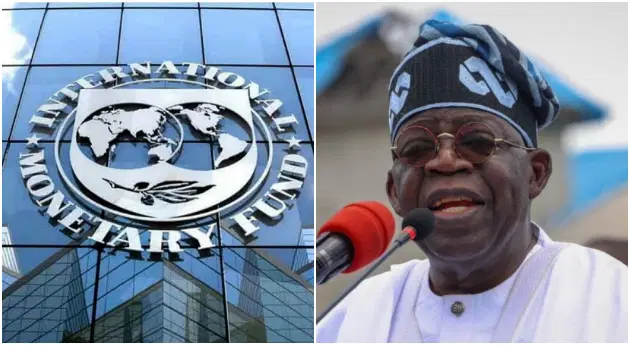
•IMF logo and Tinubu
When the International Monetary Fund (IMF) released its latest Article IV Consultation report on Nigeria last week, the tone was broadly optimistic but experts see deeper pain across the country.
The IMF’s prescription, according to the analysts, reads more like a recipe for prolonged hardship, reports The Guardian.
The Fund praised the federal government’s “bold” economic reforms, including the removal of costly fuel subsidies, the unification of the exchange rate system, and aggressive interest rate hikes to rein in inflation.
It projected GDP growth of 3.4 percent in 2025, the same as in 2024, describing the outlook as one of “durable” recovery if reforms are sustained.
But for many economists and policy experts, the IMF seems not to be aware of the embedded hardship across the country.
From professors and former policymakers to labour unions and civil society groups, a chorus of critics has emerged to question the Fund’s optimism, warning of social unrest, and demanding a more balanced strategy that addresses poverty and inequality.
As Nigeria grapples with runaway food inflation, anaemic industrial growth, and widespread insecurity, the debate is no longer about whether reforms are necessary—but whether the IMF’s approach is socially and politically sustainable.
A Country In The Middle Of Tough Reforms
Nigeria’s 2023–2024 reform wave is the most aggressive in decades. President Bola Tinubu’s administration ended the longstanding fuel subsidy in mid-2023, freeing up trillions of naira in fiscal savings but triggering immediate transport and food price surges.
The Central Bank of Nigeria (CBN) also allowed the naira to float more freely, ending a multi-tiered, corruption-prone exchange-rate system.
The naira swiftly lost value, pushing up the cost of imported goods. At the same time, the CBN raised its Monetary Policy Rate (MPR) repeatedly—from 18.75% in 2023 to 30.75% by mid-2025—to fight inflation now hovering between 23% and 26%.
For the IMF, these were overdue corrections. Its 2025 report praised Nigerian authorities for “bold and politically difficult reforms” that have improved fiscal transparency and laid the groundwork for macroeconomic stability.
It also backed President Bola Tinubu’s plans to broaden the tax base, tighten public sector wage spending, introduce excise taxes, and ramp up social assistance to offset the impact on the poorest Nigerians.
Analysts Speak
Not all of the IMF’s recommendations are controversial. Economists across the spectrum agree that Nigeria needs to improve tax collection (just 7.5% of GDP in 2024) and better manage public finances.
But some of the IMF’s other recommendations have drawn sharp rebukes.
Professor Uche Uwaleke, a prominent economist at Nasarawa State University and former Imo State Finance Commissioner, is among those who bared their minds on the latest IMF staff report.
“Some parts of the IMF’s advice are good,” he says. “We should accept them. Things like better revenue mobilisation, transparent forex management, crypto regulation, adoption of International Public Sector Accounting Standards (IPSAS) — all of those are helpful.
“But there are aspects we must reject,” he insists.
Uwaleke zeroes in on two main issues: the IMF’s push for the complete removal of fuel and electricity subsidies, and its support for continued aggressive monetary tightening.
Tight Money, Shrinking Growth
Since 2023, the CBN has pursued some of the tightest monetary policies in Nigerian history. The logic is straightforward: inflation is stubbornly high, and only by raising interest rates can demand be cooled and the naira stabilised.
But Uwaleke argues that this strategy has real economic costs.
“Look at the data,” he says. “Agricultural growth in Q1 2024 was barely 0.18 percent. Food inflation is over 40 percent. Manufacturing is struggling with high borrowing costs.”
He warns that if the MPR keeps rising, small businesses and farmers will be priced out of credit markets entirely, stalling production and undermining food security.
The IMF acknowledges these risks in its report but frames them as necessary short-term pain for long-term gain. Critics see the balance differently.
Beyond monetary policy, several Nigerian economists have cast doubt on the IMF’s forecast of 3.4% GDP growth for 2025.
Dr. Marcel Okeke, former Chief Economist of Zenith Bank, calls the Fund’s projection “unrealistic.”
“We have huge debt servicing costs, inflation that’s still far too high, and revenue reforms that have not yet delivered,” he argues.
“Where is the growth supposed to come from? Manufacturing is in recession. Agriculture is stagnant. The informal sector is under huge stress.”
Professor Ndubisi Nwokoma of the University of Lagos echoes these concerns. In an interview, he said that the IMF was focusing too much on macro stability and ignoring the lived experience of ordinary Nigerians.
“How can you have inclusive growth when poverty is rising and people’s purchasing power is collapsing?” Nwokoma asked. “What the IMF calls reforms, many Nigerians experience as suffering.”
These criticisms are not unique to Nigeria. Across Africa, IMF-supported austerity measures have faced a fierce backlash in recent years.
In 2024, Kenya was rocked by mass protests over new taxes introduced as part of an IMF-backed plan to reduce deficits. Riots forced the government to scrap the most controversial measures.
Civil society groups and labour unions in Nigeria have repeatedly cited Kenya as a cautionary tale. They warn that pushing too hard on subsidy removal without credible social safety nets will lead to similar unrest.
Indeed, Nigeria has already seen waves of strikes and protests since the subsidy was scrapped in 2023. Though the government has announced conditional cash transfers to the poorest households, implementation has been patchy and funding limited.
IMF’s Defence: No Pain-Free Fix
For its part, the IMF does not deny the social costs. Its report explicitly notes that reforms have driven up inflation and squeezed real incomes.
But the Fund’s economists argue that the alternative — a return to fuel subsidies and forex rationing — is worse.
They warn that subsidies were draining government coffers without delivering real development, and that Nigeria’s multiple exchange rates fostered corruption while scaring away investment.
Their position: only by accepting short-term pain can Nigeria stabilise its finances, unlock investment, and build the fiscal space to support the poor more sustainably.
The IMF has urged the government to scale up targeted social spending, including direct cash transfers, school feeding programmes, and health subsidies, to cushion the blow on the most vulnerable.
Social Safety Nets: Too Little, Too Late?
This is where even more moderate Nigerian analysts see trouble.
Uwaleke argues that Nigeria’s social transfer programmes are too small and too inconsistently delivered to truly protect the poor.
“When you remove subsidies and let prices rise without robust social buffers, you’re simply shifting the burden onto the most vulnerable,” he says.
Nigeria’s federal budget for social transfers remains small relative to its population. Critics warn that unless these programmes are rapidly expanded and better targeted, the gains from subsidy savings will be politically unsustainable.
Policy Crossroads
What emerges from the debate is not that Nigeria should abandon reforms, but that it must get the sequencing right.
Most economists agree that fuel subsidies were fiscally ruinous and had to go. But they argue that without credible safety nets and real sector support — especially for agriculture and small industry— the reforms risk stalling or being reversed under social and political pressure.
Similarly, while exchange-rate unification was necessary to restore credibility, critics say the government must move quickly to boost forex earnings through non-oil exports and reduce the economy’s dependence on imports.
And while high interest rates may be necessary to control inflation, analysts warn they must be balanced with measures to support production, or risk deepening stagflation.
A Fragile Recovery
The IMF’s Article IV report describes Nigeria’s outlook as one of “durable” recovery, if the reforms are seen through. But it also warns of significant downside risks: persistent inflation, weak oil production, insecurity, and the threat of social unrest.
Significantly, critics believe those risks are understated.
For them, Nigeria’s reform path remains a high-wire act.
Stephen Iloba, an economist, believes that the challenge is to maintain fiscal discipline and restore investor confidence —without sacrificing social cohesion or pushing millions deeper into poverty.
In the end, Iloba said, “The debate over the IMF’s advice is not about rejecting reform, but about getting it right”.
According to Uwaleke, “Reforms are essential. But they must be Nigerian solutions for Nigerian problems—not just textbook IMF prescriptions. Otherwise, the cure may be worse than the disease.”