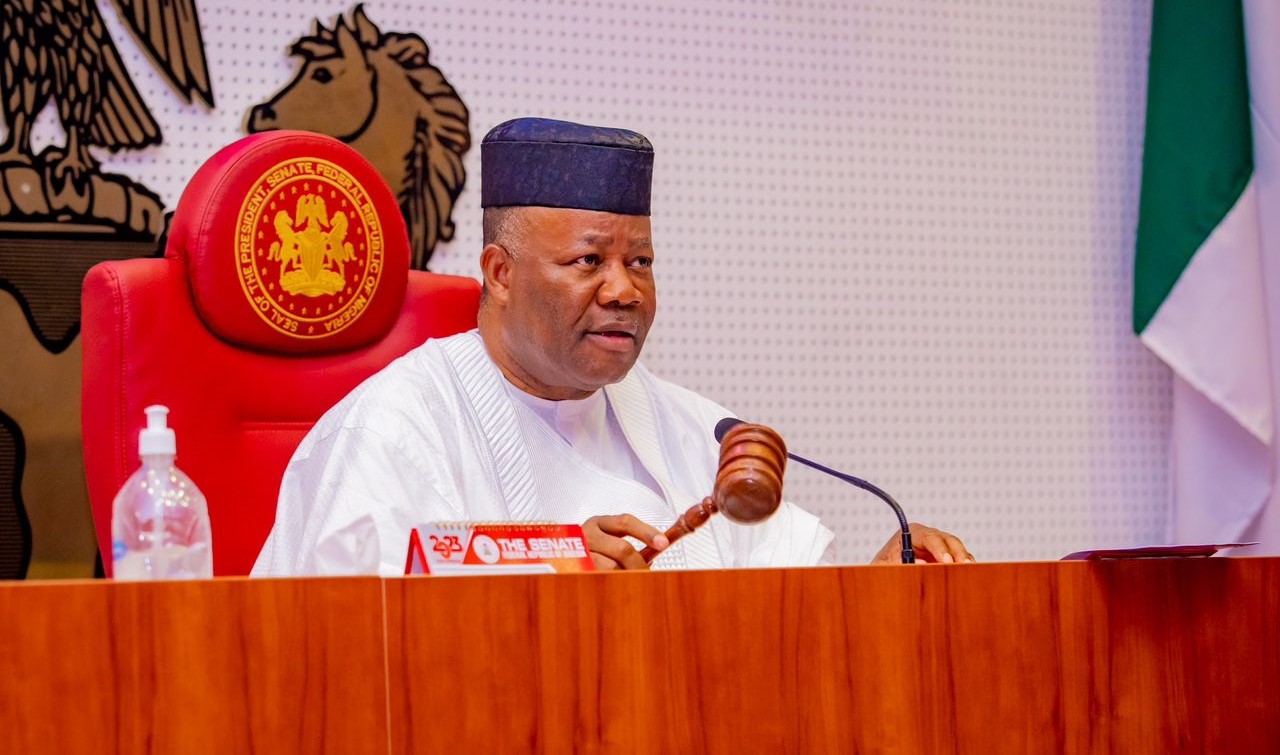
•Senate President Godswill Akpabio
To inquire — often with a faint hint of derision — about the legacy Senator Godswill Akpabio may bequeath as President of Nigeria’s Tenth Senate is to display a troubling indifference to recent legislative history.
The record is neither obscure nor equivocal. Under his stewardship, the Senate has passed more than 90 bills, with over 58 already receiving presidential assent.
That is not a statistic easily waved away, even by the most committed cynics. You are invited to verify these figures and raise the alarm if they prove to be anything less than accurate.
If the question arises from ignorance rather than malice, then this serves as an opportune moment to elucidate the record. After all, this record speaks clearly enough for itself, requiring no embellishment; only acknowledgment.
For citizens fatigued by grandstanding and hungry for facts, here are eleven key achievements that withstand serious scrutiny. Taken together, they reveal a Senate not merely passing time in office, but deliberately shaping a consequential and enduring legacy.
1. Refining the Legal Framework Governing Elections
With the recent passage of the Electoral Act (Amendment) Bill, 2025, the catalogue of landmark laws passed by the Tenth Senate has once again escalated. This seminal piece of legislation directly addresses critical areas for improvement in Nigeria’s democratic process, introducing provisions that enhance the transparency of result management and the credibility of party primaries.
By refining the legal framework governing elections, the Senate has moved beyond reactive patchworks to proactively strengthen the very foundation upon which representative governance rests. It is a declaration that the health of Nigeria’s democracy is a permanent and urgent legislative priority.
As evidenced by that recently amended law, the Tenth Senate has been conspicuously industrious, legislating with intent. Always with an unwavering focus on the intricate machinery of the state.
2. Restoring Budgetary Sanity and Scale
Perhaps the most understated yet consequential achievement of the Akpabio-led Senate is the restoration of fiscal order.
By timely passing the 2024 and 2025 budgets and re-establishing Nigeria’s adherence to a January-to-December budget cycle, the Senate has reinstated a foundational discipline of governance. This is not mere clerical neatness; it is an economic signal. Investors plan according to calendars, not excuses. Ministries execute when timelines are predictable. The ₦49.7 trillion 2025 budget, a bold leap in scale, reflects a state that has finally acknowledged the magnitude of its challenges and responded with proportionate ambition.
One may debate the figures, but seriousness has returned to the process. It is the sound of a heavy door being firmly shut on an era of chronic postponement.
3. Ministerial Screenings with Teeth
Gone are the days when ministerial confirmations resembled ceremonial nods, rituals of handshakes and rehearsed platitudes.
Under this Senate, screenings have transformed into substantive engagements. Nominees are rigorously questioned on their vision, coherence, and the intricate mechanics of delivery. Policy literacy has become paramount. Track records are scrutinized, not merely recounted. The message is straightforward and long overdue: holding an office is not synonymous with understanding it.
From the outset, the Senate has asserted that executive authority must be accompanied by intellectual heft, not merely political credentials.
4. Legislating for a Modern Economy
To be unequivocally clear, the Tenth Senate has exhibited a refreshing zeal for structural reform. The Electricity Act Amendment, which enhances decentralization in power generation and distribution, directly addresses one of Nigeria’s most obstinate growth constraints. Alongside it are the Nigeria Tax Act and the Data Protection Act, measures that modernize fiscal administration and safeguard the digital economy. These are not ostentatious laws; they are load-bearing beams for a twenty-first-century economy striving to transcend oil dependency, improvisation, and the dense administrative fog that has long impeded progress.
5. A Proactive Security Posture
Security has not merely been treated as a rhetorical device but as a legislative obligation. Through focused committee work, national security dialogues, and laws such as the Control of Small Arms and Light Weapons Act, the Senate has targeted the supply lines of insecurity.
The Defence Industries Corporation Modernisation Act signifies a deeper shift: a transition from perpetual dependence to long-term self-reliance. It represents the distinction between reacting to threats and cultivating the capacity to deter them. A subtle yet vital recalibration.
6. Embracing the Constitutional Moment
If history proves benevolent, the ongoing constitutional review process may define this Senate more profoundly than any single bill. By reopening fundamental discussions on state policing, fiscal federalism, and local government autonomy, the legislature has chosen arduous work over comfortable evasions. These are not mere academic exercises; they are the unresolved dilemmas at the heart of Nigeria’s chronic instability. To engage them earnestly is to accept that nation-building is often profoundly uncomfortable before it becomes rewarding.
7. Institutionalising the Anti-Corruption Fight
This Senate appears to grasp, instinctively, that corruption is not vanquished by outrage but by design. By fortifying legal frameworks through reforms such as the Fiscal Responsibility and Transparency Act and the Police Professionalism and Accountability Act, it has concentrated on systems rather than slogans.
The objective is unglamorous yet effective: to embed integrity into procurement, budgeting, and law enforcement itself, thereby depriving corruption of its hiding places.
8. Fiscal Stewardship in an Age of Debt
Borrowing requests have proliferated. The Senate’s response has been neither blind obstruction nor rubber-stamp approval. Instead, it has exercised scrutiny, conditionality, and a persistent demand for value.
This is the delicate art of co-governance: supporting the executive when warranted, pushing back when prudent, and repeatedly posing the often-unfashionable question of sustainability. It is not dramatic work; it is the patient, responsible labor of trusteeship.
9. Legislating for the Human Dimension
Amid grand macroeconomic recalibration, the Senate has maintained a focus on the citizenry.
The Student Loans Act expands access to higher education at a time when household incomes are under severe strain. The National Minimum Wage Increase Act is a direct legislative acknowledgment of the dignity of labor in an inflation-ravaged economy. These are not silver bullets; however, they represent deliberate attempts to soften the sharpest edges of hardship and to invest in people, still Nigeria’s most abundant and renewable resource.
10. Infrastructure as a Legislative Priority
By prioritizing approvals, oversight, and enabling legislation for major infrastructure projects, particularly in power and defense, the Senate has regarded infrastructure not as executive indulgence but as a national imperative. Roads, energy grids, and security assets do not merely consume budgets; they generate employment, unlock productivity, and stabilize communities. The Senate’s role in facilitating these pathways is not peripheral; it is central.
11. The Quiet Power of Stable Leadership
Perhaps the most underrated achievement is the institutional stability itself. Akpabio’s instinct for realpolitik, coupled with his understanding of the intricate calculus of regional and political balance, has fostered a chamber that debates, negotiates, and ultimately functions.
In a political climate where friction frequently devolves into paralysis, this relative consensus has served as the essential lubricant in the engine. It may not be glamorous, but it is, quite simply, indispensable.
A Legacy Forged in the Work of the Possible
Senator Godswill Akpabio is not given to lyricism about politics. He is, rather, a consolidator—an institutional mechanic with a reformer’s appetite—who understands that in a sprawling and argumentative democracy such as Nigeria, progress is rarely the offspring of moral exhibitionism.
It is more often the product of negotiation, arithmetic, persuasion, and, when necessary, unsentimental compromise.
Purists, who prefer the hygiene of opposition to the burdens of responsibility, may call this duplicity. Those acquainted with governance call it reality.
The distance between statute books and village squares remains stubbornly wide. Hunger has not been legislated out of existence. Insecurity has not been adjourned sine die.
The proof of any Senate’s seriousness lies not in the eloquence of its debates but in the execution of its enactments — in whether ink becomes infrastructure, whether clauses become commerce, whether appropriations become actualities.
Dismissing this Senate as irrelevant, however, requires ignoring the instruments it has deliberately fashioned and set within reach. Laws do not implement themselves; they require administrative will and bureaucratic competence across the vast machinery of the state.
What the Tenth Senate, under Akpabio, has supplied — swiftly and with focus — is architecture. At a time when institutional paralysis is too often mistaken for normalcy, it has chosen to function. That decision, prosaic though it may sound, is no small achievement in a political culture where dysfunction can masquerade as authenticity.
As 2027 approaches, bringing with it the predictable turbulence of democratic contestation, the Akpabio-led Senate deserves assessment by the cold metrics of substance rather than the warm currents of sentiment. Nations are not constructed by vibes, nor sustained by viral indignation.
They are built incrementally — by statutes, by procedures, by institutions that confront disorder and, stubbornly, insist on operating. In an era when Nigeria has too frequently flirted with drift, the deliberate choice to govern— to keep the constitutional machinery moving — may prove to be not merely a legacy, but the indispensable precondition for any legacy at all.
*Rt Hon Eseme Eyiboh mnipr, is the Special Adviser on Media/Publicity and official Spokesperson to the President of the Senate