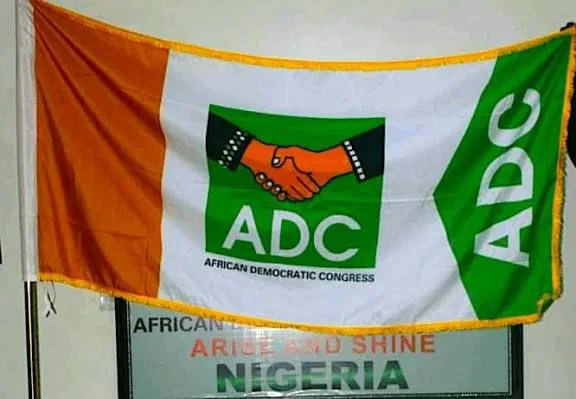
The African Democratic Congress (ADC) has raised the alarm and dismissed the newly unveiled election timetable by the Independent National Electoral Commission (INEC), saying that by the time the clock runs out in early April 2026, many opposition parties may already be out of the race.
Rather than a neutral administrative schedule, the party argues that the revised calendar is a calculated political device —one that could compress the democratic space and tilt the contest ahead of the 2027 general elections in favour of incumbency, reports Daily Independent.
At the heart of the dispute lies a stringent compliance window tied to the Electoral Act 2026. While party primaries are slated between April 23 and May 30, 2026, the more immediate hurdle is the April 2 deadline for submission of digital membership registers—a requirement the ADC insists is both excessive and exclusionary.

ADC, in a statement today in Abuja by its National Publicity Secretary, Bolaji Abdullahi, warned that the timeline effectively erects a barrier that many opposition platforms may be unable to scale before the window shuts.
The ADC maintains that the conditions attached to Sections 77 and 82 of the Electoral Act 2026 place disproportionate pressure on non-ruling parties, while inadvertently favouring those already entrenched in power. It argues that what is presented as reform risks functioning as a filter—screening out competitors before the contest even begins.
The statement read: “The African Democratic Congress (ADC) rejects the updated 2026–2027 electoral timetable released by the Independent National Electoral Commission (INEC). What has been presented as a routine administrative schedule of the upcoming general elections is, in fact, a political instrument carefully structured to narrow democratic space and strengthen the hand of the incumbent administration ahead of the 2027 general elections.
“According to the timetable, party primaries are to be conducted between 23 April and 30 May 2026, just 55 to 92 days from today. However, what is more significant is that pursuant to Section 77(4) of the Electoral Act 2026, political parties are required to submit their digital membership registers to INEC not later than 2 April 2026. That is only 34 days away. Section 77(7) further provides that any party that fails to submit its membership register within the stipulated time “shall not be eligible to field a candidate for that election.” These are not housekeeping rules. They are deliberately constructed barriers to exclude opposition from partaking in the coming election.
“It is significant to note also that Section 77(2) of the Electoral Act 2026 prescribes that the digital register of members must contain their name, sex, date of birth, address, state, local government, ward, polling unit, National Identification Number (NIN), and photograph in both hard and soft copies, while Section 77(6) prohibits the use of any pre-existing register other than the one that contains the specific information above. According to this law, failure to meet these requirements would result in disqualification.
“What makes this requirement of digital membership particularly insidious is that the ruling party had commenced the process of this registration since February 2025, long before it became a requirement of the law. This is not a product of foresight, but insider knowledge. They knew what was coming. They therefore had one whole year to carry out an exercise that they expect other political parties to execute in one month, during which they must collect, process and collate vast digital data and transmit the same to INEC by the deadline under the threat of total exclusion. This is more or less a practical impossibility.
“Democratic competition is based on a level-playing field that does not give any advantage to the contestants. A system where one party takes advantage of incumbency to give itself a one-year head-start on a requirement that other parties only became aware of when it is almost too late is a rigged and corrupt system.
“The ADC has joined other opposition political parties to reject the corrupted Electoral Act 2026. This INEC time-table, which is based on the said law, therefore, stands equally rejected for the same reason that, put together, they appear designed to serve President Tinubu’s automatic self-succession project.
“Let it be clear: ADC will not do anything that will appear to confer legitimacy on a fraudulent system. We are reviewing our options and will make this known in the coming days.
“We call on civil society, democratic stakeholders, and patriotic Nigerians across party lines to scrutinise this timetable and join us in demanding fairness, because no democracy can endure if the rules that govern it are written to suit pre-determined outcomes.”
Beyond the rhetoric, the ADC’s central claim is that the compressed timeline, combined with expansive data requirements—ranging from biometric details to National Identification Numbers—creates a logistical mountain for parties without state-backed infrastructure.
The party further alleges that the ruling establishment had a significant head start, having begun aligning with the digital registration demands as far back as early 2025 — well before such provisions became binding law. To the ADC, this is less coincidence and more calculated advantage.
“In its framing, the controversy is not merely about deadlines, but about the integrity of competition itself. If the rules of entry, it argues, are structured in a way that only a few can comply within the timeframe, then the election risks becoming a formality rather than a contest,” the party said.
As political temperatures slowly rise ahead of 2027, the ADC says it is weighing its next steps — hinting at possible collective action with other opposition forces — while urging Nigerians and civil society groups to interrogate what it describes as a creeping erosion of electoral fairness.