

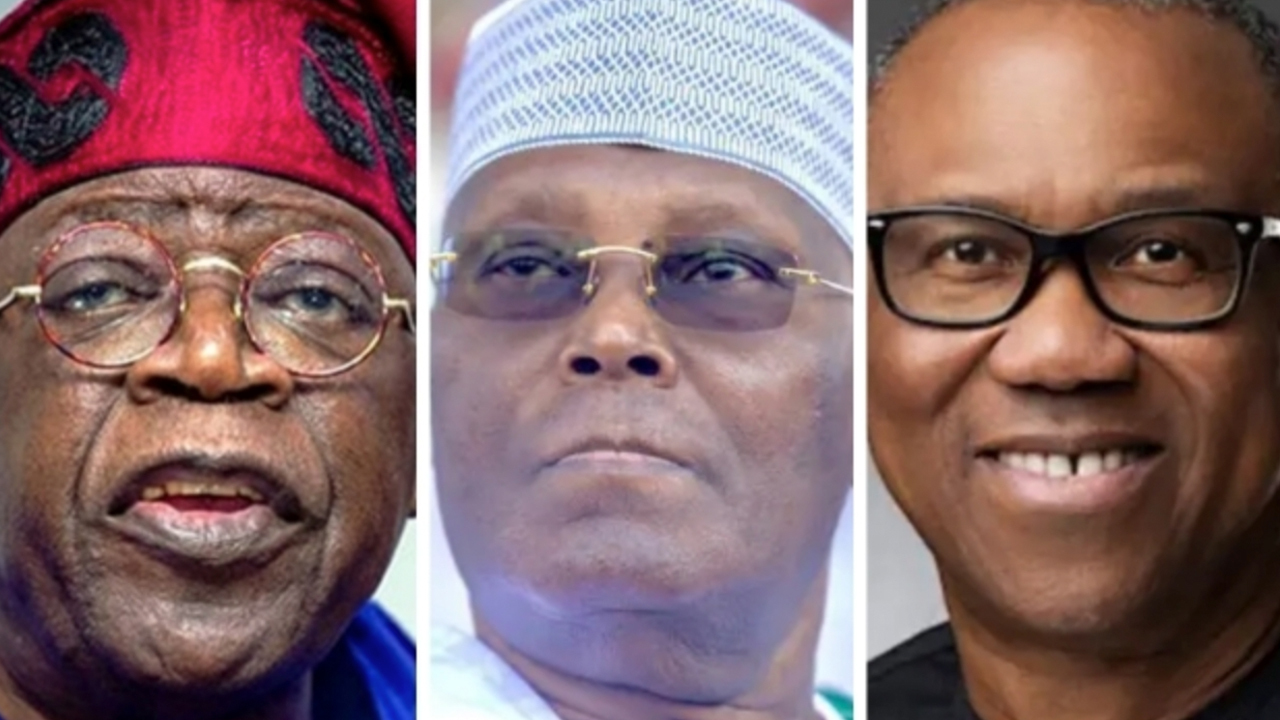
•Tinubu, Atiku, Obi
Nigeria’s political engine has shifted into a higher gear. With the 2027 general elections five months away, presidential candidates are stepping onto the campaign trail, taking their messages to voters and setting the stage for another closely watched contest for the country’s highest office.
No fewer than 146 candidates are expected to contest various executive and legislative positions across the states and the Federal Capital Territory, while President Bola Tinubu prepares to defend his mandate against 19 presidential contenders.
But beneath the rallies, political alliances and campaign promises lies a more fundamental question: what issues will ultimately determine how Nigerians vote?, reports Channels TV.
For many, the answer begins with the economy.
“The economy is the biggest issue. That’s the one thing that cuts across different parts of the country, and it continues to affect security and development concerns,” said Afolabi Adekaiyaoja, author of Nigeria politics newsletter The Bellwether.
Since taking office in 2023, Tinubu has pursued far-reaching economic reforms, most notably the removal of the fuel subsidy, a policy that had long kept petrol prices artificially low. The reforms have earned praise from economists and investors but have also brought significant hardship for households, as the naira weakened and inflation climbed to 34 per cent.
Headline inflation has since cooled to 15.4 per cent in July, but the pressure on household budgets remains a defining feature of the political conversation.
Poverty, meanwhile, continues to weigh heavily on millions of Nigerians. More than 60 per cent of the population now lives below the poverty line, according to the World Bank, compared with 40 per cent in 2019.
Security is another major concern. Violence has intensified since 2024, with banditry spreading across northern and central Nigeria and conflict increasing in Borno State, the centre of the country’s jihadist insurgency.
Ladd Serwat, senior Africa analyst at conflict monitor ACLED, described the trend as being “driven by the spread and intensification of armed banditry across northern and central Nigeria” and increased conflict in Borno State, the heart of the jihadist insurgency.
For the opposition, the challenge is not simply to defeat an incumbent but to convince voters that it offers a compelling alternative.
“The opposition has been too mired in internal and legal issues to really articulate a difference” between their policies and Tinubu’s, said Adekaiyaoja.
For some voters, however, the choice is already becoming clearer.
“The most important issues for me are the economy and cost of living,” said civil servant Afolayan Abdullahi, 42, who said he intended to vote for Tinubu.
2023 Rematch
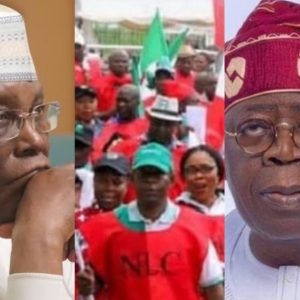
The 2027 presidential contest is already carrying the echoes of 2023, with Tinubu, Atiku Abubakar and Peter Obi once again emerging as central figures in the battle for Nigeria’s presidency.
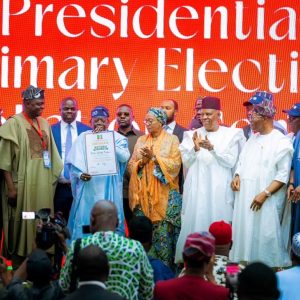
On May 24, 2026, Tinubu secured the presidential ticket of the All Progressives Congress (APC), following a landslide victory in the party’s nationwide direct presidential primary held on Saturday, May 23, 2026. He received a total number of 10,999,162 votes, while his only challenger, Mr. Stanley Osifo, received a total of 16,503 votes.
Also in May, former Vice President Atiku Abubakar was declared the winner of the presidential primary of the African Democratic Congress (ADC), after polling 1,846,370 votes to beat his closest rival, former Rivers State governor Rotimi Amaechi (now his running mate), who polled 504,117 votes.
Similarly, the Nigeria Democratic Congress (NDC) unveiled former Anambra State governor Peter Obi as its presidential candidate for the 2027 general elections.
Tinubu, regarded as one of Nigeria’s most experienced political strategists, enters the contest with his APC controlling the National Assembly and 31 of the country’s 36 states.
The January 16 poll will, in part, revisit the political battle of 2023, when Tinubu defeated Atiku and Obi with 36.6 per cent of the vote. Atiku secured 29 per cent, while Obi polled 25 per cent.
Rabiu Kwankwaso, who garnered about six per cent in the previous election, has now teamed up with Obi as his running mate, adding another layer to an already shifting political landscape.
Yet for many Nigerians, the decision to vote may begin with something more basic than political allegiance: whether they feel safe enough to get to the polling unit.
Becky Alegbe, a 28-year-old street vendor in Abuja, cited quintupled transportation costs and concerns about vote buying that have tainted prior elections.
She is registered to vote in her home village in Edo state, but her hesitation reflects a wider challenge for the 2027 election. Turnout was just 27 per cent in 2023, leaving political parties with the task of not only persuading voters but getting them to the ballot box.
Tinubu, Atiku, Obi, Others Sign Peace Accord
Before the campaign season gathered momentum, leading political figures signed the National Peace Accord, setting an early tone for what promises to be a fiercely contested election.
President Tinubu, Obi, the presidential candidate of the African Action Congress (AAC), Omoyele Sowore, and the presidential candidate of the Peoples Redemption Party (PRP), Donald Duke, were among those who signed the accord on Tuesday.
The event, held at the Bola Ahmed Tinubu International Conference Centre in Abuja, brought together representatives of other presidential candidates, governorship and National Assembly contestants, political party leaders, INEC National Chairman Joash Amupitan, Secretary to the Government of the Federation George Akume and other political figures.
Organised by the National Peace Committee (NPC), the event marked the first phase of the peace initiative, with a second phase scheduled to take place after the 2027 polls.
The accord provides a framework for peaceful political engagement as the country heads towards the January and February elections.
Before the gathering began, Obi called for an electoral process in which Nigerians could have confidence that their votes would count.
Obi Seeks Credible Polls
To ensure a peaceful exercise, the NDC presidential candidate asked Nigerians not to cast their ballots for anyone or any party that violates the tenets of the accord.
“I don’t have any fear (going into next year’s election) except to say that, please, for the sake of the children of Nigeria, can we have an election where people’s votes will count?” the former Anambra State governor said.
“Well, the punishment is that Nigerians should not vote for them,” he noted when asked what the punishment should be for those who violate the agreement.
He asked contestants to “be exemplary” in their conduct as the general elections inch closer.
“You can’t answer ‘His Excellency’ without being an excellent person,” Obi, 65, said. “So, the process that will make you answer ‘His Excellency’ should be excellent, and the only way to do it is to conduct yourself properly.”
Representing President Tinubu at the ceremony, Akume praised the leadership of the National Peace Committee, including former Head of State Abdulsalami Abubakar, Sultan of Sokoto Muhammad Sa’ad Abubakar and Bishop Matthew Hassan Kukah, for sustaining the initiative since 2014.
Tinubu also highlighted technological advances in Nigeria’s electoral system, particularly the Bimodal Voter Accreditation System (BVAS), which he said has eliminated ballot stuffing and restored power to voters.
He cited the off-cycle elections in Anambra, Osun and Ekiti as evidence of greater transparency in Nigeria’s electoral process.
“Different parties won them, and local and foreign observers described them as free, credible, and transparent. When the process and outcome are manifestly transparent, we see less post-election litigation in our courts,” he said, adding that “politicians are now more accountable to the people because votes count.”
Campaigns for National Assembly elections have also begun, while those for governorship and state legislative elections are scheduled to start on September 9.
But with the campaign season now underway, Nigeria’s political landscape is set for months of rallies, debates, alliances and competing visions. But when the noise eventually gives way to the ballot, the most important campaign will belong to the voters — and the future they choose to shape.