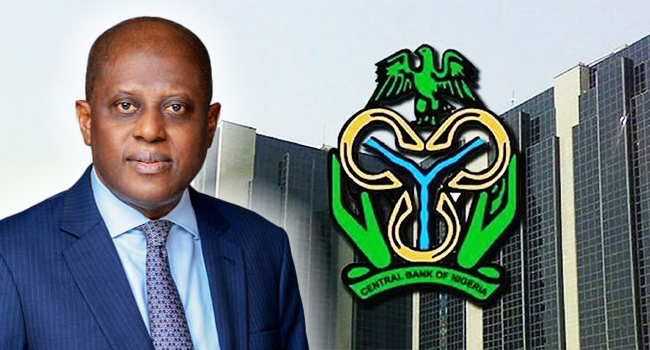
•CBN Governor Olayemi Cardoso
The Central Bank of Nigeria (CBN) has directed banks, fintech firms, mobile money operators and other payment service providers to store all payment transaction data generated within Nigeria on local servers.
It set January 1, 2027 timeline for compliance. The directive is part of a broader regulatory push to strengthen oversight, improve transparency and reduce concentration risks in the country’s fast-growing digital payments ecosystem, reports The Nation.

The apex bank also launched the Nigerian Overnight Financing Rate (NOFR), a major financial market reform aimed at strengthening monetary policy transmission, deepening financial markets, improving transparency in loan pricing, and boosting investor confidence yesterday in Abuja.
A circular issued by the apex bank yesterday and signed by the Director of the Payments System Supervision Department, Rakiya O. Yusuf, said all financial institutions and payment system participants facilitating transactions in Nigeria must ensure that payment transaction data generated within the country are stored and managed locally.
The move also aligns with Nigerian data protection laws and regulations.
The move is expected to have significant implications for banks, fintech companies, payment processors and other digital finance operators that currently rely on foreign data infrastructure for parts of their operations.
It said: “All Financial Institutions and participants facilitating payments within Nigeria shall ensure that payments transaction data generated within Nigeria are stored and managed in Nigeria in accordance with data protection laws and regulations applicable in Nigeria. Accordingly, all affected Financial Institutions shall fully comply with this requirement effective January 1, 2027.”
According to the CBN, the new measures were introduced following significant structural changes in Nigeria’s payments landscape, driven by rapid growth in electronic transactions, increased adoption of digital financial services and the emergence of dominant operators across key payment segments.
According to the CBN, while these developments have improved financial inclusion and innovation, they have also created concerns around market concentration, operational dependence on external infrastructure, ownership transparency and the location of critical payment data.
“The CBN has observed significant structural developments within the Nigerian Payments ecosystem, characterised by rapid growth in electronic payments, increasing adoption of digital financial services, and the emergence of operators with substantial market presence across key payment activities,” the circular stated.
The regulator added that localising payment data would help safeguard the integrity of the financial system while ensuring that critical transaction records remain within Nigeria’s jurisdiction.
The regulator directed deposit money banks, payment service providers and other financial institutions with digital payment operations to disclose the Ultimate Beneficial Ownership (UBO) of significant shareholders in line with existing anti-money laundering and counter-terrorism financing regulations.
Institutions are also required to maintain accurate and up-to-date UBO records and make them available to the apex bank upon request.
The measure is designed to improve transparency within the financial system and strengthen efforts to combat illicit financial flows, money laundering and the use of complex ownership structures to conceal control of regulated entities.
The CBN said the circular seeks to improve transparency through beneficial ownership disclosure while promoting a more resilient payments ecosystem.
The apex bank also introduced measures aimed at preventing excessive market concentration in key segments of the payments industry.
Under the new framework, any financial institution that controls more than 25 per cent of the card issuing market within a rolling 12-month period will be prohibited from holding more than 15 per cent market share in merchant acquiring activities during the same period.
Speaking at the launch of NOFR in Abuja, the Governor of the CBN, Mr. Olayemi Cardoso, described the new benchmark as a foundational reform that would help build a more resilient, efficient and credible financial system capable of supporting sustainable economic growth.
A key objective of the initiative, according to Cardoso, is to improve the transmission of monetary policy decisions across the economy so that actions taken by the apex bank are more effectively reflected in borrowing costs and financial market conditions.
In practical terms, NOFR is expected to narrow the gap between the benchmark interest rate set by the CBN’s Monetary Policy Committee (MPC) and the actual interest rates paid by businesses and households when borrowing from banks.
Under the current system, changes in the Monetary Policy Rate (MPR) do not always translate quickly or fully into lending rates across the banking sector due to weaknesses in the transmission mechanism and the absence of a robust market benchmark.
With the introduction of NOFR, market participants expect stronger linkages between monetary policy decisions, money market conditions, banks’ funding costs and lending rates, making monetary policy more effective.
“What we are attempting to do here is to ensure that we have a more effective monetary policy transmission mechanism supporting the delivery of the price stability mandate of the CBN. This is very, very critical. This is very important to highlight,” Cardoso said.
He explained that an efficient transmission mechanism is essential to the CBN’s ability to control inflation and maintain price stability.
According to the governor, without an effective transmission system, monetary policy actions may fail to achieve their intended objectives in the economy.
Cardoso recalled that when the current CBN management assumed office, weaknesses in monetary policy transmission posed significant challenges to policy implementation.
“I recall that when we first took office, one of the issues that we were challenged with at the time was the hosting of the MPC,” he said.
He noted that simply convening Monetary Policy Committee meetings without fixing underlying structural weaknesses in the financial system would not have produced the desired outcomes.
The governor explained that benchmark interest rates are central to modern financial systems because they represent the true price of money at a given point in time and serve as reference points for pricing financial instruments, managing liquidity and risk, and transmitting monetary policy decisions.
He said a benchmark can only gain widespread acceptance if it emerges from a transparent, trusted and well-governed framework protected against manipulation.
According to Cardoso, recent global reforms have prompted financial markets around the world to move away from judgment-based rates toward transaction-based benchmarks that reflect actual market activity.
He disclosed that the CBN developed NOFR in collaboration with the Financial Markets Dealers Association (FMDA) and with technical support from the European Bank for Reconstruction and Development (EBRD).
The governor explained that NOFR is designed as a transaction-based overnight secured interbank financing rate that reflects the true cost of overnight funding in Nigeria’s money market.
By relying on actual market transactions rather than estimates or submissions, he said NOFR enhances market integrity and credibility, reduces manipulation risks, improves price discovery and strengthens transparency.
“This is a fundamental shift that aligns Nigeria with global best practices in benchmark rate reform and strengthens confidence in our financial markets,” Cardoso said.
Such a framework could provide customers with greater clarity regarding how borrowing costs are determined while allowing monetary policy decisions to flow more efficiently through the financial system.
The governor said stronger and more credible benchmarks ultimately lead to deeper financial markets.
“The result of all of that is a deepening of our financial markets. Markets get deeper when they are trusted and when they are credible,” he said.
Cardoso noted that the launch of NOFR forms part of a broader reform agenda aimed at laying stronger foundations for future financial innovation.
He observed that financial markets are becoming increasingly digital, interconnected and technology-driven, making it necessary for Nigeria to continually modernise its market infrastructure.
“The institutions we build today will determine our ability to compete tomorrow,” he said.
According to him, NOFR is not only about addressing present market needs but also about preparing Nigeria for future developments.
“Nobody wants to be left behind, and certainly we in Nigeria are not one of those that will be caught napping,” he stated.
Cardoso said the benchmark would support treasury and liquidity management operations, improve pricing of financial contracts and securities, facilitate the development of derivatives and structured products, and strengthen risk management practices.
He added that NOFR also lays the foundation for the future development of term benchmark rates and more sophisticated financial products needed for a deep and dynamic financial market.
For businesses and bank customers, the Governor said the adoption and continued evolution of NOFR would bring greater transparency to loan pricing in the banking system.
He added that the benchmark would also serve as a reference point for pricing wholesale and institutional deposits.
Cardoso expressed confidence that successful implementation of NOFR would reinforce both domestic and international investor confidence and contribute to sustainable economic growth.
He stressed that the future of Nigeria’s financial markets would depend not only on reforms but also on the collective commitment of stakeholders to ensure their success.
“The opportunities ahead are significant, and the responsibilities are equally significant. But if our journey thus far has demonstrated anything, it is that when we work together with purpose and conviction, transformational outcomes are possible,” he said.
The governor credited the progress made so far to collaboration among regulators, financial institutions, market infrastructure providers, industry associations and other stakeholders.
Cardoso maintained that sustainable market development cannot be achieved through regulation alone but requires strong partnerships across the financial ecosystem.
“The success of NOFR will depend not only on its design, but on its broad acceptance and consistent usage across the financial system,” he said.
He therefore urged all stakeholders to actively adopt and integrate NOFR into their operations.
The governor assured market participants that the apex bank remains committed to providing the guidance, governance oversight and stakeholder engagement necessary to ensure a smooth transition and sustained implementation of the new benchmark.
Also speaking at the event, the Deputy Governor, Economic Policy, Mr. Philip Ikeazor, described the launch of NOFR as an important milestone in the evolution of Nigeria’s financial markets.
He said the introduction of a credible market reference point represented not merely market reform but progress, modernisation and a commitment to building a stronger financial system for the future.
According to Ikeazor, Nigeria’s financial system has consistently demonstrated resilience by strengthening market infrastructure and regulatory frameworks despite periods of global and domestic uncertainty.
He said as global markets increasingly adopt transaction-based reference rates, Nigeria must position itself not merely to follow change but to help shape it.
The Deputy Governor noted that the launch of NOFR marks the beginning of another phase of market development that will require continued collaboration, market discipline and commitment from all stakeholders.
He called on market participants to remain actively engaged and contribute to the continued development of Nigeria’s financial markets.
In a goodwill message, Managing Director of Access Bank, Mr. Roosevelt Ogbonna, represented by the bank’s Treasurer, Mr. David Enilolobo, said the country’s financial markets had long relied on benchmark structures built on contributions rather than actual transactions.
“NOFR is that something more,” he said, describing the benchmark as a transaction-based, overnight, government-collateralised borrowing rate built on what the market actually did rather than what participants believed it should have done.
According to him, the distinction is foundational because it provides the market with a benchmark that can be defended through actual transactions.
He said stronger market structures attract capital, reduce cross-currency risks and provide offshore investors with benchmarks they can trust.
Ogbonna noted that Nigeria’s ambition to deepen its financial markets and strengthen its position in global capital flows cannot be achieved without robust market infrastructure such as NOFR.
He commended the CBN for driving the reform, praised the FMDA technical committee for its work on the framework, and acknowledged the EBRD for providing global expertise that accelerated the process.
Market analysts believe that while NOFR may not immediately reduce lending rates, it is expected to make loan pricing more transparent, improve policy effectiveness and create a stronger link between CBN policy decisions and borrowing costs over time.
The reform also places Nigeria alongside major global financial markets that have adopted transaction-based benchmark rates as part of efforts to strengthen market integrity and financial stability.