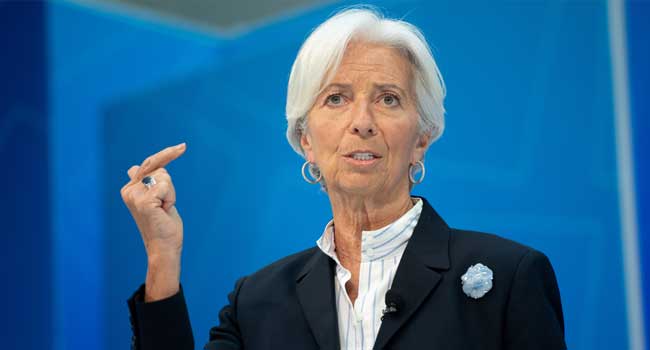
•Former IMF Managing Director Christine Lagarde
Monetary institutions worldwide need to maintain their independence, European Central Bank president and former International Monetary Fund Managing Director, Christine Lagarde, said today.
Speaking at a conference in Cambodia, she added that central banks in the developed world had lessons to learn from those in emerging markets, reports AFP.
Concerns over threats to central bank independence have risen as US President Donald Trump has put the Federal Reserve under public pressure to lower rates, lashing out at its former chief Jerome Powell and putting him under a criminal investigation that has since been dropped.
In Europe, ECB board member Isabel Schnabel warned this month that central banks were facing a “quiet erosion” of their independence as mounting government debt meant that lenders of last resort could come under pressure to keep rates low.
Speaking at a conference in Phnom Penh, Lagarde said, “the question is no longer simply how to guarantee independence” of central banks.
“It is how to protect it when it is put to the test,” she told an audience of francophone central bankers from parts of the world, including the Middle East and West Africa.
“Many of the central banks represented here today have long operated under structurally more challenging conditions,” Lagarde said.
“We have more to learn from your experience than the other way around,” she added. “You have long practised the work that has now become the task of all.”
The experience of the oil shock and stagflation of the 1970s had further shown that independence was “crucial”, Lagarde said, pointing to findings that showed countries with less independent central banks faced greater price growth.
“This evidence underscored the need to shield monetary policy decisions from the electoral cycle,” she said.
“To best serve the public interest, a central bank must be close enough to the state — but independent enough to resist the pressures of the moment,” she added.
Increasingly frequent economic shocks, as well as declining trust in public institutions such as central banks, threatened to weigh on their authority, Lagarde said.
“It is precisely when monetary policy decisions are politically fraught and economically costly that credibility is most needed,” she said.