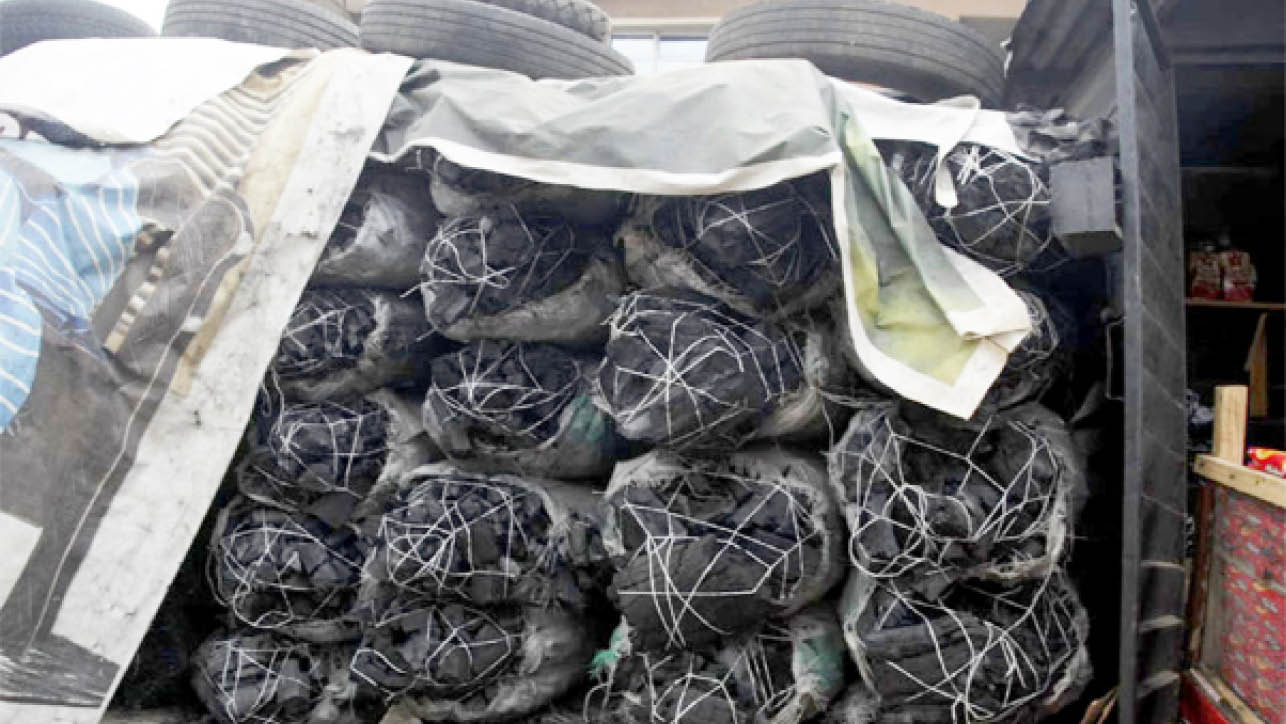
•Bags of charcoal
Many households now turn to charcoal, an alternative that is increasingly becoming expensive as demand grows.
Across several states, including Kaduna, Kano, Ondo, Kwara and the Federal Capital Territory (FCT, among others, residents say they are struggling to cope with the soaring cost of both cooking gas and charcoal.
Consumers and residents interviewed by our correspondents said they are left with limited options for meeting their daily cooking needs, reports Daily Trust.
A market survey in Ilorin, Kwara State, showed that the price of cooking gas has continued to rise amid reports of scarcity, while the cost of charcoal has also increased, putting additional pressure on households.
At Alkad Gas, a kilogramme of cooking gas sold for N1,700, while a 12.5kg cylinder refill cost N21,250.
Similarly, at AP Gas Plant, a kilogramme sold for N1,700 on Monday, up from N1,600 a day earlier.
A retailer, Mr Abdul Alhaji, attributed the increase to supply challenges and the impact of tensions in the Middle East on the market.
“We started around N920 before the Iran-US/Israel tension and since then, it has been increasing almost daily to the present N1,700 per kilogramme. The challenge is that nobody knows what the price will be tomorrow. There has also been a scarcity for about two weeks now, with some stations having product while others do not,” he said.
In Kaduna State, residents and charcoal sellers said the price of the porous carbon has increased significantly in recent weeks due to the growing demand and challenges associated with supply.
A charcoal trader in Sabon Gari, Muhammad Bala, explained that more households now rely on charcoal because cooking gas has become increasingly expensive.
According to him, a sack of charcoal that was previously sold for between N6,500 and N7,000 now costs around N8,000.
“The demand for charcoal has increased because many people can no longer afford to refill their gas cylinders regularly. As more people buy charcoal, the price has naturally gone up,” he said.
Bala noted that supply challenges have also contributed to the increase. He explained that charcoal producers are finding it more difficult to access forest areas due to insecurity.
“People who produce charcoal used to go deep into the forests to cut trees and process charcoal. Now, because of bandit attacks, many are afraid to enter those areas. They stay close to the edges of the forests, which limits production,” he explained.
He further stated that the rainy season is expected to worsen the situation. According to him, the thick vegetation that develops during the season makes forest activities more dangerous.
“When the grasses become tall, producers cannot easily see what is happening around them. They fear attacks and therefore avoid entering the forests. This could further reduce supply and push prices higher,” he added.
Bala warned that if the current trend continues, the price of a sack of charcoal could approach N10,000 in the coming months.
Residents count the cost
For many households, the increase in charcoal prices is creating additional financial pressure.
A resident of Malali East, Mrs. Halima Abdullahi, said she recently purchased a quarter bag of charcoal for N1,800, compared to N1,500 for the same quantity a few days earlier. She expressed concern that the price may soon exceed N2,000.
“Everything is becoming expensive. We switched to charcoal because gas became difficult to afford, but now the price of charcoal is also increasing. Nigerians are going through hard times. People are struggling every day. We can only continue to pray that things improve,” she added.
A similar trend is playing out in Ondo State, where traders reported increased patronage from residents seeking alternatives to cooking gas.
Mrs. Madeyese, a charcoal seller, said a bag of charcoal currently sells for about N8,500. For customers unable to afford a full bag, charcoal is also sold in smaller nylon packs costing about N300.
She disclosed that charcoal prices had started rising about three months ago.
“Before, we sold a bag for around N5,000. But about three months ago, the price rose to N8,000 even before gas prices increased significantly,” she said.
Despite the cost, she noted that demand remains high because many residents still consider charcoal more affordable than cooking gas.
Users endure tedious cooking
While charcoal may provide some financial relief, users say it comes with several disadvantages.
An Akure resident, Kayode Ibijobi, said cooking with charcoal can be stressful and time-consuming.
“You have to keep blowing air into the charcoal to make it burn properly. Sometimes you need nylon or paper to help start the fire quickly. You cannot be in a hurry when using charcoal. The process takes time. Sometimes I end up running late for work because I spend too much time trying to get the fire ready,” he explained.
Ibijobi noted that he was able to cope when a container of charcoal sold for around 1,400. “Now that the same quantity costs around 2,000, it is becoming harder to afford,” he lamented.
Another charcoal user, Mrs. Foluke Akindele, explained that charcoal cooking requires careful preparation and patience.
“You have to sit close to it and keep monitoring the fire. Everything you need for cooking must be arranged nearby because the process requires attention,” she noted.
Kano residents embrace charcoal
In Kano State, many residents also reported switching to charcoal due to the rising cost of cooking gas.
Abdullahi Hamisu, a resident of Dorayi, said he recently purchased a bag of charcoal for N8,000, compared to N7,000 previously.
“The cost of gas keeps rising. Many families now use charcoal because it is relatively cheaper and easier to manage,” he said.
Hamisu disclosed that his family now combines gas and charcoal to reduce expenses.
“My wife suggested that we start using charcoal alongside gas. This helps us reduce the amount spent on gas refills every month,” he said.
Another resident, Ladan Ado, said he recently purchased a half bag of charcoal for N4,000 to supplement cooking gas.
According to him, many residents in his neighbourhood have adopted a similar strategy.
“People are looking for ways to cope. A kilogram of gas now costs about N1,800, and filling a six-kilogram cylinder requires a substantial amount of money. That is why charcoal is becoming more popular,” he explained.
However, a charcoal trader, Salmanu Ali, maintained that although demand has increased considerably, prices have remained relatively stable in his area.
Abuja households face rising costs
In the Federal Capital Territory, residents say charcoal is no longer providing the financial relief it once offered.
Maryam Yusuf, a mother of three living in Garki, said she switched to charcoal after finding it increasingly difficult to afford cooking gas.
Initially, she believed charcoal would reduce household expenses, but recent price increases have changed that perception.
“A bag that used to cost around N6,000 is now close to N8,500. Feeding my family is becoming more difficult every day,” she said.
She called on authorities to take steps to address the rising cost of cooking energy.
Food vendors feel the heat
Chinedu Okafor, who operates a food business in Nyanya, said the charcoal price increase had affected his profit margins.
“I depend on charcoal for roasting and cooking. When prices increase, I either raise the cost of food or absorb the losses,” he explained.
According to him, customers have already begun complaining about higher food prices.
“Not long ago, charcoal was still affordable. Now it costs over 8,500 per bag, making business more difficult,” he said.
Aisha Bello, a grilled fish seller in Kubwa, echoed similar concerns.
“Charcoal became our lifeline when gas became too expensive. Unfortunately, it (charcoal) is now becoming unaffordable as well,” she lamented.
She warned that continued increases could force many small businesses to shut down.
“Small entrepreneurs are already struggling with high operating costs. If charcoal prices continue to rise, many businesses may not survive,” she said.
Expert explains hikes
An economist, Prof Gafar Ijaiya, attributed the hikes in cooking energy prices to the law of supply and demand, worsened by tensions in the Middle East and security challenges.
“This is the principle of demand and supply in economics. Supply is short while demand is high, and that has resulted in an increase in prices.
“Kerosene, firewood and charcoal have traditionally been the choice of many low-income households for cooking despite campaigns against indiscriminate tree felling. Their prices have also risen beyond the reach of many people.
“The situation has been compounded by tensions in the Middle East and insecurity. Nigerians should, however, be thankful that the Dangote Refinery came at the right time because one can only imagine what the prices of petroleum products would have been today without it.
“I think there is little the government can do in this instance because it cannot encourage indiscriminate tree felling, given the environmental consequences. We can only hope that the Iran-US-Israel issue is resolved so that prices can come down and encourage more people to return to the use of gas and kerosene,” he said.
A member of depot owners confirmed to our correspondent that the company and other members had endured a gas stockout for several months.
He added: “It’s the same story: paucity of supply and dry depots for some time now. This is not a good business for us and is bad optics for consumers of cooking gas in Nigeria.”
FG urged to utilise Nigeria’s gas resources
An energy expert, Rasheed Adeleke, told our correspondent that there is a need for the federal government to intervene in the skyrocketing prices of cooking gas in the country.
According to him, Nigeria has a huge deposit of gas resources that will outlast several administrations in Nigeria, adding that the focus of the government should be on how best the resources can be utilised locally.
“Full domestic utilisation of gas should be central in the economic agenda of the current administration because of the import of gas in industrialization and economic growth,” he added.
He urged the government to incentivize the sector with a view to promoting consumption of cooking gas, explaining that such a gesture should be deliberate, sustainable and reliable to enable consumers to drop consumption of dirty energy for clean and cheap cooking gas.
The Nigerian Association of Liquefied Petroleum Gas Marketers (NALPGAM) confirmed the dip in supply and escalating cost of the product, which continually made it inaccessible to average Nigerians.
Its President, Edu Inyang, implored the Federal Government, the Ministry of Petroleum Resources, the Nigerian Midstream and Downstream Petroleum Regulatory Authority (NMDPRA), NNPC Ltd, domestic producers, terminal operators, international suppliers and all critical stakeholders in the LPG value chain to take urgent, coordinated steps to stabilize the market.
According to him, there should be a deliberate effort to increase domestic LPG allocation to the Nigerian market, ensure transparent and equitable distribution of available supply across regions and reduce bottlenecks in product importation, storage, and distribution.
He emphasised the need to implement strategic interventions to stabilise retail prices and protect consumers and invest in critical infrastructure, including storage and distribution facilities.
“Government should adopt policies that support affordability, sustainability, and long-term growth of the sector,” Inyang added.