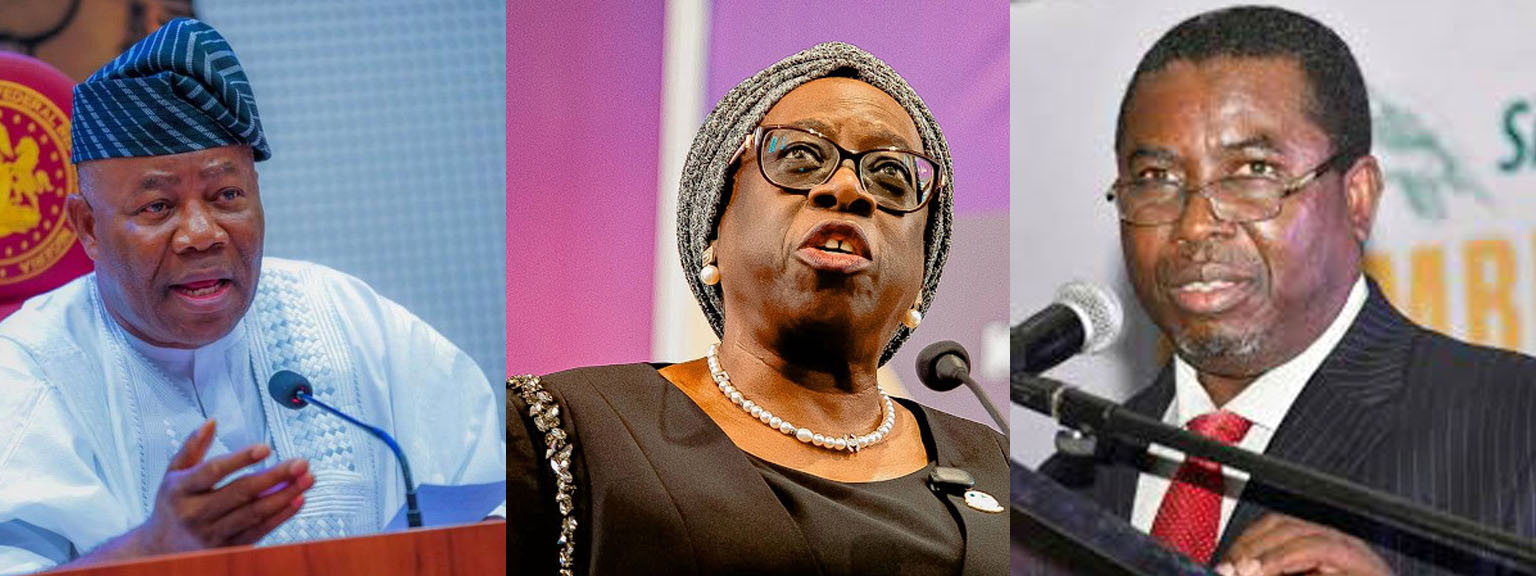
•Senate President Godswill Akpabio, Chief Justice of Nigeria Kekere-Ekun and INEC Chairman Joash Amupitan
Following the recent alarm raised by former Presidents Olusegun Obasanjo, Goodluck Jonathan and former Anambra State governor, Peter Obi, over the compulsive erasure of democratic values in Nigeria, concerned stakeholders have expressed the need to reset the system so that it can serve the needs of the people rather than those of the elite class so overwhelmingly manifest under the present dispensation.
Among the stakeholders who spoke to our correspondent is Dr Bolaji Akinyemi, a Christian activist, who called for what he termed ‘Performance Democracy’, which he said would lead to improvement in the lives of the people, rather than the violence and destruction as recently witnessed in Osun State, reports Sunday Independent.
Akinyemi, the Convener, The Apostolic Round Table (TAC), a periodic public affairs talk-shop on state of the nation, stated that Nigeria’s democratic crisis is no longer merely about who wins elections, but whether democracy delivers for citizens.
It would be recalled that former President Olusegun Obasanjo, former President Goodluck Jonathan and Peter Obi had called for stronger democratic institutions, independent judiciaries and effective political parties to sustain democracy in Nigeria and across Africa.
They made the call at the Goodluck Jonathan Foundation’s 2026 Democracy Dialogue, organised in collaboration with the Bauchi State government at the Sir Ahmadu Bello International Conference Centre, Bauchi, Bauchi State.
THE CASE FOR PERFORMANCE DEMOCRACY
According to Akinyemi, “The violent run-up to the Osun governorship election, alongside concerns raised by former Presidents Obasanjo and Jonathan and Peter Obi, exposes a system too often consumed by electoral competition while neglecting performance, accountability and citizens’ welfare.
“Performance Democracy offers a necessary reset: democracy must be judged not only by ballots cast, but by lives improved, institutions strengthened, security provided and promises fulfilled.
“Nigeria needs a democracy that rewards competence, measures outcomes and empowers citizens to demand results.
“All well-meaning Nigerians should support Performance Democracy as a pathway for developing democracies in Nigeria and around the world.”
Barrister Olalekan Festus Ojo, a human rights lawyer and an advocate of good governance, maintained that when voices as historically significant as former Presidents Obasanjo and Jonathan, men who have themselves occupied the highest democratic office in the land, and Peter Obi, who galvanised millions of Nigerians around democratic hope in 2023, all converge in expressing alarm about the state of Nigerian democracy, every responsible citizen and institution must listen with the utmost seriousness.
According to Ojo, the Managing Partner, Platinum & Taylor Hill LP, one of Nigeria’s leading law firms, Obasanjo, Jonathan and Peter Obi’s collective concern is not partisan commentary, but a constitutional alarm bell.
Ojo stated: “The violent, blood-soaked run-up to the Osun governorship election crystallised every democratic deficit that Nigeria has accumulated over decades of institutional negligence.
“The areas requiring urgent fixing are clear and non-negotiable. Electoral security architecture is fundamentally broken.
“The deployment of politically compromised police officers as electoral security guarantors, officers whose loyalty flows to state governors rather than to constitutional duty, produces exactly the partisan violence witnessed in Osun State.
“Independent, federally controlled electoral security deployment is non-negotiable for 2027.
“Judicial independence is under existential threat. When courts are perceived as instruments of political manipulation rather than constitutional guardians, democratic losers have no legitimate recourse and violence becomes the alternative dispute resolution mechanism. The NJC must act decisively and visibly.
UNDEMOCRATIC FOUNDATIONS
“Internal party democracy is a fiction. Primaries are purchased, not won. Candidates are imposed, not elected. A democracy built on undemocratic foundations cannot stand.
“The monetisation of politics must be confronted directly through campaign finance reform with genuine enforcement, the current expenditure limits in the Electoral Act 2026 are universally violated with absolute impunity.
“Finally, civic education must be treated as a national security investment. A citizenry that understands its democratic rights, rejects vote-buying, and demands accountability from elected officials is the most powerful democratic institution of all.
“Nigeria has chronically underinvested in building that citizenry. 2027 may be the last opportunity to begin.”
Barrister Kenneth Udeze, the National Chairman of Action Alliance (AA), maintained that ahead of 2027, three critical areas of the nation’s democracy need urgent fixing.
One of such areas, he said, is the ‘Electoral Integrity & INEC Independence’, stressing, “Disobedience to court judgments and compromised processes erode trust. The Independent National Electoral Commission (INEC) must be truly independent and bound by law.”
Another area that needs to be fixed, according to Udeze, is the ‘Security of Lives During Elections’, stressing, “The violent run-up in Osun election shows we must end thuggery, vote-buying, and intimidation. Security agencies must be neutral and proactive.”
Udeze also pointed at ‘Internal Party Democracy’, stating, “Imposition of candidates and hijack of party structures kill grassroots participation. Parties like AA must be allowed to operate freely per court decisions.
“Without fixing these, elections become transactions, not choices. Democracy can only thrive where the rule of law, safety, and fair play are guaranteed.”
Barrister Emeka Iheonu, another Lagos-based lawyer, stated: “To enhance democratic practice in Nigeria, the following ought to be in place and adhered to by the various stakeholders.
STRUCTURAL WEAKNESSES
“First is granting the Independent National Electoral Commission (INEC) complete financial and administrative independence to reduce political interference.
“The second is strengthening the use of electronic voting and result-viewing systems to ensure transparency during vote collation.
“Thirdly is enforcing strict legal penalties against vote buying and campaign finance violations. Ensuring that the courts operate without political influence to uphold the rule of law and constitutional authority.
“Also, there is need to reform anti-corruption agencies so they operate independently, rather than serving the ruling government.
“There is the need to grant financial and administrative freedom to Local Governments so that they can deliver basic services directly to communities.”
Iheonu also spoke of the need to create policies and quotas within political parties to increase the representation of women, young people, and persons with disabilities.
He added: “It is also necessary to defend press freedom and the right of citizens to peacefully protest and criticise unpopular government actions. Also necessary is educating the public on electoral laws, budget tracking, and their civic rights to hold leaders accountable. “There is also the need to create an effective opposition through the Shadow Cabinets system instead of haphazard criticism and commentary.”