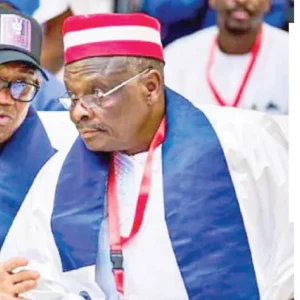
•EFCC chairman, Ola Olukoyede
Despite the spending limits prescribed under Section 92 of the Electoral Act 2026 (as amended), the staggering sums reportedly spent by politicians to secure party tickets during the recent primaries have raised fresh concerns over the enforcement of campaign finance laws ahead of the 2027 general election.
The disclosure by the Chairman of the Economic and Financial Crimes Commission (EFCC), Ola Olukoyede, has further fuelled questions about the readiness and capacity of regulatory agencies to curb excessive spending during the main election campaigns, reports Saturday Guardian.

Under Section 92 of the Electoral Act 2026 (as amended), a presidential candidate is prohibited from spending more than N10 billion on an election campaign. The spending ceiling for governorship candidates is N3 billion; Senate candidates, N500 million; House of Representatives candidates, N250 million; House of Assembly candidates, N100 million; and local government chairmanship candidates, N100 million.
Contrary to these limits, Olukoyede, disclosed that some governorship aspirants reportedly spent between N20 billion and N30 billion merely to secure party tickets ahead of elections.
Though the figure may appear unbelievable, the EFCC chairman is unlikely to make such a grave allegation without credible intelligence to support it.
Moreover, since he made the disclosure, none of the political parties or aspirants concerned has publicly challenged or refuted the claim.
The revelation, made in Ilorin during a lecture organised by the Centre for Peace and Strategic Studies at the University of Ilorin, has reignited concerns over the growing monetisation of politics in Nigeria and its implications for governance, accountability and democratic development.
For many observers, Olukoyede’s disclosure merely confirmed what has become an open secret in Nigerian politics: the race for public office is increasingly becoming a contest of financial muscle rather than ideas, competence, public service records or popular support.
With political parties already positioning for the 2027 general election, the disclosure has triggered a broader conversation about the huge sums spent during party primaries, the influence of money on internal party democracy and the long-term consequences for governance.
The Rising Cost of Primaries
Primary elections have gradually evolved into one of the most expensive stages of Nigeria’s electoral process. The cost of obtaining Expression of Interest and Nomination Forms for elective offices has risen sharply since Nigeria’s return to democracy in 1999 when major political parties charged less than ₦1 million for both forms. By 2003, the PDP fixed its expression of interest form at ₦10,000 and the nomination form at about ₦1 million.
In 2007, the party retained the ₦10,000 expression of interest fee but increased the nomination form to ₦5 million. In 2011, the Congress for Progressive Change (CPC), under which former President Muhammadu Buhari contested, charged ₦500,000 for the expression of interest form and ₦5 million for the nomination form, totaling ₦5.5 million.
By 2015, the APC fixed its presidential forms at ₦27.5 million, while the PDP charged ₦22 million.
Ahead of the 2019 election, the APC increased the cost to ₦45 million, while the PDP reduced its fee to ₦12 million.
The sharpest increase came during the 2023 electoral cycle when the APC set a record by charging ₦100 million—₦30 million for the expression of interest form and ₦70 million for the nomination form, while the PDP also raised its fee to ₦40 million, comprising ₦5 million for the expression of interest form and ₦35 million for the nomination form.
For the 2027 polls, the APC retained the N100 million fees for its presidential ticket comprising N30 million for the Expression of Interest form and N70 million for the nomination form. Governorship aspirants paid N50 million, Senate aspirants N20 million, House of Representatives aspirants N10 million and State House of Assembly aspirants N6 million.
The PDP (Wike faction) pegged its presidential forms at N51 million, governorship N31 million, Senate N7 million and House of Representatives N4 million.
The All Progressives Grand Alliance (APGA) fixed its presidential ticket at N75 million (N25 million for the Expression of Interest form and N50 million for the nomination form), while governorship aspirants paid N35 million, Senate N21 million, House of Representatives N16 million and State Assembly N8 million.
The Labour Party charged N50 million for its presidential ticket, N25 million for governorship, N10 million for Senate, N5 million for the House of Representatives and N3 million for the State House of Assembly.
The Nigeria Democratic Congress (NDC) set its fees at N60 million for the presidency, N30 million for governorship, N8 million for Senate, N6 million for the House of Representatives and N2.5 million for the State Assembly, while granting a 50 per cent waiver to female aspirants and a 75 per cent waiver to persons with disabilities.
The African Democratic Congress (ADC) charged N90 million for the presidency, N30 million for governorship, N10 million for Senate, ₦5 million for the House of Representatives and N2 million for the State Assembly, with a 50 per cent discount for youth aspirants and a 25 per cent discount for women and persons with disabilities.
In contrast, the African Action Congress (AAC) remains the only party with relatively modest nomination fees, charging N2.1 million for the presidential ticket, N1.1 million each for governorship and Senate, N600,000 for the House of Representatives, and N250,000 for State House of Assembly. However, despite its comparatively affordable fees, the party has yet to emerge as a major force in Nigeria’s electoral landscape.
Beyond nomination fees, aspirants spent heavily on consultations, the mobilisation of party delegates, logistics, accommodation, campaign structures, media engagements and political negotiations. In many cases, even unsuccessful aspirants incurred huge expenses during the screening and clearance process before eventually losing at the primary stage.
As Olukoyede estimated, if contesting for a governorship ticket in a major political party costs an aspirant an average of N30 billion in political spending and negotiations, then securing governorship tickets across the 36 states could involve expenditures approaching N1 trillion.
Even if only 30 highly competitive governorship contests attract such spending levels, total expenditures could reach approximately N900 billion.
When the spending of unsuccessful aspirants is added, alongside expenditures on senatorial, House of Representatives, state assembly and local council contests, the cumulative figure becomes significantly higher. This is despite the fact that the real cost of elections in Nigeria extends far beyond what is officially declared to the electoral authorities.
Campaign financing, legal disputes arising from primaries, political settlements, coalition-building efforts and post-primary reconciliations all contribute to the enormous financial burden. The implication is that a substantial amount of private wealth is being channelled into politics in anticipation of future returns.
One of the most troubling consequences of expensive primaries is the emergence of what Nigerians describe as an “investment mentality” in politics. When individuals spend billions of naira pursuing elective office, public service risks becoming secondary to financial recovery.
For perspective, the Nigerian President earns a total monthly remuneration of about N1.17 million, comprising a basic salary of N292,892, a hardship allowance of N146,446 and a consistency allowance of N732,230, according to the Revenue Mobilisation Allocation and Fiscal Commission (RMAFC). At that rate, it would take more than 85 months, over seven years of saving every kobo of the salary, to raise the N100 million required to purchase the APC’s Expression of Interest and Nomination forms.
A Nigerian governor earns about N7.8 million yearly. Put differently, a governor would have to set aside his or her entire official salary for more than six years, without spending a kobo, to afford the APC’s governorship nomination form.
The disparity becomes even more striking when viewed against the earnings of ordinary Nigerians. The national minimum wage is N70,000 per month or N840,000 yearly. According to the Nigerian Consumer Outlook Report 2025, less than one per cent of Nigerians earn above N1 million monthly, while the vast majority survive on less than N100,000 or have no stable source of income.
The World Bank also estimates that over 60 per cent of Nigerians live below the national poverty line, leaving many, especially young people, with little or no savings and limited access to capital.
It is, therefore, possible that rather than viewing governance as an opportunity to serve the people, some politicians may see electoral victory as the beginning of a process of harvesting returns from their political investments. This concern was echoed by Olukoyede, who warned that the commercialisation of politics creates strong incentives for corruption once elected officials assume office.
The pressure to recover campaign expenditures can influence decisions relating to contract awards, appointments, budget implementation and the allocation of public resources. This also helps explain why preparations for a second term often begin almost immediately after a candidate wins an election.
The danger is that public institutions become instruments of private enrichment rather than vehicles for delivering public services. In such circumstances, public projects may be inflated, procurement processes manipulated and government spending distorted to satisfy political sponsors and financiers.
The result is a vicious cycle in which corruption becomes embedded in the political system long before elections are even conducted.
Fueling Corruption In Public Office
Many anti-corruption advocates, including the Chairman of the Human and Environmental Development Agenda (HEDA), Olanrewaju Suraj, believe there is a direct relationship between the high cost of seeking political office and the persistence of corruption in government.
He argued that when political campaigns require enormous financial resources, candidates often depend on wealthy sponsors, contractors, business interests and political godfathers.
Such financiers rarely provide support without expecting returns. Once elected, public office holders may come under pressure to reward their backers through government contracts, appointments, policy concessions or privileged access to state resources.
Another major concern arising from the high cost of party primaries is the exclusion of capable but financially disadvantaged aspirants.
Ideally, democracy should provide equal opportunities for citizens to contest public office based on ideas, leadership qualities and public support.
However, when elections become prohibitively expensive, only the wealthy or those backed by powerful political networks can realistically participate.
This inevitably narrows the pool of leadership talent available to the country. Many professionals, academics, entrepreneurs and civil society leaders with valuable expertise may be discouraged from entering politics because of the enormous financial barriers.
The commercialisation of party primaries also poses a serious challenge to internal party democracy. The growing commercialisation of party primaries has continued to attract criticism from political stakeholders, who warn that the trend threatens Nigeria’s democratic future by placing wealth above competence, credibility and integrity.
Former Chairman of the Inter-Party Advisory Council (IPAC) and National Democratic Party (NDP) senatorial candidate for Kogi East, Chief Peter Ameh, lamented that party primaries have become excessively commercialised, turning candidate selection into an auction in which the highest bidder prevails rather than the most competent aspirant.
While acknowledging that political parties require funds to operate, he argued that the current system sidelines capable and visionary leaders, particularly youths, women and persons of modest means.
According to him, political parties are public institutions established to deepen democracy and provide equal opportunities based on merit rather than financial strength.
Ameh warned that the trend encourages corruption, as elected officials often seek to recover their campaign investments, while at the same time eroding public confidence in democracy.
Similarly, Executive Director of the Civil Society Legislative Advocacy Centre (CISLAC) and Chairman of the Transition Monitoring Group (TMG), Auwal Musa Rafsanjani, described the rising cost of nomination forms, delegate inducement and campaign financing as a serious threat to democratic accountability.
He noted that excessive monetisation excludes reform-minded and credible candidates who lack vast financial resources, weakens internal party democracy and transforms political contests into commercial transactions.
Rafsanjani warned that politicians who spend heavily to secure party nominations may regard public office as an investment to be recouped, thereby fuelling corruption, patronage, abuse of public resources and voter apathy.
He advocated stricter enforcement of campaign finance laws, lower nomination fees, greater transparency in party financing, stronger electoral institutions and the prosecution of electoral offenders.
For a founding member of the APC, Osita Okechukwu, the antidote to money politics lies in conducting free, fair and transparent elections that allow voters to choose their leaders without financial manipulation.
He argued that credible elections would strengthen accountability and improve governance by enabling citizens to reward performance and reject failure at the polls.
Political commentator and social engineering expert, Dr. Sama’ila Yusuf, also condemned the excessive monetisation of politics.
He warned that democracy cannot survive when political power becomes a commodity reserved for the wealthy.
While the EFCC Chairman has raised the alarm to this dangerous slide, the Electoral Act also places responsibility on the commission, the Independent National Electoral Commission (INEC) and other relevant government agencies to curb the growing monetisation of the electoral process.
Sections 92, 93 and 94 of the Electoral Act 2026 place campaign finance under INEC’s regulatory oversight, while the EFCC, ICPC and other law enforcement agencies are expected to investigate and prosecute offences involving illegal campaign financing, money laundering and other financial crimes
The challenge, therefore, is not merely identifying the problem but demonstrating the political will to enforce existing laws. Unless campaign finance regulations are strictly implemented and violators sanctioned, the soaring cost of politics will continue to shut out competent Nigerians, deepen corruption and weaken the country’s democratic foundations.