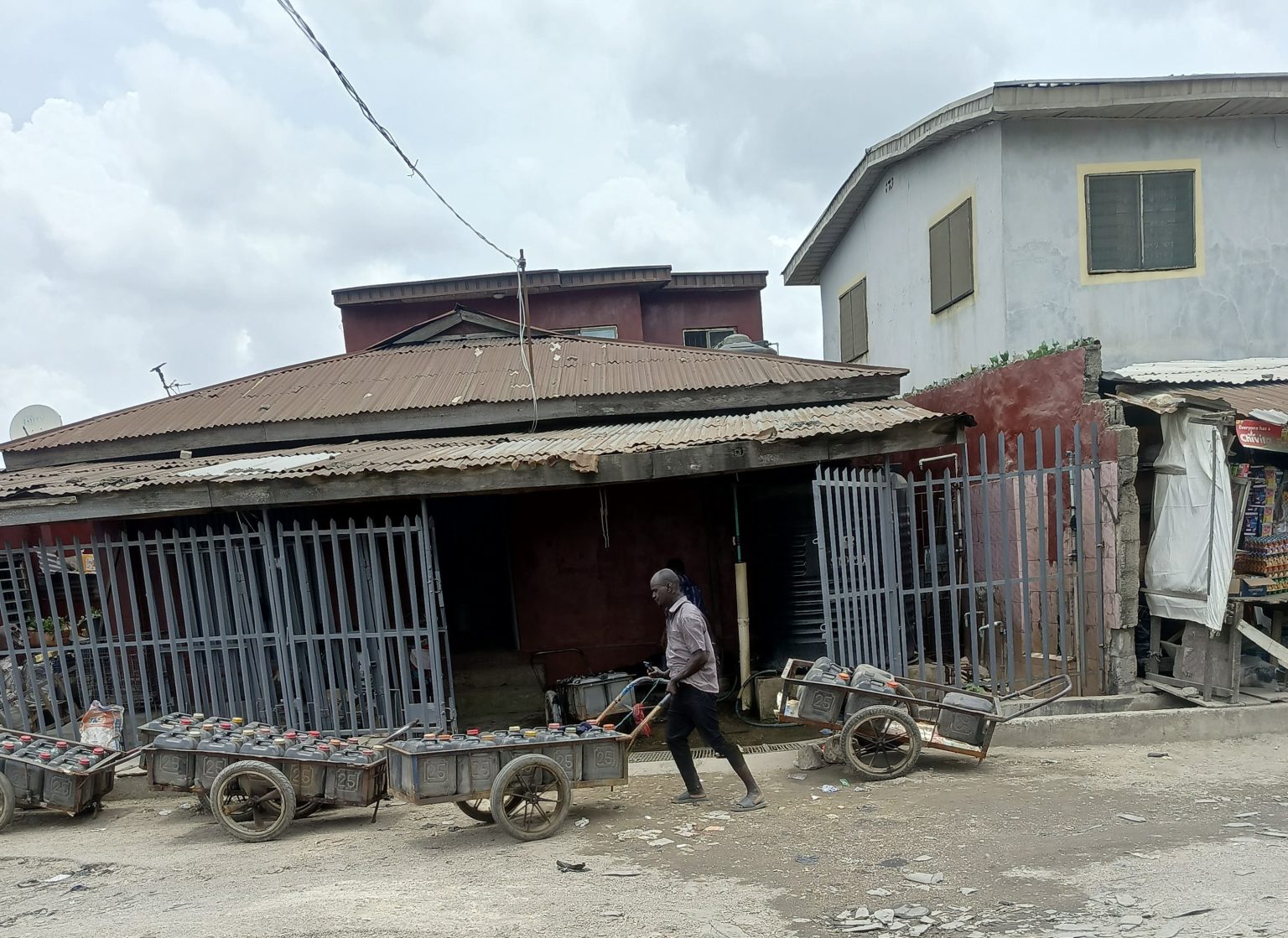
•A local water vendor
Three-year-old David Kakini cried uncontrollably in front of the family’s ramshackle home as the sweltering afternoon heat swept through Ago Egun, a densely populated waterfront settlement in the Bariga area of Lagos.
His 22-year-old mother, Rebecca, said frequent bouts of fever and catarrh have transformed her once bubbly baby into a shadow of his former self, reports Daily Trust.
“They told us at the health centre that his frequent sickness is caused by germs inside the water we use in our community.
“I am worried and afraid; I don’t want to lose him to sickness,” she said with a trembling voice.
Though perched on the edge of the Lagos Lagoon, clean water remains a luxury for many families in Ago Egun, a community of fishermen and women from Badagry and the neighbouring West African countries.
Residents say underground water sources in the community of over 5,000 people are polluted by lagoon water contaminated with heavy toxic items, including industrial discharges and untreated waste.
Research by aquatic toxicologist Aina Adeogun of the University of Ibadan revealed that the polluted water from the lagoon posed a significant risk to both human health and aquatic life.
Traditional head of Ago Egun, Felix Joseph, confirms this finding, revealing that previous borehole wells erected in the community delivered only muddy, contaminated water unfit for domestic use — a development he says proved costly for the health of his people.
“Instead of finding clean water through the boreholes, we were exposed to sicknesses and deaths,” he said.
Blaming the community’s water crisis for the death of her four-year-old niece, Bose, and several other children during a suspected diarrhea outbreak in 2023, Enayon Kojo, a fish trader in the area, says the situation has left many parents like her on the edge.
“Bose would still be here if we had clean water. Her death is difficult to forget.
“Children are coming down with malaria, typhoid, and dysentery frequently in this area. As mothers, we are worried,” she said.
Between 2017 and 2018, several children were reported to have died of diarrhea, measles, and convulsions in the community. Many of the cases were traced to the germ-infested water residents used for domestic purposes.
Health workers raise danger alarm
During visits to CMS and Ashogbon health centers — two of the closest public hospitals to Ago Egun — workers confirmed that the majority of child illnesses, including diarrhea and skin infections in the region, were caused by contaminated water.
“We have had several cases of children stooling uncontrollably and having stomach problems, and many of these have been traced to the poor quality of water they drink and use for other domestic needs,” a nurse who identified herself only as Yemi, at Ashogbon Health Centre, said.
At CMS Health Centre, a health worker who asked not to be named disclosed that children exposed to germ-infested water were regularly treated at the facility but was unable to give any specific figures on the number of weekly and monthly cases handled.
“We often have cases of children brought to the centre because of exposure to germ-infested water.
“We are doing our best to educate parents on the dangers of relying on contaminated water for drinking, cooking, bathing, and doing other domestic chores,” the source said.
Information Officer of Bariga Local Council Development Area, Eunice Shittu, said the council was aware of the problem, but she did not state what actions had been taken.
“We know Ago Egun and the challenges being faced there. I’ll get back to you on this issue,” she said when contacted.
A city built on self-help
Rebecca and Enayon’s predicament in Ago Egun reflects a wider public health emergency unfolding across urban slum settlements in Lagos, Nigeria’s largest city and home to over 22 million people, where public infrastructure, such as water and sanitation facilities, is not commensurate with the city’s ballooning population.
In a 2025 report, the African Cities Research Consortium said poor investment in water, sanitation, and hygiene facilities in low-income areas like Ago Egun is responsible for health crises caused by untreated, contaminated water supplied by local vendors.
According to the group, riverine and informal communities should be prioritised in water and sanitation planning, given the deaths from waterborne diseases in these areas.
Action Research Lead for ACRC and Shantytown Empowerment Foundation (SHEF) WASH project in Okerube, Rasheed Shittu, said that the water and sanitation challenges in Ago Egun require a multi-layered approach.
“There should be provision of safe alternative water sources, such as treated water distribution points or household water treatment solutions, to reduce reliance on contaminated groundwater while long-term infrastructure is developed.
“Any intervention must also include hygiene promotion and sanitation improvements, as water quality cannot be addressed in isolation from the broader WASH issues,” Shittu added.
Infrastructure that stops short
Despite Lagos’ status as a megacity, access to public water remains deeply unequal.
The Lagos State Water Corporation operates major plants but produces only about 35% of the city’s daily demand when operating at full capacity. Despite billions of naira spent over the years addressing the situation, many communities remain unserved.
Over N66.934 billion was spent between 2019 and 2025 to address the water challenge in Lagos, yet many families still source their water.
Experts say the situation reflects structural inequality in urban planning.
Without access to government pipelines, families in Ago Egun rely on cart pushers who transport water from distant sources. On average, households spend between ₦5,000 and ₦10,000 weekly —yet the water is often unsafe.
For drinking, many turn to sachet water, but residents say even that offers no assurance.
“We spend a lot of money buying water for domestic use and medicine for our sick children,” Sewanu Favour, a mother of three raised in the area, disclosed.
“Even the sachet water we buy for drinking doesn’t shield us from sickness,” she added.
Balogun Omotayo, a community leader, while lamenting the situation, says authorities must intervene quickly to save them from the tragedy the unavailability of clean water has thrown them into.
“The lack of water is causing many problems for us here.
“We urgently need help to address this problem and save lives,” he said.
Earlier this month, the Lagos State Water Corporation announced a public-private partnership designed to attract investment for asset rehabilitation, operational efficiency, and expanded access to potable water across the city, especially in underserved communities. Managing Director of the agency, Mukhtaar Tijani, says the development marks a major step towards addressing the water needs of the state.
A viable way out
Suggesting the adoption of the social enterprise model, which puts the management of water infrastructure in the hands of community representatives as a possible way out of the water crisis currently experienced in Ago Egun, Shittu stated that the technique has proven to be viable in Okerube, a densely populated town under Alimosho Local Government Area of the state, where it is currently being tried out.
“The social enterprise model we are co-leading in Okerube is showing real promise as a sustainable approach to community water provision.
“We believe this model could offer a viable, long-term water solution in a place like Ago Egun,” he said.
Homes without toilets
Beyond clean water, the lack of functional toilet facilities also contributes to disease outbreaks in Ago Egun. Without this critical infrastructure, residents are forced to defecate into polythene bags, which they eventually dump in the lagoon. During high tide, these wastes are washed back into the community, spreading germs across every corner of the area.
Professor of Public Health and Community Medicine at the University of Ibadan, Michael Asuzu (rtd), describes this situation as a recipe for illnesses and deaths.
“Without access to clean water and sanitary facilities, coupled with the filthy environment of Ago Egun, child mortality will be high.
“Also, elderly people with weak immune systems may not be able to survive for long in such a place,” he said.
Big city, few toilets
Currently, Lagos has approximately one toilet for every 12,865 people, far below the World Health Organisation’s recommendation of one for every family of five, while in emergency situations, it is pegged at one toilet for 20 people.
To address this challenge, the Lagos administration in August 2025 announced plans to install 10,000 public toilets by 2030 to eradicate open defecation in the state. Commissioner for the Environment and Water Resources, Mr Tokunbo Wahab, in March this year said the state had reinstated a monthly sanitation exercise as part of the broader plan to tackle open defecation and improve environmental cleanliness across the city.
However, Public Health Physician and Director of Public Health Services, Ministry of Health, Ondo State, Dr Fagbemi Stephen, says residents must also adopt good sanitary and hygiene practices to reverse illnesses in impoverished communities like Ago-Egun.
“It is not only about providing clean water or functional toilets; residents of affected communities must collectively imbibe a culture of good hygiene and sanitation to protect their environments and safeguard their health,” he said.
Endless wait for help
Helpless residents in Ago Egun say they are tired of spending their meagre earnings on treating illnesses and buying water.
“Government and all well-meaning Nigerians must come to our aid before it gets too late,” Oluwashina Awasun, an elder in the community, said, echoing the frustration of hundreds of families who call the Lagos slum home.
*This report was facilitated by DevReporting in partnership with Pro-Poor Development Media Network (PDM-Network) and supported by the African Cities Research Consortium (ACRC)