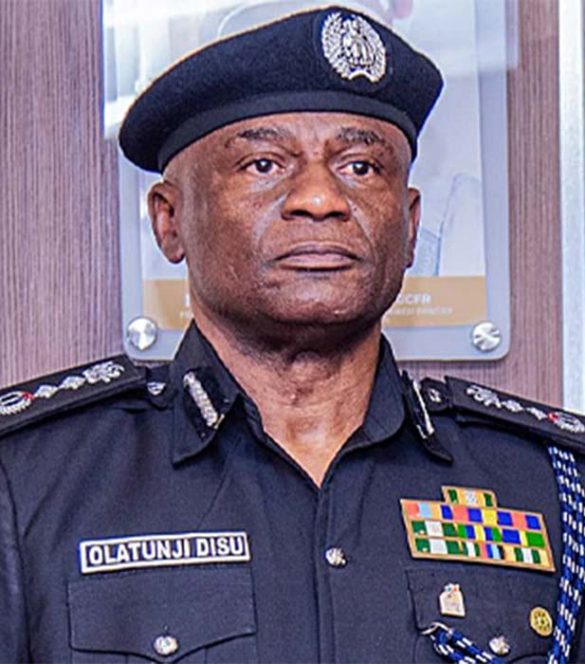
•Inspector General of Police, Olatunji Disu
Once considered a relatively peaceful residential enclave in Alimosho Local Government Area, Gowon Estate, Lagos, has descended into a state of lawlessness, with hard drug dealers, peddlers, and addicts brazenly taking over its streets. Residents live in constant fear as the illicit drug trade thrives in broad daylight, seemingly unchecked by security operatives who appear overwhelmed, indifferent or compromised.
This article delves into the activities of the hoodlums, the desperation of the community, and the troubling silence of the authorities tasked with restoring order, reports Saturday Independent.

Once a quiet, middle-class suburb of Egbeda in Alimosho Local Government Area of Lagos State, Gowon Estate has become a shadow of its former self.
Today, residents, visitors and passers-by live in constant fear as suspected criminals, drug dealers and addicts have taken over most streets in this axis. Security operatives, including the Police Rapid Response Squad (RRS) and the Nigeria Police Force, appear docile, overwhelmed or compromised, leaving the community to fend for itself against a booming illicit drug trade that operates in broad daylight.
Investigations by our correspondent reveal that the epicentre of this lawlessness is 31 Road and its adjoining junction linking Okunola Road. Other hot spots include Wale Omo Osho Street and several adjoining streets, where young men – stern, dreadful and often armed – loiter around, waiting to beckon to potential customers.
The trade is so open that different brands of cars stop briefly, conduct transactions in a jiffy without occupants stepping out, and then zoom off, while waiting, young men approach and complete the deal.
“It is a serious business,” said a resident who spoke on condition of anonymity for fear of reprisal.
“Most of those boys you see standing by the roadsides, sitting by parked cars, are into drugs. As you walk along the roadside, you will see the Police Task Force vehicle parked under a tree, about 30 metres away from where the drug business is taking place. But the police operatives pretend as if nothing is going on. I don’t know if I should call it a compromise or the protection of the thriving illegality.”
The constant presence of drug users and dealers has turned everyday life into a nightmare. Another resident, who also wished to remain unnamed, lamented that people are now skeptical about leaving their homes early in the morning for work or returning late at night.
“You know the drug users are often associated with all forms of crime,” he said.
“There is no doubt that some of these people you see here belong to one armed group or another. Definitely, some of these may be armed robbers, kidnappers, cultists, house-to-house thieves and so on. The use of hard drugs energises them while perpetrating crime.”
The fear is palpable. Residents say they no longer feel safe even inside their own homes. The sound of arguments, the sight of syringes and drug wrappers on the streets, and the brazenness of the dealers have become part of daily life.
Many have resorted to keeping to themselves, avoiding certain routes after dark, and praying that the authorities will eventually act.
One of the most puzzling aspects of the situation is the visible presence of law enforcement. A Police Rapid Response Squad (RRS) operational vehicle, with officers meant to ward off criminal activities, is stationed a stone’s throw from the notorious 31 Road junction. Yet, the drug trade continues unabated right under their noses.
“One begins to wonder why such illegality should be taking place before their very presence,” a resident who has been repeatedly disturbed by the reckless abandonment of the security agencies told our correspondent.
“The police cannot say they do not know there is a serious drug business and other criminal activities going on here. A lot of our youth are hooked on drugs, and their lives and futures are wasting away. I just hope that God will help us.”
The resident questioned whether the task force operatives were there to protect the drug dealers rather than fight crime. He expressed frustration that the presence of the police had not deterred the criminals, and appealed to the media as the only hope for the community.
“The essence of bringing this to the notice of the media is that I believe only the fourth estate of the realm can help this community out of its predicament,” he said.
The situation also raises serious questions about inter-agency collaboration between the Nigeria Police Force and the National Drug Law Enforcement Agency (NDLEA).
If the police in Gowon Estate could arrest drug suspects and hand them over to the NDLEA for discreet investigation and prosecution, why does the trade continue to flourish?
When our correspondent visited the Divisional Police Headquarters in Gowon Estate to share intelligence with the Divisional Police Officer (DPO), the reception was far from welcoming. After informing the police orderly of his presence and the purpose of his visit, the reporter was asked to wait.
After a long wait, a woman believed to be the DPO opened her office door halfway and asked, “How can I help?” Our correspondent introduced himself as a journalist seeking to share intelligence about the hoodlums and illegal drug business. The lady DPO immediately responded, “Go and meet the PPRO,” and without further discussion, shut the door.
The encounter was a stark illustration of the apparent lack of cooperation or proactive engagement from the police leadership in the area.
In contrast, the NDLEA’s Lagos Sector Command Public Relations Officer, Mallam Musa Abdullahi, was more forthcoming.
When contacted, Abdullahi admitted that illegal drug activities were indeed going on around 31 Road, Gowon Estate. He said that NDLEA operatives had raided the area several times but had not been able to pin down the drug barons.
“Most of the people we accost or arrest are users, not barons and traffickers,” Abdullahi explained.
“The law is not very stringent on users. We are seriously after the barons. We appeal to members of the public to assist us with information that will lead to the arrest of the barons.”
Abdullahi emphasised that the NDLEA was not leaving any stone unturned in the war against hard drugs, with several arrests and prosecutions already achieved.
He asserted that over 70 per cent of the cases that go to the courts in Nigeria are brought by the NDLEA, highlighting the agency’s central role in the fight against narcotics.
Efforts to obtain an official response from the Lagos State Police Command were equally frustrating. Our correspondent visited the office of the Police Public Relations Officer (PPRO), Adebisi Abimbola, a Superintendent of Police, on Tuesday, April 28, 2026, but she was not at her desk, having reportedly gone out on an official assignment with the Commissioner of Police.
A second visit on Tuesday, May 5, 2026, also proved unsuccessful, as she was again out on assignment. Calls to her mobile phone were neither picked up nor returned.
The lack of a response from the police command suggests either an unwillingness to engage with the media or a systemic failure to address the crisis in Gowon Estate.
The drug business in Gowon Estate is not a small-scale operation. Investigations revealed that all manner of hard drugs – from cocaine, heroin and cannabis to Canadian laud and Ghana laud – are freely sold and purchased on the streets, unchallenged. The trade is highly organised, with dealers operating in shifts, lookouts posted at strategic points, and a steady stream of customers arriving in vehicles.
Ismail Aniemu, a public affairs analyst, explained why the drug trade continues to thrive despite law enforcement efforts.
“Because the drug business is a very lucrative illegal business, barons and peddlers, irrespective of the massive war, arrests and prosecutions waged by the NDLEA, find it difficult to quit the illegitimate business,” Aniemu said.
He noted that the extension of the tenure of Brigadier-General Buba Marwa (rtd) as NDLEA Chairman/CEO was a direct result of the positive impact the agency had made in the narcotics war over the years. Marwa, according to Aniemu, had proven to be very efficient as Chairman and Chief Executive of the NDLEA.
“The high-profile arrests, seizures and the renewed zeal with which NDLEA officers under his leadership have been working speak a lot about his efficiency and commitment to service,” Aniemu said.
“In fact, if every appointee of the President had been working the way Marwa is working, Nigeria would have gone further than this in every aspect of our national life.”
Aniemu also reflected on what the fate of Nigerians – particularly the youth – would have been had the large quantities of narcotics intercepted by the Nigeria Customs Service and the NDLEA at seaports, airports, land borders and elsewhere actually entered society.
“This is a country of over 230 million people,” he said.
“You have a very strong, teeming youth population. There is drug addiction and substance abuse across various strata of Nigerian society. And there are those whom I call the merchants of death, who make money from it.
“What you would imagine is where we would be if someone like Marwa were not there to have helped stop most of this unlawful drug trade. We cannot have perfection. The drug trade is going on all over the world. It is a network. It is a very organised crime. But we also need somebody as committed, dedicated and result-oriented as General Buba Marwa, who proved to be excellent in the discharge of his responsibilities in that regard.”
For the residents of Gowon Estate, however, these national-level achievements offer little comfort. They live every day with the reality of drug dealers operating across the street from a police post, of young men being recruited into addiction and crime, and of a system that seems unable or unwilling to protect them.
“We are tired of being afraid,” said one mother of three who resides near 31 Road.
“Our children cannot play outside. We cannot walk to the market without being harassed. The police are there, but they do nothing. Who will help us?”
The question hangs in the air, unanswered. As the drug trade continues to flourish, Gowon Estate stands as a stark reminder of the challenges facing law enforcement in Nigeria’s urban sprawls – and of the urgent need for genuine, coordinated action that goes beyond rhetoric and reaches the streets where people live.