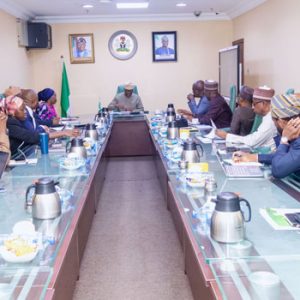
•Minister of interior, Olubunmi Tunji-Ojo
Blatant abuse of expatriate quota (EQ) rule by foreign companies, the rising number of undocumented foreign workers and the underhand dealings of local capitalists in expatriate recruitment are driving Nigeria deeper into the unemployment crisis.
As bad as the situation is, relevant government agencies who should have brought the culprits to book are actively aiding the abuses or looking the other way, reports The Guardian.
The federal government, on its part, is profiteering from rising EQ even as its revenue from the source doubled the target for the year as far back as October. The accrued revenue (N1.2 billion) may be insignificant, but stakeholders suggest that when government agencies begin to use the figures as bragging rights, Nigerians have reasons to be worried.
Already, there are also strong indications that some employers, especially in critical sectors, are shopping expertise abroad with blatant disregard for labour laws with government agencies.
The organised labour has kicked against the influx of foreign workers and how their presence undermines the chances of Nigerians, calling on the government to act fast to save local labour supply. However, some stakeholders who were informed about the subject said many employers are forced to go overseas on account of low competence level back home.
These come on the heels of disclosure by the Minister of Interior, Olubunmi Tunji-Ojo, that Nigeria has exceeded its 2023 N600 million expatriate quotas (EOs) target by over 100 per cent to hit N1.2 billion at the end of October.
The N1.2 billion revenue generation EQs have raised serious concerns about government attitude to joblessness and some officials are not already trading the opportunities that should have been left for locals.
According to data from the Ministry of Interior, there are about 150,000 expatriates in Nigeria with their presence more prevalent in sectors such as oil and gas, construction, telecommunication, manufacturing and hospitality.
The data said that between 2019 and 2022, about 13,829 foreigners were issued EQs permits, while a total of 1,161 business permits were also given to foreign companies to operate in Nigeria in the year.
According to the National Bureau of Statistics (NBS), the average basic salary of expatriates is over 45 per cent above the basic salaries, creating a huge wage gap between expatriates and Nigerian employees.
Chairman of the joint committee, Adams Oshiomhole, told the minister that the policy on issuance of EQs was giving room for expatriates to steal jobs meant for Nigerians in the country and making the country’s qualified engineers work under foreign technicians.
Oshiomhole alleged that he has it on good authority that prisoners from foreign lands are working in Nigeria as construction workers. His words: “Many non-Nigerians are in the country, some of them live inside containers. I even believe and dare say that there are foreign prisoners who are working in Nigeria. They were shipped to our country to serve their prison terms.
“They were being paid according to their country’s minimum wage by the construction industry that brought them. Prisoners are not expected to work in their countries if the product or whatever they engage in is meant to be exported.”
Recently, the Nigerian Content Development and Monitoring Board (NCDMB) revealed that it turned down 328 expatriate requests from oil and gas companies in 12 months, stating that there was a substantial increase in the number of applications for EQ, which increased in 2023 as compared to 2022.
Manager of Strategy Development and Information at NCDMB, Olubisi Okunola, at a forum recently, said the board received 1,484 expatriate applications, approved 1,156 requests and rejected 328 applications this year alone.
President Bola Tinubu, during his inaugural speech, promised to tackle the high rate of unemployment in the country, part of which he said Nigerians should expect one million jobs in the digital economy and 500,000 jobs when the Ajaokuta Steel Company comes on board.
The unemployment rate is close to 40 per cent, according to advisory services firm, KPMG. Nigeria is said to have lost about $4.5 billion to foreign artisans who are imported to work in the construction industry – a situation that is worsening access to jobs by Nigerians.
To address the challenge, the federal government promised stiffer sanctions for EQ abuse by local and foreign companies. But the abuse has increased significantly
It was gathered that Indian and Chinese companies in Nigeria have rapidly expanded the importation of workers from their home countries.“A few greedy capitalists collude with corrupt officials from the Ministry of Labour and Immigration. They pay bribes to secure licenses and work permits for foreign workers, even those lacking skills. As a result, Nigerians end up training these foreigners, eventually losing their jobs to them. The issue persists despite labour unions’ efforts to address it,” an official who does not want his name in print told our correspondent.
Regrettably, Nigeria has often engaged the services of artisans such as bricklayers, iron benders, tillers, POP installers, electricians, AC repairs, interior decorators, carpenters and plumbers of other West African country origins, who are perceived to have the competence to deliver quality projects
According to statistics, Lagos State has the most active construction site with an estimated 48,000 ongoing projects requiring over 15,000 artisans, while the country at large needs about 1.5 million artisans per year. These positions are filled by foreigners, most of whom do not have work permits.
A member of the Council of the Regulation of Engineering in Nigeria (COREN) who spoke anonymously, said over 70 per cent of artisans found on construction sites across the country are foreigners.
He said as of two years ago, the council raised the alarm that some N900 billion was being lost to this process, but that “nothing was done by the government”.
“I am sure, the figure would be over N1 trillion by now,” the official said. A promoter of welding activities and founder of Mudiame Welding Institute, Sunny Eromosele, in an interview, said the current skill gap in jobs like specialised welding had resulted in the influx of foreigners into the country.
He alleged that the labour for the country’s railway projects and Dangote Refinery was 90 per cent supplied by India and China. Deputy General Secretary of the Nigeria Labour Congress (NLC), Chris Onyeka, pointed at the racketeering and EQ abuse as a serious challenge. He said it was wrong, especially for a country that has challenges with unemployment, to auction jobs meant for Nigerians to foreigners.
“These people will have to repatriate their funds in dollars, which ultimately puts pressure on naira. It does not make any economic sense for a country that is in dire need of jobs. We don’t need that kind of revenue, it is counter-productive. Asians come and collude with our public officials and take our jobs,” he said.
Deputy President of the Trade Union Congress of Nigeria (TUC), Dr Tommy Okon, said EQ, even if it generates revenue for the country, should not be administered to the detriment of Nigerians.
He alleged that a lot of people coming in the name of expatriates are messengers in their country, with no technical know-how, who have been subjected to menial jobs in their country.
He lamented the country’s obsolete labour laws, which he said the foreign employers capitalise on to perpetuate unfair labour practices. Okon called on the National Assembly to expedite action on the timely review of labour laws.
“Some of the expatriates are coming to make use of the brains of our engineers because ours are better than theirs. The Interior Minister should look at the quota to review it. Nigerians cannot go abroad and be heads; they have to pass through training. Nigeria has lost so much already,” he said.
A professor of economics at the Lagos Business School (LBS), Bongo Adi, said Nigeria needs proper job diagnosis and assessment to ensure that jobs meant for Nigerians are done by Nigerians. He urged the Minister of Interior to embark on job assessment and evaluation where expatriates who are handling jobs where Nigerians have expertise are sanctioned.
Noting that prioritising revenue generation and job creation are mutually exclusive, he said creating jobs was part of growing the economy through productive sectors to increase productivity.
“We cannot do without skill enhancement because it would lead to productivity and that means jobs that are efficient and value-added to grow the government’s revenue. These two should go together,” Adi said.
The National President of the National Union of Civil Engineering Construction, Furniture and Wood Workers (NUCECFWW), Stephen Okoro, in an interview with our correspondent, alleged that about 50 per cent of expatriates operating in a Chinese company have been issued Nigerian diplomatic passports.
He told this paper how the union raised the alarm but “were told to focus on their job as a labour union and cater to the welfare of workers as the instruction to grant the foreigners diplomatic passports was an ‘order from above.’
“We were told that we were going beyond our boundary and that we should be more concerned about the welfare of our members. But if someone is infringing on the rights of workers by taking away our jobs from foreigners, that is also our right but they will say we are going beyond our boundary,” he said.
He said the union has approached the Ministry of Labour several times, where they promised to tackle the menace, however, Okoro said till date, no positive response has been observed.He urged the Ministers of Labour and Interior, who issue the permits to call for a stakeholders’ forum for unions, whose sector is mostly affected, to make their position known.
Similarly, a former Deputy President of the Nigeria Labour Congress (NLC), Amaechi Asugwuni, said foreigners are making the cost of construction very expensive for the government. He canvassed for a strong policy in the form of a law to tackle the menace in the sector.
According to him, the Ministers of Interior and Labour are not doing their jobs well in this regard.
“They must take responsibility and clear the menace. It is better to use the law to fight crime in Nigeria because policy is easily compromised. It should come as an Executive Bill to promote indigenous contractors. Foreign firms make do with this because they settle the government very well. It is unacceptable for any decent nation to allow corruption to be the detail of its governing model,” he said.
Asugwuni, who is also a past National President of NUCECFWW, maintained that nobody is kicking against foreign contractors doing their bidding but would rather kick against foreign contractors who are in the construction industry but bringing expatriates to do the jobs of Nigerians.
“That is exporting our jobs indirectly. They are not paid in Naira but dollars making the cost of construction very expensive for the government. When foreign organisations bid for jobs, they charge in dollars but Nigerian contractors in Naira. By doing so the cost cannot be the same, the overhead, especially.
“You spend trillions on infrastructure, yet Nigerians are backward on employment,” he said. President of the NLC, Joe Ajaero, who promised to revisit the nation’s expatriate quota law to have first-hand evidence that has been exceeded, insists on the country’s adherence to expatriate quota as enshrined in the law.
“There are certain jobs where you engage people from outside. We need to voice out from our various sectors. We insist on the maintenance of our expatriate quota as enshrined in the law.
“You see them bring people who are janitors, technicians and jobs that Nigerians can do. If these ministries, including that of Labour, are doing their jobs very well, you won’t see such. The inspectorate division of the Ministry of Labour on the standard of work is not doing its jobs properly,” he said.
The Director-General of the Nigeria Employers’ Consultative Association (NECA), Adewale-Smatt Oyerinde, urged the government to fix the educational system to turn on talents who are ready to work.
Disputing the fact that expatriates were taking over Nigerian jobs, he said those companies needed the talents and the reason they sourced for them was because many Nigerians were not leveling up with the competence level in the country.