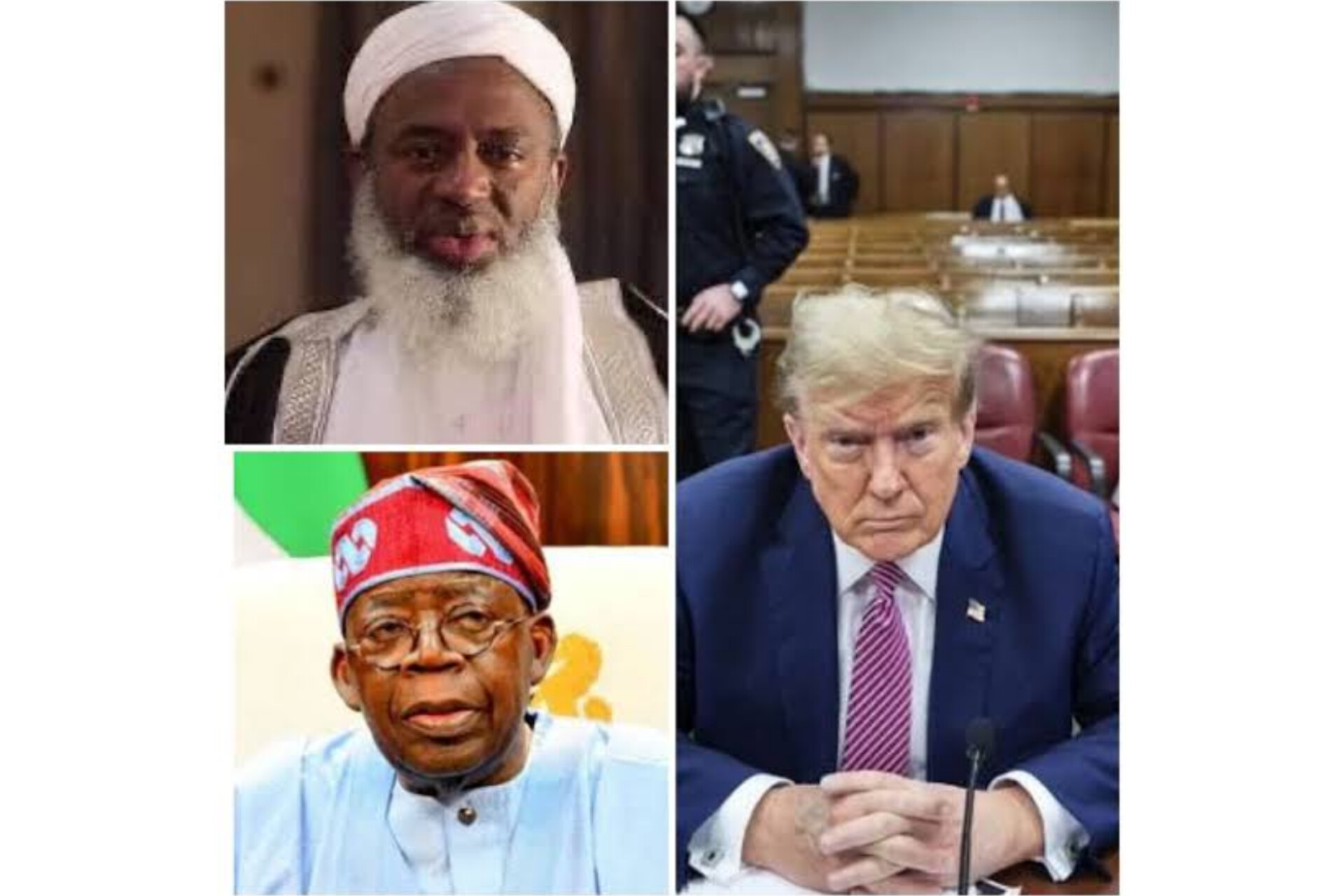
•Gumi, Tinubu and Trump
In a move that threatens to further inflame already heightened tensions surrounding the persistent violence in Nigeria’s Middle Belt, controversial Kaduna-based Muslim cleric Ahmad Gumi has alleged that Christian groups are staging fake mass killings by burying empty coffins and disseminating fabricated videos to perpetuate a narrative of Christian genocide.
Gumi’s assertion, made in a Facebook post on Wednesday, adds a volatile new dimension to the escalating debate over the nature and scale of religious-fuelled violence in the country.

His claim, which relies on the anonymous testimony of a doctor whose identity he has not revealed, has been met with skepticism and outrage from religious leaders and human rights advocates alike, reports Saturday Independent.
“Do you know that some Middle Belt Christian groups are now staging fake mass killings. They are burying empty coffins and recording the process as if real victims were killed, just to push the narrative of a Christian genocide,” Gumi wrote, attributing the information to an unnamed doctor.
“This is desperation at its peak. A disgrace. Manipulating information just to provoke hatred and international sympathy? I hope it’s not true!”
This allegation comes as international pressure mounts on the Nigerian government to address the ongoing violence.
Prominent American lawmakers, including Senators Ted Cruz and Representatives Riley Moore and Nancy Mace, have vocally condemned what they perceive as targeted killings of Christians, echoing a sentiment recently amplified by former U.S. President Donald Trump.
Trump, in a series of posts on Truth Social in October, asserted that “Christianity is facing an existential threat in Nigeria,” and blamed “radical Islamists” for a “mass slaughter.”
He even threatened military intervention, stating he would “deploy troops in Nigeria against terrorists allegedly targeting Nigerian Christians” if the Tinubu government failed to act decisively.
Gumi’s claim, therefore, arrives at a critical juncture, potentially undermining the legitimacy of mounting international concerns and providing ammunition for those who deny the severity or religious dimensions of the violence.
Critics argue that Gumi’s statement, lacking verifiable evidence, serves to deflect attention from the real suffering of victims, regardless of their religious affiliation.
They point to a well-documented history of attacks and displacement, particularly in the Middle Belt, often involving clashes between farmers and Fulani herdsmen, with religious undertones that have been exploited by extremist groups.
“These kinds of unsubstantiated allegations do nothing to help the situation,” said Rev. Joseph Hayab, Chairman of the Christian Association of Nigeria (CAN) in Kaduna State, when contacted for comment.
“They only deepen the wounds and erode trust between communities that desperately need to find a path to peaceful coexistence.”
He further challenged Gumi to provide concrete evidence to support his claims.
The timing of Gumi’s allegation also raises questions. It coincides with increased scrutiny from international organisations, including human rights watchdogs, who have documented numerous incidents of violence in the region, often with religious motivations.
Experts warn that the spread of misinformation and unsubstantiated claims like Gumi’s can have devastating consequences, further polarising communities and making it harder to address the root causes of the conflict.