

•Dr Dada
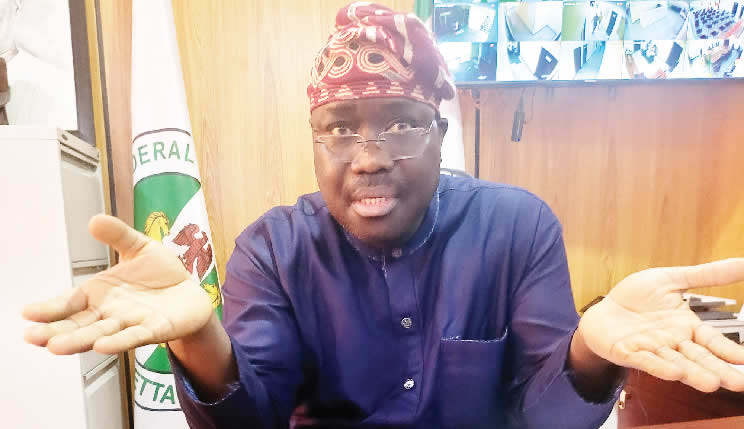
The Chief Medical Director of Federal Medical Centre, Ebute Metta, Lagos, Dr Adedamola Dada, in this interview explains measures being taken by the hospital to retain health workers and how health insurance can reduce quackery, reports The PUNCH.
Brain drain (japa) is a very big issue. How is the Japa syndrome affecting your facility and services to patients?
For us, we are expanding our services. And you can go round to see that we are expanding our services. And that is because once there is a problem, we don’t believe that we should fold our hands and let the problem overwhelm us. Rather, what do we do? We try to think through the problem and find a solution. One of the solutions that we have found is that in this city of Lagos, we have a lot of people who have the required skills, who are still strong, and who are retired; retired specialist consultants, retired nurses, and all the rest of them. So what we have done is to actively encourage these retired people out of retirement.
And then the second thing, as I said, is to create an enabling environment, a good environment, so that even those who are staying will prefer to stay with us. And that is what has been happening.
People are resigning. Some people are resigning. But I can tell you categorically that the impact has not been too severe on us. And that is not because people are not resigning, but it is because we have been able to design programmes and alternatives to ensure that we are in a position to replace some of these people who are resigning. Yes, it is a problem in the system, but we must not allow ourselves to be overwhelmed by problems.
In terms of numbers, like, how many of these retired nurses or doctors have you called back?
We’ve called back quite a number of them. If you are talking in terms of specialists alone, almost half of the specialists in my anaesthesia department, almost half of them are retired, and they are still strong, and they are still working. But you find out that in many other places, they probably have reduced the number of surgeries they are doing. But our own number, the number of surgeries we are doing, has not reduced. In fact, it has gone up. That is because we have been able to attract these specialists and experts who are still strong, who have retired to come back into practice, provide an enabling environment for them, and understand their need and their capacity.
This is happening in all departments. If you go to the gynaecology department, if you go to the surgical department, if you go to the paediatrics department, we have a lot of these retired specialists who are still very useful to the system, who are still very strong.
They are offering these services and they have nowhere to go because they are not going to Japa.
So, it also gives us a great deal of stability and capacity to plan ahead. So these are the challenges. We also recruit the new ones, but even if those ones go, we have a strong foundation formed by these people. These retired people are always there to offer the service and give us the leverage that we need to be able to attract newer hands to come and support them even if somebody resigns.
There’s no doubt that people are leaving. But what we have done is to create a hard core of those who will not leave.
The cost of IVF (In vitro fertilisation) treatment in Nigeria is expensive. How best do you think the government can come in to assist couples?
Like I said earlier, we are a hospital whose decisions are data-driven. One of the things that we found out from the data that is coming out is that we have a large load of patients who actually have these challenges (infertility). So, working on that, we have discovered that even if only 50 per cent of the patients that we have, who have these challenges, advanced to the level of seeking treatment via IVF, we will be able to hopefully crash the cost of IVF in the country by almost about 50 per cent. If we are able to do that, we are a government organisation; it, therefore, means that the government has been able to reduce the cost using the concept of economic volume
We have more volume. And because we have more volume and we are treating more patients, we’re going to be able to get the consumables and the inputs at a better rate than those who are doing it outside, and then we’ll be able to crash the cost.
IVF treatment is expensive and not really that accessible for average Nigerians. This is fuelling quacks and extortion of helpless couples desperately in need of children they can call their own. How best do you think some of these issues can be tackled by the government?
It is not just IVF care that quacks are getting into. Quacks are getting into very many spheres of healthcare delivery chains and services. If you are looking at Ophthalmology, quacks are getting into ophthalmology practice. Quacks are getting into orthopaedics practice. I’m sure you have heard of the traditional bone centres. Quacks are getting into delivery services, they’re getting into paediatrics. They’re getting everywhere.
One of the major things that we need to do which I know that the government is doing is to ensure that people have access to health care through the national health insurance scheme. I am sure you are aware that the national health insurance scheme has been made compulsory for all Nigerians. So, there is access. Once access is created and people don’t have to pay at the point of need, you just find out that fewer and fewer people would actually approach these untrained hands for their care because evidence abounds that usually what happens with this untrained hand is that they even complicate problems.
My own dissertation as an orthopaedic surgeon; when I was in my fellowship at the National Postgraduate Medical College, was on traditional bone centres and the complications that they cause in the healthcare system. And the result of that dissertation actually showed that a lot of havoc is caused by this group of people because they are not trained. Many of them cannot even recognise complications.
But once we create access, which this government is doing, then you find out that many more persons would approach the orthodox healthcare services and just naturally this other group would go down.
You have come up with a strategy to tackle the issue of brain drain in your hospital. How best do you think the government can actually handle the problem looking at the prediction that the country may lose 50 per cent of healthcare workers by 2025?
I have never believed in prophets of doom, and I have never premised my own strategy and plans on negativism. I always look at the positive side of things. I don’t believe that 50 per cent will leave in 2025. And in any case, we are producing. We are producing newer doctors and we know some of them are leaving.
See, it’s an international ecosystem. Medicine is an international profession. Nursing is an international profession. Pharmacy is an international provision. There is no country in the world where doctors do not exist. You go to the UK, and a lot of doctors are leaving the UK for Canada. A lot of doctors are leaving the UK for Australia. And because many doctors are leaving the United Kingdom for Canada and Australia, they are also coming to Africa to poach doctors and poach other healthcare workers.
You can’t compete with the salaries that have been paid in those places. Of course, improving the well-being of doctors nurses and healthcare workers is very important.
One of the things I have done is that every doctor that has resigned from this institution, I designed a questionnaire to ask them why they are leaving. And you find out that it’s not all of them who are leaving because of lack of money or inadequate remuneration. But some are also leaving because they are worried about the future of their children. Some of them are worried about what becomes of them after retirement. Some of them are worried about factors in the environment. All that we need to do is to actually improve those factors. Improve the remuneration, create an enabling environment, give hope and a good sense of security and all the rest of them.
It is not also the first time that this is happening. Don’t forget that in the 1980s, a lot of the Nigerian doctors actually left for the Middle East. And then after that, things stabilised when the economy improved.
If the economy of Nigeria improves, and we are very confident that the economy of Nigeria would improve, then a lot of these people who are leaving would be retained.
Don’t also forget that the grass is always greener on the other side. Today, if you ask a number of those who have left, and if you ask them if their finances have improved, they may say to you that the quality of life because of better road system, and better electricity has improved. But only a few of them will tell you that in terms of disposable income, they are a lot better because there are also strategic advantages here.
For one, we pay far less tax in this country compared to other countries. Also, despite the inflation that we’re all talking about, the cost of food and the cost of living in Nigeria comparatively is still a lot cheaper.
So, there’s a way these issues level out. And then part of the strategy that the government wants to do now is to produce more with the belief that when you produce more, some will leave, but more will be left.
For me, I don’t think there should be any need to panic. I think what we should just do is to improve our economy.
Courses such as medicine, nursing, pharmacy, physiotherapy, and laboratory sciences are international courses. They are wanted all over the world, and I don’t know of any country that has enough health workers to meet its set needs.
It doesn’t mean that people are not going, but what we just need to do is to sit down and find a way around it. People are resigning here in my own institution, but I have to sit down and look at my environment. What strategic advantage do I have? I make use of that strategic advantage to ensure that services and care of the patients who come here are not severely disrupted because people are leaving.
Anybody who wants to leave, I always shake their hands and wish them the best of luck. I’ve never held anybody back. But part of that also comes from the fact that, like I said, I have a hardcore foundation already in every department. When this problem started a couple of years ago, I knew that we needed to prepare for it.
You can argue that that is possible because we are in Lagos, where you have a lot of people. Yes, that’s a strategic advantage. So people should look inward and also look for strategic advantage that they can use to ensure that the problem does not overwhelm or negatively influence the system. Problems are meant to be solved by human beings.
Six years as CMD of FMC, Ebute Meta, how has the journey been so far?
It has been very interesting for me. It has given me the opportunity to actually contribute my own little quota for the development of the public health system.
When we started, it was quite challenging because first, as of that time, we had a 75-bed hospital. Today we are over 400-bed hospital. We had only three theatre suites when we started, but today we have 11 theatre suites.
In the last six years we have grown to, in my own opinion, become the most efficient public health institution in the country. And the Nigerian public has also shown their appreciation and understanding of the work we are doing.
So, six years is a long time and honestly, I’m extremely happy with what we have been able to achieve we still have quite a couple of years more and I am hoping that we’ll be able to consolidate and put the institution on a very strong footing.
Certainly, I have moved the institution from a little-known hospital to the hospital that has become more or less like a reference centre all over the country. Our patient load has increased in the last six years, obviously, because of the good services we have been rendering to Nigerians. Our facilities have tremendously expanded. And in terms of the quality of service that we have been giving to Nigerians.
During this period, what are the challenges faced by the institution and how do you tackle some of them?
The challenges have been in phases. The country itself has operated more or less in phases. When we first came in, we didn’t have too many challenges of human resources. The challenges we had when we first came in were the quality of service, the attitude of the health workers, the availability of facilities and infrastructure, and then of course, the need to modernise our operations.
So, that led us to actually bring up our five pillars strategic plan, which was one on human resources; to train the human resources that were able to actually deliver the kind of services that we need to deliver. So, train them not just in their jobs, but train them also in their attitudes. Train them in the need for them to be able to show compassion to patients and to be able to put themselves in the position of the patients, and then to generally create a welcoming environment that can calm down people who are truly very challenged by their network. So the human resources element was very important.
The second one was the quality of our care in terms of what type of services we are rendering to people. So, we had to bring in technical experts who actually helped us. And today, now we are the only public institution that is a level four safe care hospital. And the quality of our services is quite widely acknowledged.
Of course, we have not got to where we are going, but definitely, we are taking the right steps towards what we need to do.
The third area has to do with our infrastructural development and expansion of our services. We have expanded tremendously our services. We are from almost about 75- bedded hospital, we have become almost a 450 -bedded hospital. From a three theatre- suite hospital, we have become an eleven bedded theatre- hospital. From zero, almost near zero ICU (intensive care units). We have a 16-bed ICU today.
In terms of dialysis, also, at the time that we came in, the facility was almost nonexistent. Today, we have one of the most popular and one of the cheapest dialysis centre. We have a purpose-built paediatric centre with paediatrics medicine, with neonatal intensive care unit with paediatric ICU and paediatrics theatre.
We also today now have one of the best-equipped infectious disease wards. We have expanded our accident and emergency. And then, of course, we have our accident and emergency. If you go to our wards, we have modernised our wards and we have one of the best wards. We were the first public hospital that became totally paperless in terms of our clinical operation.
We have also started remote medical care through the use of telemedicine.
So, basically, the challenges had been in phases. Of course, today, now we are facing challenges of manpower, but we never believe that we must fold our hands and not take appropriate measures to actually solve our problems.
We have also identified that problem and in our own peculiar way, we have tried to solve it. Apart from expanding our services, like I said, the other thing we did was our finances. We reorganised our finances and automated our finances. Like, you know, every patient that comes to this hospital today is given what looks like an ATM, and every patient has a wallet. And the financial system and the clinical systems are integrated, so it is almost virtually impossible for you to access care without a financial backup, except if it is in the case of an emergency.
In the use of technology, we have remained the public hospital at the forefront of the deployment of technology to improve healthcare services and healthcare outcomes.
These are challenges that we had faced, and we had designed and devised methods to actually resolve those challenges. We have been able to create a conducive environment, not just for the workers, but for the patients. And to my mind, we have become one of the destinations of choice. We’re not competing with the public hospitals.
Actually, those we are competing with are the top-earned private hospitals in this state. And many of them actually have acknowledged that. And I am confident that the hospital, even after my tenure, will continue to do well. Of course, this building that has just been commissioned by the minister is further expanding our capacity.
So, we’re going into things like the IVF. We have opened an ophthalmology centre. We have a new clinic; Generally, I think we have been able to identify those challenges and we have not allowed those challenges to overwhelm us. In fact, we have allowed those challenges to motivate us and ensure that we are getting the best out of ourselves.