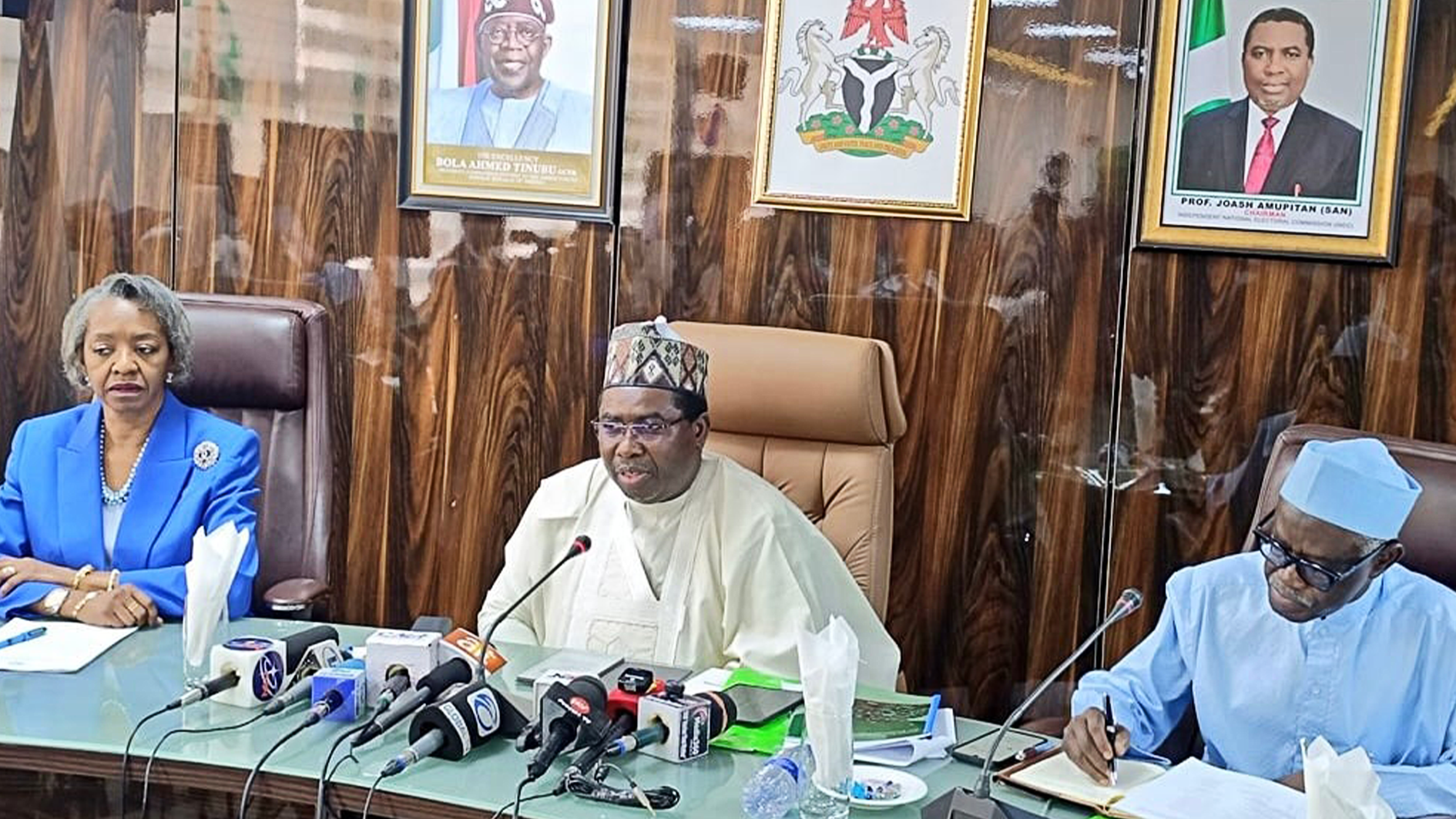
•INEC chairman Amupitan (C)
The chairman of the Independent National Electoral Commission (INEC), along with national commissioners, is meeting with chairmen and secretaries of political parties, ahead of the forthcoming Ekiti governorship election
Today’s engagement is one of the consultative meetings scheduled by the electoral umpire to review preparations for the Ekiti election, reports Channels TV.

It is holding exactly eleven days to the governorship election, which is scheduled for June 20th, 2026.
The meeting hopes to enable the political parties and the electoral umpire to put finishing touches on all the preparations for the Ekiti governorship election.
Amupitan Defends Appeal
In his opening remarks, the INEC chairman, Joash Amupitan, defended the commission’s decision to appeal the recent court judgment on the powers of the commission to set a timetable for elections, including that of setting timelines for pre-election activities for political parties, such as the conduct of primaries and the submission of the lists of candidates.
The chairman maintained that the decision, which upheld the powers of INEC to issue the election timetable on the one hand and, on the other hand, struck out the powers of INEC to set the timeline for political parties’ primaries, was inconsistent and therefore sought a clearer judicial pronouncement.
He said in Suit No. FHC/ABJ/CS/517/2026 — Youth Party v. INEC, delivered on 20 May 2026, the Federal High Court questioned certain timelines in the Commission’s timetable.
In a subsequent judgment in Suit No. FHC/ABJ/CS/720/2026 — Social Democratic Party (SDP) v. INEC, delivered on 26 May 2026, a separate court affirmed the Commission’s authority to issue an electoral timetable but nullified certain timelines relating to the nomination and substitution of candidates.
The INEC chief said the Commission had filed appeals against both decisions and taken the necessary legal steps to obtain authoritative pronouncements from the Appellate Courts.
According to him, the activities contained in the timetable were not isolated events but interrelated operational processes essential to the orderly conduct of elections.
Amupitan listed critical electoral activities for which the Electoral Act prescribed no express statutory timelines but which must nonetheless be accommodated within the overall electoral calendar. These include the submission and verification of party membership registers, the monitoring of party primaries across the Federation, the pre-upload of primary results on the Commission’s portal, the printing of ballot papers and result sheets, quality assurance procedures, the configuration of BVAS machines, and compliance with statutory obligations such as inviting political parties to inspect election materials pursuant to Section 42 of the Electoral Act 2026.
“The Commission therefore considers it imperative that all electoral activities be harmonised within a coherent and workable framework that promotes certainty, transparency, administrative efficiency and equal treatment of all political parties,” he said, assuring the public that, notwithstanding the pending appeals, INEC remained firmly committed to conducting the 2027 elections in strict compliance with the Constitution and the Electoral Act.