

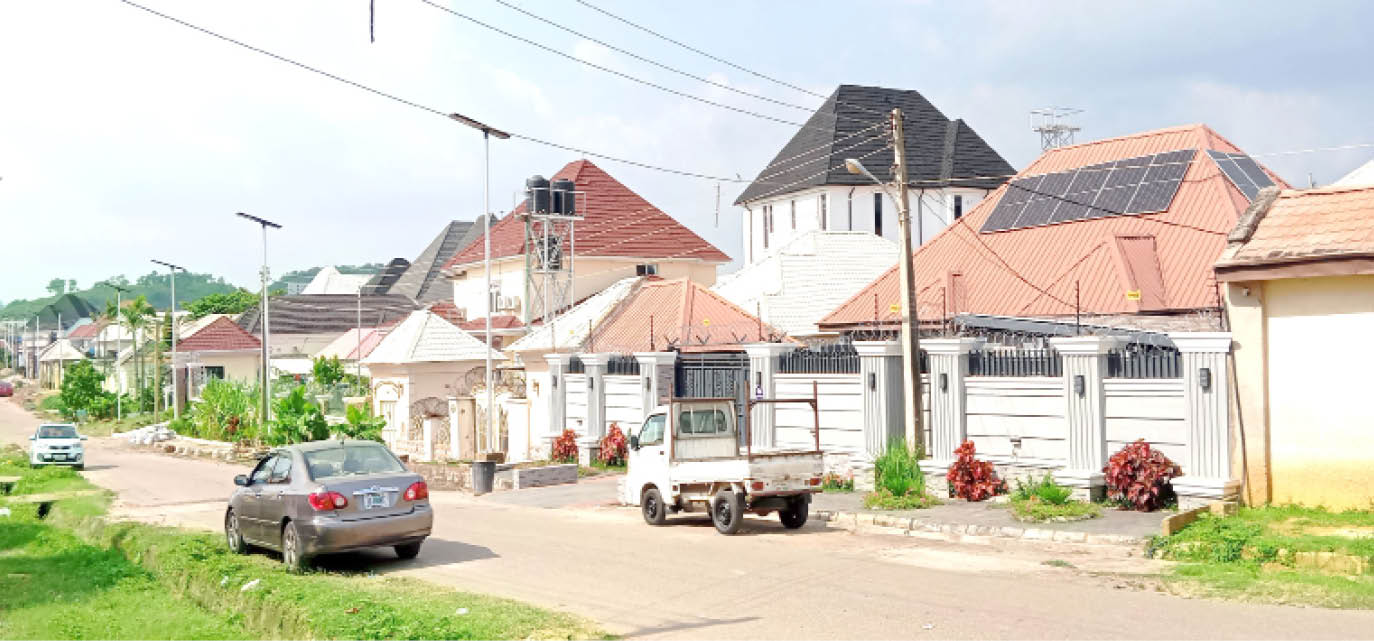
•Buildings at Zone C, Apo resettlement in the Federal Capital Territory, Abuja
Renting property in Abuja, Nigeria’s capital city, is increasingly becoming unaffordable for ordinary citizens, forcing many residents to relocate to suburban areas in neighbouring states, findings have revealed.
A shortage of affordable housing has driven up demand, leaving prospective tenants at the mercy of landlords who charge exorbitant rents, reports Daily Trust.

This situation is further compounded by the high cost of living and rising household expenses across the country.
Under Nigeria’s existing tenancy laws, landlords are permitted to collect rent up to 12 months in advance. However, investigations show that many Abuja landlords now demand payments of up to two years upfront — a practice that has made it even harder for prospective tenants to secure accommodation.
Experts note that rent control has been largely ineffective in Nigeria, as the real estate market is driven by private developers and shaped by market forces of demand and supply.
In Abuja, districts such as Guzape, Maitama, Asokoro, Wuse, Jabi, Wuye, and Gwarimpa are among the most expensive residential areas, with rents for a one-bedroom apartment reaching as high as N3 million — excluding additional costs such as legal, agency, and caution fees.
As a result, many Nigerians, including civil servants and low-income earners, have been compelled to relocate to neighbouring states in search of cheaper accommodation.
Popular relocation destinations include Suleja and Madalla in Niger State, as well as Mararaba, New Nyanya, Masaka, and Ado in Nasarawa State, where rents are significantly lower.
Residents said the daily commute to Abuja from these satellite towns is a small price to pay compared to the burden of rent in the capital city.
Suburbs to the rescue
Speaking with our correspondent on the issue, a civil servant, Olajide Bayo, said rents in the city centre have become unbearable in the last three years, increasing by between 100 and 300 percent without a corresponding improvement in infrastructure or facilities.
He attributed the surge to the high demand for housing, as most workers prefer to live close to their workplaces in the capital city.
“The government has not shown a serious commitment to developing estates for civil servants and the general public. I used to live in Apo Resettlement, where the rent for a one-bedroom flat was N500,000. Today, the same flat goes for between N1.5 million and N2.5 million. Many of us who couldn’t cope with the rising cost of living had to relocate,” Bayo said.
He added that he now resides in Mararaba with his family, where he pays N700,000 for a one-bedroom flat.
“It’s still expensive, but better than what I paid before,” he said.
Bayo criticised the government for focusing only on property taxation without addressing the poor state of infrastructure in existing estates.
“Even in government estates, roads are bad, waste management is poor, and healthcare facilities are nonexistent. The private sector is filling the housing gap, but the government lacks the power or will to regulate rent prices,” he said.
Similarly, Solomon Kumai, a private sector worker, said he was forced to leave Kubwa for Suleja due to rising rents.
“Three years ago, I was paying N400,000 in Kubwa, but my landlord doubled it to N800,000, and later to N1.6 million. My annual salary is N1.6 million — how can I pay all as rent? I had to move to Suleja, where I still pay N400,000 for the same kind of apartment,” he said.
For Keturah Danjuma, another civil servant, affordable housing is becoming impossible for low- and middle-income earners.
She said areas that were once affordable, such as Kubwa, Lugbe, Gwarimpa, and Lokogoma, have witnessed massive rent hikes.
“I lived in Lokogoma, paying N1 million for a two-bedroom flat, but last year my landlord raised it to N2 million. How can someone earning N70,000 minimum wage afford that? I moved to Zuba and now pay N700,000 for a two-bedroom, but my transport costs have doubled,” she said.
In Kubwa, Engineer Abbas Idris said his rent for a one-bedroom apartment rose from N500,000 to N1.5 million without explanation.
“Salaries aren’t increasing, but rents keep going up. When I searched for another place, I discovered that a self-contained now costs between N600,000 and N800,000, a one-bedroom N1 million to N1.2 million, and a two-bedroom up to N2 million. I eventually moved to Madalla,” he said.
In Kado Kuchi, a trader, Joshua Ilama, said landlords have become “greedy,” hiking rents beyond reason. “When I moved here in 2018, a self-contained unit was N150,000. Now it’s N600,000 to N800,000, while one-bedrooms are N1.5 million. Even mud houses covered with cement, known as Gbagyi houses, attract high rents,” he said.
Ilama said after the roads in the area were graded and tarred, landlords quickly increased rent.
“People are relocating to other suburbs because what you pay for a self-contained here can get you a one-bedroom elsewhere. Landlords should have mercy; everyone is struggling under this harsh economy,” he added.
For Jalo Mustapha, a civil servant, the situation is no different.
“I was paying N500,000 for a self-contained apartment in Life Camp, but my landlord increased it to N1.2 million. I had to move to Dakibiu, a small village near Jabi, where I pay N400,000. It’s sad and frustrating,” he said.
Landlords speak
House owners in Abuja have attributed the sharp rise in rent to Nigeria’s worsening economic conditions, citing soaring costs of building materials, maintenance, and taxes.
A landlord in the Apo Resettlement area, Nuhu Ahmadu, in a chat with our correspondent, attributed the surge in rent to Nigeria’s harsh economic realities, including rising costs of building materials, maintenance, and taxes.
“These factors make it difficult to keep rents stable. We are not being greedy; we’re only trying to stay afloat and maintain our properties.
“However, the rising cost of materials, maintenance, and taxes compels landlords to raise rents to meet expenses. We need enough funds to maintain our buildings, and rent increases are often the only way to keep up with repairs and general upkeep,” he said.
Another landlord in Jahi, Chinedu Akabueze, said both landlords and tenants face the same inflationary pressures.
“Both tenants and landlords buy from the same expensive markets. These properties are our lifelong investments, and we must maintain them in line with current economic realities. We sympathize with tenants, but the government is not helping either.
“The price of a bag of cement has increased by more than 150 percent — from about N4,000 to over N10,000. So, even minor maintenance now costs a fortune,” he said.
In Lugbe, another landlord, Christopher Danladi, said, “Many people wrongly assume that landlords raise rents for fun. That’s not true. Landlords are also victims of economic conditions. Those who blame landlords for high rents are either ignorant or overlooking the economic factors that justify such increases.”
Danladi explained that the cost of building materials has skyrocketed in recent years.
“For example, 6-inch and 9-inch blocks that used to sell for N200 and N300 two years ago now go for between N550 and N700, depending on location. A bag of cement now costs between N9,500 and N10,000, compared to less than N4,000 a few years ago. We also pay tenement rates and other levies.
“Besides, the cost of maintaining an existing building is no longer the same. Some houses require maintenance every two to five years, depending on their condition. And some tenants, frankly speaking, are reckless — they damage the property before leaving, forcing the landlord to spend heavily on repairs before renting it out again,” he said.
Danladi added that landlords should not be demonised for the prevailing housing situation.
A real estate expert, Abdullahi Sani, has attributed the soaring rent prices across Nigeria to the forces of demand and supply, worsened by economic instability and rising building costs.
Speaking to our correspondent, he explained that the sharp increase in the prices of construction materials naturally translates into higher rents.
“Since the removal of fuel subsidy and the unification of exchange rates, it hasn’t been easy for tenants to meet their rent obligations. Many properties remain vacant because people can no longer afford the rent. Currently, rents depend on location and design, and in highbrow areas, rent could go as high as N20 million yearly for a duplex,” he said.
Sani emphasised that housing is influenced by multiple factors.
“Land must be accessible, documentation and planning costs should be affordable, and financing—especially mortgage facilities—should be available and reasonable.
“The prices of building materials like cement have risen by over 100 percent in recent times, now selling for about N10,000 per bag. The same applies to iron rods and even local sand. Skilled labour is also costly and scarce. It might surprise you to know that we sometimes go as far as the Benin Republic to hire qualified tillers, plumbers, and electricians,” he said.
Offering a different perspective, a real estate agent based in Wuse, Abdullahi Musa, advised residents of the FCT to focus on home ownership instead of remaining lifelong tenants.
“The high cost of rent isn’t peculiar to Abuja. It’s the same story in Lagos, Calabar, Enugu, Ogun, Ibadan, and other cities. The removal of fuel subsidy has worsened things, but building materials have been rising long before that and are not likely to come down anytime soon,” he said.
Musa urged tenants to start saving and investing in their own properties, no matter how small. “No matter how long you live in a house, you can never become the landlord.
“You can begin by acquiring land in the suburbs and developing it gradually. “There’s a saying that, ‘brick by brick, a house is built.’ Once you cut unnecessary spending and make a conscious effort, you can own a home faster than you think. Every tenant should aim to become a landlord because rent prices will not decrease anytime soon,” he said.
No regulation yet for real estate sector – REDAN
The immediate past president of the Real Estate Developers Association of Nigeria (REDAN), Aliyu Wamakko, said the absence of a regulatory law for the real estate sector has made it vulnerable to abuse, particularly money laundering.
He revealed that during his tenure, REDAN developed the Real Estate Regulatory Council of Nigeria (RERCON) Bill 2023, aimed at fully regulating the sector and curbing illicit financial flows.
“The bill had inputs from all relevant stakeholders — state commissioners, regulatory institutions, and professionals in the built industry. It was passed by the 9th National Assembly and transmitted to President Tinubu for assent, but he declined to sign it,” Wamakko said.
He lamented that the lack of regulation has allowed individuals to use stolen public funds to construct unoccupied buildings across the country.
“Many of the houses you see are products of money laundering. The owners don’t even put up signage to indicate the estate developers because they are proceeds of crime. They simply keep building because they have excess illicit funds,” he said.