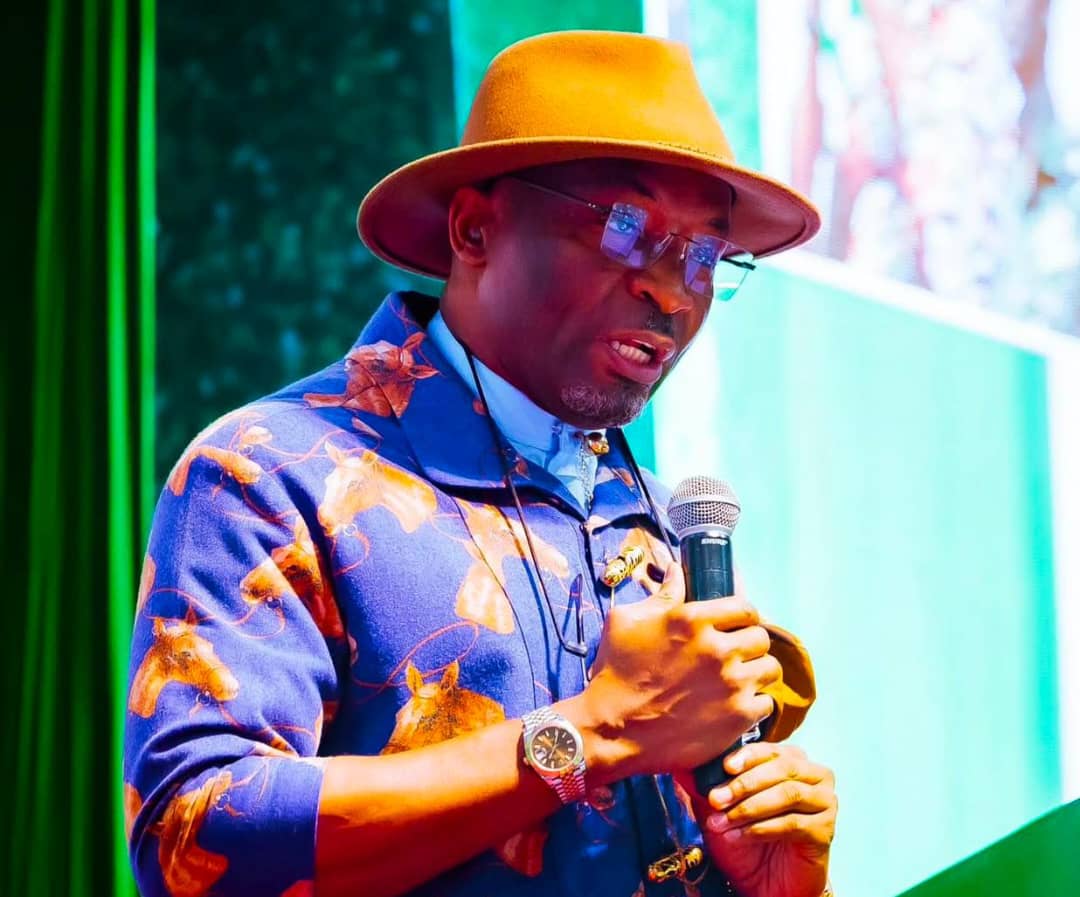
•Benjamin Okezie Kalu
Deputy Speaker of the House of Representatives, Rt. Hon. Benjamin Okezie Kalu, has insisted that the proposed establishment of state police must be driven by the imperative of protecting lives and property rather than serving political interests, warning that any decentralised policing structure must be insulated from abuse by those in power.
Kalu stated this yesterday while delivering his keynote address at the 2026 South-East Regional Security Summit themed, “Collaborative Approaches to Strengthening Security and Regional Stability.”
He argued that addressing the worsening security challenges in the South-East and across Nigeria requires stronger collaboration among governments, security agencies, communities and other critical stakeholders, reports Daily Independent.
The deputy speaker, who also chairs the House Committee on the Review of the 1999 Constitution, said Nigeria’s highly centralised policing system has become increasingly inadequate to meet the security demands of a large and diverse federation.
According to him, the proposal to establish state police is intended to bridge existing gaps in response time, local intelligence gathering and community policing while complementing, rather than replacing, the Nigeria Police Force.
Kalu referenced the Executive Bill, HB 2797, seeking the establishment of State Police Services and other related agencies, describing it as a timely response to the country’s evolving security realities.
He, however, cautioned that decentralising policing must not create opportunities for political intimidation or repression.
“The establishment of state police must be anchored on accountability, professionalism and service to the people. It must never become an instrument of political repression or partisan interests,” he said.
The deputy speaker assured Nigerians that the National Assembly would continue to pursue constitutional reforms necessary to establish state police while embedding robust safeguards to prevent abuse of the system.
He also commended President Bola Ahmed Tinubu for initiating reforms aimed at addressing structural deficiencies in Nigeria’s policing architecture, describing the proposed decentralisation as a significant step toward improving internal security.
Kalu further welcomed the federal government’s decision to expand the Nigerian Army from eight to twelve divisions and recruit approximately 28,000 additional personnel, saying the measure would enhance the country’s security capacity.
While acknowledging ongoing federal efforts, he maintained that security challenges, particularly in the South-East, require coordinated regional responses because criminal networks operate across state boundaries.
“Criminal networks do not recognise state boundaries. Our response must therefore be regional. The framework should include a joint intelligence-fusion mechanism, interoperable communication systems, coordinated patrols along inter-state routes, a shared database of wanted persons and criminal networks, and harmonised procedures for rapid response. Every distress call must reach the nearest capable security formation, irrespective of jurisdiction.
“Security agencies should also deepen intelligence-led operations. Checkpoints alone cannot defeat mobile and technologically enabled criminal groups. We require drones, geospatial mapping, forensic capability, automated vehicle identification, emergency communication systems and professionally managed surveillance infrastructure.
“Technology, however, cannot replace community trust. Residents usually know when strangers enter their forests, when abandoned buildings become criminal camps or when unusual arms move through their communities. They will provide information only when they believe their identity will be protected and their reports will lead to responsible action.
“We must consequently establish secure community-reporting channels, protect informants and strengthen collaboration with traditional rulers, town unions, youth organisations, women’s groups, transport unions and neighbourhood associations,” he said.
Beyond policing reforms, Kalu proposed the establishment of a permanent South-East Regional Security Coordination Council to institutionalise collaboration among the five states in tackling security threats.
He also advocated the creation of a shared regional intelligence platform to facilitate information exchange among security agencies and improve coordinated responses to emerging threats.
To ensure the summit produces measurable outcomes, the deputy speaker recommended that relevant institutions develop, within 60 days, a comprehensive operational framework outlining responsible agencies, funding requirements, implementation timelines and performance indicators.
He further urged participants to reconvene within six months to assess progress against agreed targets rather than merely holding another round of discussions.
“We should reconvene within six months — not merely to deliver speeches — but to evaluate measurable results,” he said.
Kalu pledged that the House of Representatives would continue to support security sector reforms through legislation, adequate appropriations and effective oversight to ensure public resources translate into improved safety for citizens.
He also stressed that insecurity has far-reaching consequences beyond the immediate loss of lives, noting that persistent violence has disrupted businesses, education and healthcare services while eroding investor confidence and slowing economic growth.
The deputy speaker commended the Federal Ministry of Defence and the Office of the Senior Special Assistant to the President on Community Engagement (South-East) for convening the summit, expressing hope that the gathering would produce a practical and coordinated regional security framework capable of addressing the unique security challenges confronting the South-East and, by extension, the country.