•Unwashed water storage
Mrs Nene Bristol has lived in the same compound for over 11 years. She moved to the house when she married her husband in January 2013.
The compound located in the Ada George area of River State, houses six flats and two bedrooms. The Bristols live in the two-bedroom apartment and share two big water tanks with the rest of the neighbours.
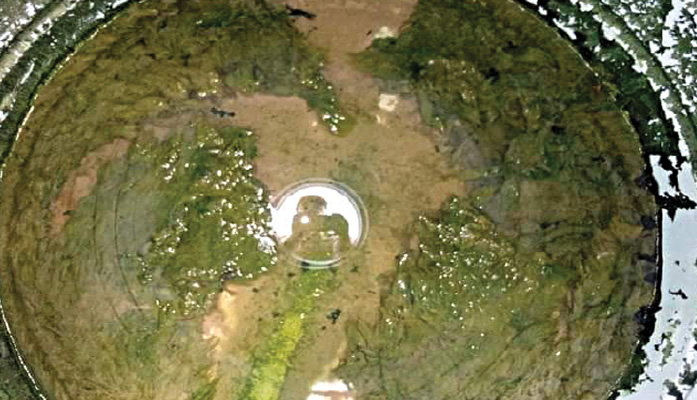
However, she told our correspondent that since she moved into the compound in 2013, the water tank had not been washed, reports Sunday PUNCH.
“It is even shocking to me right now that it has been 11 years already and they (the owners) have not washed it. There was one time when the water coming out from the tank was greenish and we contributed money for it to be treated.
“It took about three days for the water to return to normal but the chemical used for treatment was too harsh for some people. Some people with sensitive skin had rashes after using the water.
“Even my husband had a skin reaction and we had to buy loads of antibiotics thinking it was an infection of some sort until our dermatologist told us that it was a water-related skin infection. It was a major issue then but somehow it just didn’t cross our minds to wash the tank,” she said.
What is more, Mrs Bristol also told our correspondent that she used the water from the tank to cook, bathe, and sometimes, drank it when she could not afford to get sachet water (also known as ‘pure water’).
“I really don’t know how we can do it (wash the tank). The tank is so high up in the sky and it will be difficult. One time, a man said he would wash it, but others opposed it, saying no one should pour a detergent into the tank in the name of washing it; it has just been chaotic,” she added.
One of her neighbours in that same compound, who gave her name as Erefagha, told our correspondent that she stopped drinking the water from the tank when she found a dead frog inside it.
“I raised the issue in our WhatsApp group about the need to wash it but the rest of the tenants said it was unnecessary since we always pumped the water every two days. I simply use it to bathe and cook sometimes,” the mother of two said.
Erefagha said she moved into the compound in 2019 from an apartment in Eleme after her husband was dismissed from his former place of work.
“I moved into this compound in November and expected that the tank would be washed in December but I am shocked that it has been more than eight years and no one has thought to wash it even after there have been terrible cases of water-borne diseases in the compound,” she said.
Her only daughter, Tumini, almost lost her life days before her 17th birthday.
At seven, she picked an apple from the refrigerator and decided to wash it before eating, but that was where her problems began. After eating that apple, she began to experience stomach discomfort. She became restless and had beads of sweat forming around her head.
“Before we knew what was happening, Tumini was on the ground, writhing in pain. She vomited what looked like blood and was no longer talking. She was only seven years old at that time.
“We had to rush her to a clinic and she was admitted. The doctor, after many tests, asked what the last thing she ate was. It was examined and revealed that it was the water.
“I snapped the result and posted it on the compound’s WhatsApp group chat but no one believed me. That was the last time I drank that water.
“We are planning to relocate to another compound for this singular reason but the money has not come the way we want,” she added.
A resident of a small compound in the Ajao Estate area of Lagos State told our correspondent that the water storage tank in his compound had not been washed since he moved in in 2018.
“It is a bluish 1,500-litre tank and it is shared between me and my neighbour. We are both single people and we do the same job that makes us travel a lot of times. So, the water can just be in the tank for three months without anyone using it.
“I don’t think we have ever thought of washing it because it is even too high and climbing up there can be disastrous,” he added.
Omerua, who said he did not drink the water, stated that he used it to cook.
“I use it for cooking, sometimes, and I remember seeing a brownish colour once, and we called a plumber who said the pipe was blocked. He simply asked us to pump the water from the machine and we did and it became clear after some hours,” he noted.
Access to potable water
Many residents in many urban centres own boreholes with water storage tanks installed on a high beam or platform. These storage tanks, which are mostly plastic, can also be metal.
Without water, life cannot be sustained beyond a few days and the lack of access to adequate water supply leads to the spread of diseases.
Water of both acceptable quality and sufficient quantity is critical for proper human health and well-being.
For many years, attention has been focused on both access to and quality of water, but while access to safe water has significantly improved worldwide, quality appears to be further declining and it has been deteriorating more than proportionally to the economic and population growth.
Quality drinking water has acceptable chemical, physical, biological, and radiological characteristics, based on local and widely-acceptable international standards, such as World Health Organisation standards.
According to official data from the World Health Organisation, safe drinking water remains inaccessible to about 1.1 billion people in the world.
Those most susceptible to waterborne illnesses are children, the elderly, pregnant women, and immune-compromised individuals, making water-borne illnesses one of the five leading causes of death among children under age five.
A lecturer in the Department of Agricultural and Bioresources Engineering, University of Nigeria, Nsukka, Enugu State, Dr V. D. Chia, noted that domestic water supplies were among the fundamental requirements for human life.
He said, “Diarrhoea diseases, attributed to poor water supply, sanitation, and hygiene, account for 1.73 million deaths each year and contribute over 54 million disability-adjusted life years, a total equivalent to 3.7 per cent of the global burden of disease.
“The failure to provide safe drinking water and adequate sanitation services to all is perhaps the greatest development failure of the 20th century. If no action is taken to address unmet basic needs for water, as many as 135 million will die from these diseases by 2030.”
Public water supply is generally inadequate and, in most cases, inaccessible. The supply is intermittent and unreliable, thus resulting in high dependency on unsafe supplementary sources such as streams, hand-dug wells, and ponds.
As the population grows and urbanisation increases, more water is required, and greater demand is made for ground and surface water.
Nigerian cities are growing at an exponential rate of between 10 and 15 per cent, according to official figures from the National Bureau of Statistics.
Human activities, including soil fertility remediation, indiscriminate refuse, and waste disposal, and the use of septic tanks, soak-away pits, and pit latrines are on the increase.
For most communities, the most secure source of safe drinking water is pipe-borne water from municipal water treatment plants, which, in many cases, are mostly unwashed.
Sustainable Development Goal Six addresses universal and equitable access to safe and affordable drinking water.
This implies that all people in the world have the right to access water in the right amounts, quality, and cost, in a sustainable manner.
A 2019 report by the World Bank indicated that the proportion of the world’s population using safely managed drinking water services had been increasing, even before the adoption of the 2030 SDG.
However, the apex bank noted that despite these efforts, the world still faced an invisible crisis of poor water quality, which threatened among other things, the well-being of humans.
Also, the diminishing quality of water can be attributed to contamination at different points of the water supply system, including distribution and storage.
Although many local and international organisations have directed vast efforts toward the improvement of water quality, water contamination is still rampant.
Water storage, the main feature of the indirect water supply system and many other piped water supply systems has for many years been identified as a source of contamination of domestic water.
According to research by Dr Musa Manga of the Water Institute at UNC, Department of Environmental Sciences and Engineering, Gillings School of Global Public Health, University of North Carolina, United States of America, household water storage is fraught with many challenges which result in compromising the quality of water.
A survey conducted by our correspondent using Google Forms showed that out of 213 respondents, 181 said they had not washed their water storage tanks in the last five years.
More than 110 said they were not aware whether their tank had been washed or not. Over 13 per cent said they were not aware their water tanks were supposed to be washed because of how high it was placed.
Only nine per cent stated that their tanks were washed, at least, every year, which is still below the recommended standard of once every three months.
In Manga’s submission in the article, “The effect of household storage tanks/vessels and user practices on the quality of water,” he noted that water storage tanks did harbour several pathogens that cause different diseases and illnesses.
He stated, “Waterborne illnesses caused by bacteria found in contaminated household water storage tanks increase the risk of spreading waterborne diseases, and may lead to many infectious outbreaks.
“With the projection by the United Nations in 2018 that nearly six billion people will be faced with clean water scarcity by 2050, there is a critical need to investigate sources of water contamination.
“Several studies, many of which from the developing world, have investigated the impact of water storage on water quality.”
He further queried, “What features of storage tanks or vessels and user practices impact household water quality? How do the features of storage tanks or vessels and user practices affect household water quality? What can be done to mitigate the effects of the storage tank or vessel features and user practices on water quality?”
According to Pressure Wash Nigeria, the lack of air in the confined space of the tank is a comfortable ground for algae and bacteria buildup.
The group stressed that water storage cleaning should be thorough and regular.
Water storage tanks and contamination
A water storage cleaning company, Environ Waste Nigeria Limited, describes a water storage tank as any plastic, aluminum, or steel container that receives and stores water from either municipal treated water systems or underground boreholes.
Both sources, it noted in an article on its website, have problems associated with storing water in an enclosure for a while.
A list of contaminants possibly present in water storage tanks, according to EWNL, includes dissolved and suspended particles, organic compounds, including pesticides; toxic metals like lead and mercury, micro-organisms like protozoa, parasites, bacteria, and viruses; and additives like chlorine and fluorine, among others.
The presence of these contaminants, the resource noted, due to unclean tanks, might result in bio-accumulation of carcinogens.
“Regular cleaning of your water tank prevents rusting from inside and reduces the cost of maintenance and replacement. Cleaning your tank regularly adds value and improves the bottom line.
“The quality of drinking water is a powerful environmental determinant of health. Drinking water quality management has been a key pillar of primary prevention for over one and a half centuries and it continues to be the foundation for the prevention and control of waterborne diseases.
“Water is essential for life, but it can and does transmit disease in countries in all continents from the poorest to the wealthiest. The most predominant waterborne disease, diarrhoea, has an estimated annual incidence of 4.6 billion episodes and causes 2.2 million deaths every year,” it added.
How regularly should one clean a water storage tank?
The survey conducted by our correspondents among residents of Lagos, Port Harcourt, Ogun, Cross River, Akwa Ibom, Borno, Plateau, Abuja, and Benue states, showed that many people hardly clean their water tanks until someone falls ill from drinking the water.
Also, in a video posted by a Facebook user, Amaka Ozoemenam, in May, a set of monkeys were seen having a field day, swimming in an open water tank behind a house. They jumped in and out of the tank, splashing the water all over as though taking a bath, unknown to the residents.
But for a resident who was fortunate to record the incident on camera, no one would have been able to trace any contamination to the animals.
In another post on January 1, 2024, captioned, “When last did you wash your water tanks”, several users in the comment section were shocked that the water tanks were meant to be washed.
One of them wrote, “Dem dey wash am. I am sure we have not washed our own for more than 16 years.”
In replies, users solicited the help of professionals who could perform the service in Lagos, Ogun, Imo, Abuja, and some other urban areas.
A commenter, Sister Ogochukwu, said since she left the village more than 21 years ago, her mother’s water storage tank had not been washed.
“I know it is supposed to be washed but it is just my mother that is there, and she cannot do it. There are three big tanks installed on a beam. I am even ashamed of admitting this online, but I would appreciate all the help I can get,” she said when our correspondent messaged her privately.
However, a public health expert, Dr Fashina Olushola, said, “Just like our homes, cleaning services are also important for our tanks. Professional deep cleaning services should be carried out on our water tanks at least every six months.
“Water is the prime cause of most diseases, and if we drink or use dirty water regularly, it will surely lead to some serious health issues. Even if you don’t find anything wrong with your tank, you should properly clean it regularly to get it germ-free from some common smears like insects, ants, rats, etc.
“You should make it necessary to clean it if you get a hard water supply in your area because hard water contains a high level of dissolved solids.”
Cleaning water tanks a tough task
Cleaning water tanks is also a tough task that requires a lot of experience and well-versed tools, so it is always advisable to use professionals for all water tank cleaning services for efficiency. Professional water tank cleaning companies use all the latest tools and technologies to give the best services to their customers.
Speaking with our correspondent, a water storage cleaning expert, Ajunwoko Akachukwu, who is based in Owerri, Imo State, and has been in the business for more than six years, said, “Cleaning these water tanks is something we need to advocate because most Nigerians leave it until someone falls sick or dies or sees a snake before they call on professionals to come to clean it.
“Sometimes, they simply ask plumbers to do the job. Because of how hot the tank can be, having been closed for many years, and with the heat from the sun, the plumber may not be able to do a thorough job except if he has been trained on how these things are done.
“There are techniques to use and rules that must be obeyed so the cleaner does not introduce even worse germs to the tanks after washing.”
Another cleaner who operates in Abuja, Chikwado Ucheagwu, noted that stationary water was the best medium for the growth and multiplication of germs.
He said, “This is because most of these germs thrive inside water and when the water tank is not cleaned, they begin to breed their offspring inside the tank.
“If you bathe with infected water, you may experience things like skin irritation, allergies, and even hair fall and this will cause a health problem and will make you spend extra money on medication.
“It is obvious that you wouldn’t be drinking the water in your tank, right? You will bathe with it and also wash your clothes and utensils.
“Therefore, while you keep in touch with such contaminated water, you may get some skin infections. You must know that hard water ruins your hair, right? Similarly, if your water is contaminated by some toxic matter or some germs, don’t you think it will harm your skin?
“Of course, it will! Don’t think just groundwater can cause skin diseases, an uncleaned tank may also result in contamination of water. But you could easily avoid such skin diseases by cleaning the overhead water tank every 6 months or so.”
On how much it costs to have a tank washed, Ucheagwu explained, “The prices range for plastic tanks from as low as N5,000 to as high as N17,000 depending on the size of the tank and the level of the cleaning. Metal tanks cost more, ranging from N30,000 to N150,000, depending on the size and height.”
A water storage cleaning company, Lacreme, on its website, noted that a foul smell may develop in the water tank over time if it was unwashed.
“The bacteria that grow inside the water tank generate byproducts that include many chemicals and gases. These generate a foul smell in the water tank and the water supply coming through it.
“Algae easily reaches any wet or moist surface and starts growing rapidly; unless regularly controlled. If the tanks are not cleaned properly and regularly, the algae can get deposited on the bottom and walls of the tank, thus infecting the water.
“It is important that you contact a professional to get your water tank cleaned at least once a year. The process might take a few hours but the results will prove to be beneficial for your health as well as that of your family,” it added.
Speaking of water filtration, Lacreme noted that water filtration systems may not prove 100 per cent effective if the water tank was not clean.
“While it is true that most of us have water filtration systems installed in our houses and workplaces, they may not prove 100 per cent effective if the water coming from the tanks is not clean. They may prove effective against only certain kinds of particles and impurities but may not help prevent infections and thus certain kinds of water-related diseases,” it stated.
Tank cleaning and colour
Our correspondent gathered that the colour of the tank may determine how regularly the tank should be cleaned.
A microbiologist, Dr Ayub Ayub, said if coloured tanks were washed and not rinsed properly, the microbial growth may be more than before, especially with it being under the sun and being enclosed for months.
He added that the best way to rinse was with a pressure washer so that the soap suds the films on the interior of the container and doesn’t get etched inside of it.
When it gets etched inside, Ayub noted that it would attract more microbes to it. He also gave a distinction between how hard and soft water might react in different environments.
He explained, “Hard water is water with more calcium and magnesium. It can be checked by knowing the parts per million, based on size. Soft water is mostly like distilled water, made by boiling water in a boiler or sort, and extracting the steam to another container where it can be condensed back to the water, that will be distilled water.
“Most water tanks will deliver hard water. Most boreholes are hard water. You need some altered or hard water for drinking. In America and even Brazil, they add fluoride and other minimum things in the water, after processing it, to their water delivery main water line – the one that will be used for homes.
“Hard water with microbe opportunities will quickly adhere to the walls of the interior tank, and their strong adhesive offshoots will expand to their piping and also in your bucket or faucet. With one or two cycles of sun exposure, microbes will etch to the walls of the container,” he noted.
The microbiologist also noted that most of the coloured containers needed to be washed at least twice or thrice a year, adding that black tanks could be washed twice.
Another microbiologist and public health expert, Sampson Allison, said the colour of the tank and how often water is pumped into the tank would determine how much cleaning it needs and when.
He said, “Borehole water often contains particles – sand in particular – and even if you filter the sand, the sunlight that hits your water tank promotes the growth of microorganisms – typically bacteria your eyes cannot see – that still contaminate the water.
“Furthermore, if like many Nigerians, you don’t drink directly from your borehole or storage tank, the contaminated water can still make you sick because you brush your teeth with it, shower with it, and cook with it.”
Speaking on the colour of water storage tanks, he said, “Plastic water storage tanks in Nigeria come in black, red, blue, or green. Black is the most popular colour as it comes in the regular 2,000 litres.
“The heat a plastic water storage tank absorbs from sunlight coupled with the moist nature of its interior encourages the growth of bacteria like E. coli over time. However, the interior of a black tank is coated with a material that makes it block, rather than absorb, much of the sunlight.
“Therefore, microorganisms take longer to accumulate inside a black tank. This means that black tanks require the least frequent cleaning, as they also cost the most. You should clean them at least twice a year.
“Conversely, the interiors of most red, blue, and green tanks are not coated with a reflective material, so bacteria form faster in these tanks. You should clean these tanks at least four times a year depending on how often you pump water into them.”
However, a water resources engineer, Dr Sophie Longjohn, said that the more often a user pumps fresh water from a borehole into their water storage tank, the less frequently they need to clean the tank.
Longjohn said, “This is due to the fact that your tank becomes dirtier the longer water remains in it. Ideally, you should pump fresh water from your borehole every day and use all the water in your tank. By doing this, water in your tank won’t remain in it for too long. But doing so puts more strain on your borehole, and you might need to use a small water storage tank to get through the water faster.
“Now, since 2,000-litre tanks are the most common, your home, like the majority of Nigerian homes, most likely has a large tank and you don’t pump water every day.
“In light of this, cleaning your tank according to its color is definitely a better idea than determining how frequently you fill it with water. This implies that at least once a year for a black tank and at least three times a year for other colours.”