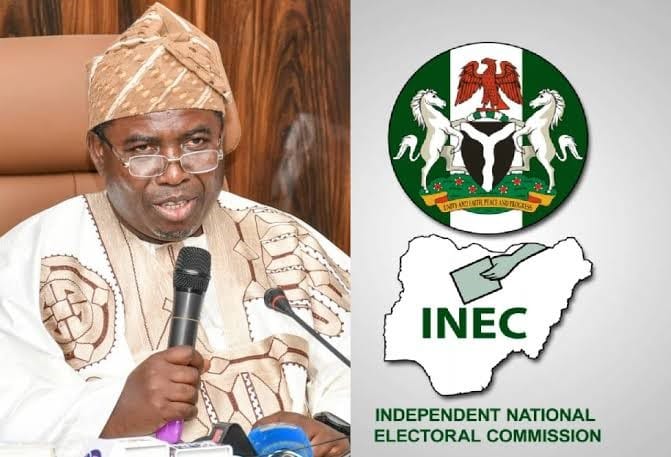
•INEC chairman, Prof. Joash Amupitan
Chairman of the Independent National Electoral Commission (INEC), Prof. Joash Amupitan, has said the success of next year’s general election will depend not only on the preparedness of the commission but also on the commitment of political parties to uphold democratic principles, respect the rule of law, conduct transparent primaries, discourage violence, hate speech, and vote-buying and promote issue-based campaigns.
Amupitan spoke yesterday in Abuja at a meeting with leaders of political parties, reports The Nation.
The INEC chairman expressed concern about several cases bordering on leadership of the parties still pending in various courts, describing them as “unnecessary distraction”.
He called for a quick resolution of the issues without further delay.
Amupitan said INEC values the critical role political parties play in the nation’s democratic process and recognised that credible elections would only be achieved through constructive partnership among all stakeholders and stay committed to maintaining open channels of communication to ensure that policies, regulations, operational plans and timelines were clearly understood by all stakeholders.
The INEC chairman reminded the party leaders that “the credibility of elections depends on our collective commitment to the rule of law, democratic values, and the integrity of the electoral process”.
He assured all that “the commission remains independent, impartial in the discharge of its constitutional responsibilities and firmly committed to ensuring that every valid vote counts and that the will of the Nigerian people is faithfully reflected in electoral outcomes”.
Amupitan added: “We shall continue to provide a level playing field for all political parties and candidates, while ensuring strict adherence to the Constitution, the Electoral Act, and all relevant guidelines.”
The INEC chairman announced that the commission had issued the Regulations and Guidelines for Political Parties and the conduct of elections in line with Section 151 of the Electoral Act, 2026, and acknowledged the conclusion of party primaries in the relevant jurisdictions.
He said the primary election process remained the gateway to democratic governance, adding that its credibility directly impacts the quality and integrity of the electoral process.
According to him, following the conclusion of the primaries, INEC is transitioning to the candidate nomination phase.
Amupitan also announced that “on Friday, June 26, the commission will issue official access codes to all political parties for the purpose of accessing the candidate nomination portal”.
He added: “These access codes will enable designated national officers of political parties to upload the names, personal particulars and other required information relating to nominated candidates.
“I urge political parties to ensure that their ICT personnel and relevant officers are adequately prepared and that all submissions are completed well before the stipulated deadlines. The portal is fully automated and will close automatically at the expiration of the prescribed period.”
The INEC chairman also assured the parties that the commission remained committed to expanding voter access and ensuring that all eligible citizens are afforded the opportunity to participate in the democratic process and the data of every registered voter is protected.
He said: “The current phase of the Continuous Voter Registration (CVR) exercise provides an important opportunity for eligible Nigerians who have attained the age of 18 years, as well as voters seeking transfers, corrections or updates of their records, to register and regularise their voter information.
“As political parties with structures in every ward and community across the country, I urge you to intensify voter education and mobilisation efforts so that eligible citizens take advantage of this opportunity and subsequently collect their Permanent Voter Cards.”
Speaking on the judgment of the Federal High Court on the electoral timetable, the INEC chairman said the commission had carefully considered the two judgments on the scope of its powers to prescribe timelines for electoral activities delivered on May 20 and 26.
He stressed that while the commission remained fully respectful of the decisions of the courts and of the judicial process generally, such judgments raised important legal questions about the extent of the commission’s constitutional and statutory powers in coordinating and regulating electoral activities.
Amupitan noted that in view of the differing conclusions reached in the judgments and in order to ensure certainty and stability in preparations for the 2027 general election, the commission has filed appeals against the decisions and had taken the necessary legal steps to obtain authoritative pronouncements from the appellate courts.
He said: “The commission’s position remains that the activities contained in the timetable and schedule of activities are not isolated events. They are interrelated operational processes designed to ensure the orderly, transparent and successful conduct of elections.
“While the Electoral Act prescribes timelines for certain activities, there are several critical electoral processes for which no express statutory timelines are provided but which must necessarily be accommodated within the overall electoral calendar. The absence of coordinated timelines for such activities would create uncertainty, disrupt election planning and undermine the commission’s constitutional responsibility to organise, undertake, and supervise elections in an efficient and credible manner.
“These activities include, among others, the submission and verification of party membership registers; the monitoring of party primaries across the Federation; the pre-upload of the names of winners of monitored primaries by political parties on the commission’s designated portal as an accountability mechanism aimed at strengthening internal party democracy.”
The activities, the INEC chairman said, also include “the nomination process itself; the printing of ballot papers and result sheets; quality assurance procedures; deployment of election materials; training of election personnel; voter education and sensitisation activities; procurement of sensitive materials, the configuration of the BVAS machines and compliance with statutory obligations, such as inviting political parties to inspect samples of electoral materials pursuant to Section 42 of the Electoral Act, 2026”.
He also said: “Sometimes, environmental factors are also key, such as the weather that calls for the early deployment of sensitive materials and the terrain where those materials are to be deployed. The commission, therefore, considers it imperative that all electoral activities be harmonised within a coherent and workable framework that promotes certainty, transparency, administrative efficiency and equal treatment of all political parties.”
Amupitan assured political parties and the Nigerians that notwithstanding the pending appeals, the commission remained firmly committed to conducting the 2027 general election in strict compliance with the Constitution, the Electoral Act and all lawful judicial pronouncements.
Chairman of the Interparty Advisory Council (IPAC), Yusuf Dantalle, said every patriotic Nigerian aspires to see a democratic system that is inclusive, transparent, accountable, and responsive to the needs and expectations of the people.
He noted that the success of any electoral process begins long before Election Day.
According to him, an “starts with the credibility, transparency, and legitimacy of the processes through which political parties nominate candidates for public office”.
Dantalle added: “Political parties remain the primary vehicles for democratic participation and electoral competition. Consequently, the integrity of the electoral process is fundamentally linked to the integrity of internal party processes.
“The nomination of candidates by political parties for the 2027 general election officially concluded on Saturday, May 30, 2026, in accordance with the timetable and schedule of activities released by INEC. However, the conduct of these primaries exposed significant legal, administrative, and operational challenges that deserve urgent national attention.
“Political parties encountered unprecedented difficulties in conducting primaries for the offices of the President, governor, senator, member of the House of Representatives, and member of the State House of Assembly. These challenges arose largely from the restrictive provisions of Section 84(2) of the Electoral Act, 2026, which limited parties to either consensus or direct primaries, effectively eliminating the option of indirect primaries.”
The IPAC chief said the experience gained during the just-concluded nomination demonstrated that the removal of indirect primaries created considerable constraints for political parties, adding that in many instances, parties adopted the consensus option, despite the existence of multiple aspirants who had duly purchased expression of interest and nomination forms.
Dantalle said: “Several aspirants were persuaded, and, in some cases, pressured to withdraw from the contest after preferred candidates had been identified by influential party stakeholders. While some aspirants accepted these arrangements in the interest of party unity, others challenged their exclusion, arguing that genuine consensus requires the voluntary agreement of all contestants. Consequently, several disputes have found their way to the courts, creating uncertainty and avoidable tension within the political system.
“Furthermore, the enormous financial and logistical demands associated with direct primaries presented significant challenges, particularly for political parties that do not control governmental resources. Faced with these realities, some parties adopted extraordinary measures to avoid circumstances that could necessitate direct primaries.
“In some cases, nomination forms were not made widely available to prospective aspirants. In others, the congress and primary election schedules were not publicly announced promptly to minimise potential disputes.
“These developments constitute an unfortunate and unintended consequence of the current legal framework governing party primaries.”
The IPAC chief expressed concern about the uncertainty generated by conflicting judicial pronouncements regarding INEC’s powers to regulate and fix timelines for party primaries and the resolution of disputes arising therefrom.
He said: “While one court nullified aspects of the commission’s timetable, another subsequently affirmed INEC’s authority in that regard. This situation has created confusion among political parties, candidates, and other stakeholders. Although the commission has appealed the earlier judgment, the existence of conflicting decisions on critical electoral matters undermines public confidence and introduces avoidable uncertainty into the democratic process. The events surrounding the recently concluded primaries have unfortunately validated many of the concerns previously raised by the council.
“Accordingly, IPAC calls on the National Assembly, in collaboration with relevant stakeholders, to undertake a comprehensive review of the Electoral Act 2026 with a view to addressing the operational deficiencies revealed during the nomination process. Electoral laws should promote democratic participation, strengthen political institutions, and advance the national interest rather than create avoidable obstacles to effective political competition.
“IPAC, therefore, urges political actors across the country to embrace issue-based campaigns and reject all forms of violence, intimidation, hate speech, and political extremism. Democracy thrives on healthy competition of ideas, not confrontation and bloodshed.
“We equally call upon security agencies to discharge their constitutional and statutory responsibilities with professionalism, neutrality, and diligence to ensure a peaceful political environment throughout the electoral cycle.
“As the nation’s electoral management body, INEC occupies a pivotal position in Nigeria’s democratic architecture. The commission must continue to uphold the highest standards of impartiality, professionalism, transparency, and accountability. All political parties and candidates must be accorded equal treatment and provided with a level playing field.
“The confidence of Nigerians and the international community in our electoral system depends substantially on the integrity, independence, and credibility of the commission. We, therefore, urge INEC to remain steadfast in the discharge of its constitutional mandate.
“As the umbrella body of all registered political parties in Nigeria, the Inter-Party Advisory Council remains committed to constructive engagement and collaboration with INEC, the National Assembly, security agencies, civil society organisations, development partners, and all other stakeholders in the collective effort to deepen democratic governance and strengthen electoral integrity in our country.”