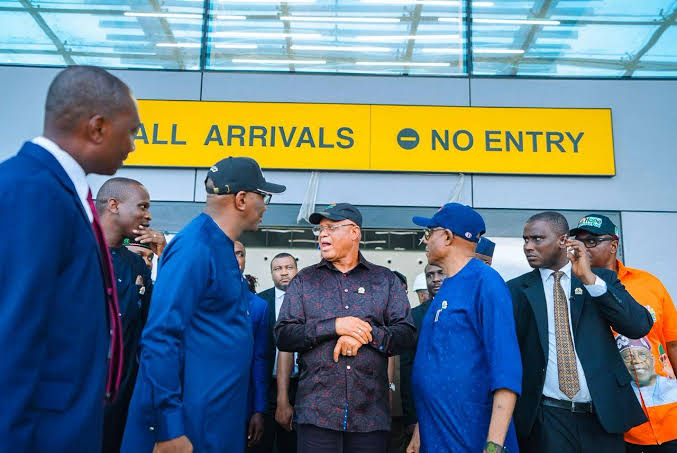
•Governor Umo Eno (C)
This is the Akwa Ibom story of vision, patriotism, and continuity in governance.
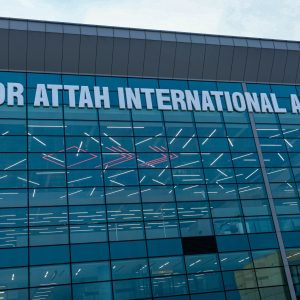
The eyes, they say, are windows to the soul. Governor Umo Eno gave life to this expression as his eyes glowed with quiet radiance while he sat at the airport ceremony on Saturday, May 2, 2026, marking the commencement of international flights from Victor Attah International Airport (VAIA), Uyo, to Kotoka International Airport, Ghana.
To a discerning observer, he appeared the most fulfilled and quietly elated participant at the event. The reason was not far-fetched.
Through his gaze, one could perceive a man consciously restraining his joy, careful not to display it too openly. It was reminiscent of a husband deeply enamored with his bride, containing his excitement outwardly while inwardly immersed in admiration, pride, and fulfillment. That was the emotion that defined the moment for him.

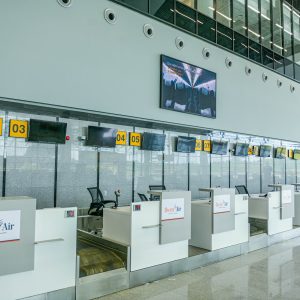
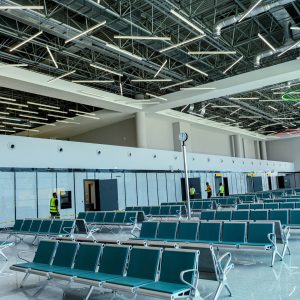
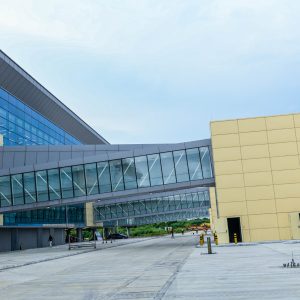
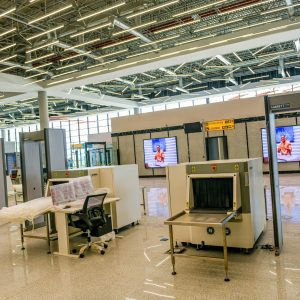
This sense of fulfillment was entirely justified. The New Terminal Building, as rightly clarified by Nigeria’s Minister of Aviation, Festus Keyamo, SAN, is more than a terminal. It is Nigeria’s emerging transit hub and a powerful symbol of collective aspiration. For Akwa Ibom people across generations, it represents a dream realized and a legacy sustained.
In reflecting on this achievement, it is natural to acknowledge the contributions of past leaders whose visions laid the foundation for this moment. His Excellency Arc. Obong Victor Attah, His Excellency Senator Godswill Akpabio, GCON, and His Excellency Mr. Udom Emmanuel each played defining roles in shaping what has now become a landmark success. Their efforts did not fade with time. Instead, they have continued to evolve and flourish under the stewardship of Pastor Umo Eno.
For Governor Umo Eno, therefore, the significance of this milestone runs deeper than the ceremony itself. It represents a consolidation of a legacy that has come to define Akwa Ibom State. The Victor Attah International Airport stands today as one of the clearest expressions of vision, patriotism, and continuity in governance.
The origin of this journey can be traced to Governor Victor Attah, who conceived the airport project and secured the land in the face of considerable resistance from host communities and critics. Despite these challenges, he initiated the foundational work in 2006 and set the vision in motion.
Building on this foundation, Governor Godswill Akpabio advanced the project to a historic milestone with the landing of the first aircraft on September 23, 2009. That day remains etched in the collective memory of the state. Thousands of residents and indigenes gathered, many trekking long distances, to witness the event. The overwhelming turnout made it impossible for the Governor’s convoy to access the venue, necessitating his continuation of the journey in a police backup vehicle.
Governor Udom Emmanuel sustained and expanded this trajectory. His administration delivered the Maintenance, Repair and Overhaul facility, developed the international wing, and established Ibom Air. At inception, the airline faced significant skepticism, with critics dismissing it as another unsustainable venture. However, its launch on June 7, 2019 marked a turning point. In the years since, Ibom Air has steadily demonstrated viability, reinforcing the effectiveness of a business-oriented approach to governance.
This progression set the stage for the current administration. Governor Umo Eno has elevated VAIA to a new level of relevance and capacity. His government has delivered the Aviation Village, a world-class airport hospital, and expanded the fleet with additional Airbus aircraft. More importantly, the commencement of international flights and the planned activation of the cargo component signal a strategic repositioning of the airport within both national and regional aviation networks.
As a result of these cumulative efforts, VAIA has evolved into more than an infrastructure project. Operated by the Ibom Airport Development Company Limited, it now represents a complete lifecycle of vision, from conception through growth to maturity, driven by resilience, foresight, and innovation.
This evolution also reflects a broader governance philosophy. Akwa Ibom’s aviation success is rooted in deliberate long-term planning and a commitment to managing public resources with business discipline. This approach is increasingly yielding tangible outcomes, as the state becomes more accessible and attractive to investors and global partners.
The implications of this progress are significant. With sustained growth, the state is gradually strengthening its capacity for internal revenue generation. This reduces dependence on federal allocations and advances the broader objective of economic diversification. Under Pastor Umo Eno, the vision of a post-oil economy is steadily taking shape.
Within this context, the terminal itself represents more than physical infrastructure. Its integrated design, accommodating both domestic and international operations within a single framework, reflects a practical response to operational inefficiencies in the aviation sector. It is a model of thoughtful execution grounded in user experience and service delivery.

In the final analysis, the story of Victor Attah International Airport is ultimately a story of leadership. It demonstrates what is possible when vision is sustained across administrations and aligned with purpose. It also reinforces a central principle of effective governance, which is the consistent delivery of value to the people.