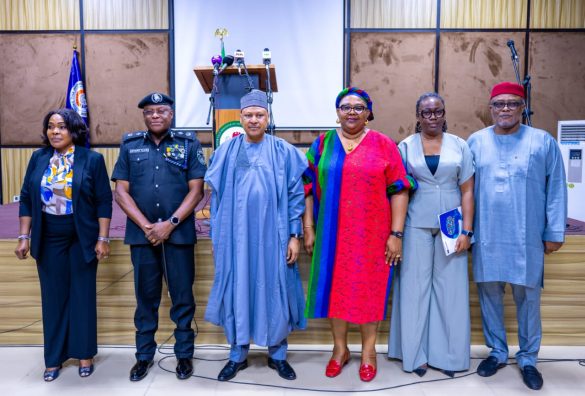
•Information minister, Mohammed Idris (C)
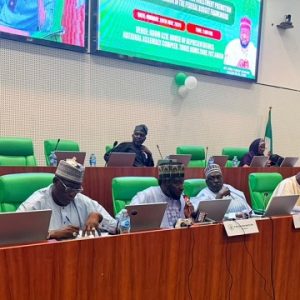
The federal government yesterday declared that Nigeria is positioning itself as a global hub for tackling fake news and misinformation, as top government and security officials underscored the critical role of a free but responsible press in safeguarding democracy, national security, and development.
Minister of Information and National Orientation, Mohammed Idris, made this known during the commemoration of the 2026 World Press Freedom Day in Abuja, where he stressed that Nigeria, in partnership with international bodies, is ready to lead global efforts in addressing information disorder, reports Daily Independent.

Idris said the rise of digital platforms, social media, and artificial intelligence has significantly transformed the information ecosystem, creating both opportunities and risks.
“While these advancements have expanded access to information, they have also amplified the dangers of misinformation and disinformation, which threaten public trust, national cohesion, and security,” he said.
He revealed that Nigeria, working closely with UNESCO, had secured the hosting rights for a major global media initiative after a rigorous selection process, noting that the country would serve as a centre for developing solutions to fake news.
“We will provide that hope for the global community to find lasting solutions to the issues of fake news and misinformation,” Idris stated.
The minister reaffirmed the government’s commitment to press freedom, describing it as a cornerstone of democracy, while also cautioning that such freedom must be exercised with responsibility.
“As we approach future elections, the role of the media becomes even more critical. The media must provide accurate, timely, and verified information while resisting harmful narratives capable of undermining democratic processes,” he added.
Earlier, the Director-General of the Department of State Services (DSS), Mr. Tosin Adeola Ajayi, highlighted the delicate balance between press freedom and national security, noting that both must coexist within clearly defined legal and ethical boundaries.
Ajayi described press freedom as a fundamental human right and a key driver of development, transparency, and accountability, but warned that unrestrained information flow without responsibility could pose risks.
“Press freedom and national security are not permanent adversaries. In mature societies, both coexist through clear laws, responsible institutions, and ethical journalism,” he said.
He explained that while security agencies rely on confidentiality for operations such as intelligence gathering and counter-terrorism, excessive secrecy could erode public trust and weaken democratic accountability.
“Secrecy without accountability breeds suspicion, while transparency without caution can create vulnerability. The goal is to strike a principled balance,” he noted.
Ajayi also urged media professionals to exercise sound editorial judgment, particularly in times of crisis, to avoid compromising national security or endangering lives.
He further called for sustained engagement between the media and security institutions through regular briefings and structured communication channels to reduce friction and build trust.
On his part, the Acting Inspector-General of Police, (IGP) Olatunji Rilwan Disu, reaffirmed the Nigeria Police Force’s commitment to protecting journalists and upholding press freedom.
Represented by Anthony Okon Placid, a Deputy Commissioner of Police, and Police Public Relations Officer, Disu described the media as a critical partner in national security, emphasising its role in conflict prevention, intelligence gathering, and promoting accountability.
“There can be no sustainable development or lasting security without the free flow of accurate information. A free press is not just a component of democracy, it is what sustains it,” he said.
He assured journalists that the police would continue to strengthen engagement protocols to ensure they can operate without fear of harassment or intimidation.
“Any infringement on the rights of journalists is an affront to the rule of law, and we remain committed to investigating and addressing such violations,” Disu added.
However, he cautioned media practitioners against the spread of unverified information, warning that misinformation could fuel unrest and threaten national stability.
“As gatekeepers of truth, the responsibility on the media is greater than ever. Ethical journalism is essential in an era where false information can spread rapidly,” he said.
Stakeholders at the event agreed that collaboration among government, security agencies, and the media is essential to building a peaceful, informed, and democratic society, stressing that while press freedom must be protected, it must go hand in hand with professionalism, accountability, and a shared commitment to national interest.