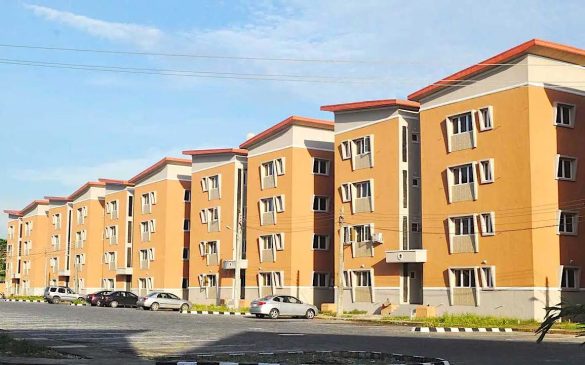
•A housing estate
Decades of policy failures and an inability to sustain initiatives have left millions of Nigerians without adequate housing. Despite new government programs aiming to address the escalating crisis, which sees the nation facing one of the continent’s most severe housing shortages, ordinary citizens remain trapped by issues of quality, accessibility, and affordability, with the dream of homeownership slipping further from reach, reports Saturday Independent.
Nigeria’s housing crisis has emerged as one of the country’s most persistent social and economic challenges.
Despite decades of promises, multiple government programs, and loud announcements of “breakthrough” initiatives, millions of Nigerians continue to live in inadequate, unsafe, or unaffordable housing.
New projects, while commendable in ambition, struggle to meet the demands of the country’s growing population and rapidly urbanising cities, leaving ordinary citizens trapped in a cycle of uncertainty and unfulfilled promises.
From Lagos to Kano, the shortage is not just a matter of numbers; it is about quality, accessibility, and affordability, and the failure to sustain pro-people policies across successive administrations. For many Nigerians, the dream of owning a home remains an elusive hope.
Nigeria faces one of the most severe housing shortages on the African continent. According to the Federal Ministry of Housing and Urban Development, 15.2 million housing units nationwide are structurally inadequate, meaning they physically exist but fail to meet basic standards of safety, habitability, and access to essential services such as water, sanitation, and electricity.
Broader estimates, including those from industry analysts, place the overall housing deficit at over 20 million units, with some analyses suggesting the figure could be as high as 28 million.
The mismatch between population growth, urban migration, and housing delivery underscores both a quantitative and qualitative crisis.
To close this gap, the federal government estimates Nigeria must deliver 550,000 new housing units annually over the next decade, a target that current production levels fall far short of achieving.
At present, housing construction and delivery continue to lag behind urban population growth, resulting in widespread informal settlements, slums, and overcrowded conditions in major cities.
A senior staff member of the Ministry of Housing and Urban Development, speaking on condition of anonymity, emphasised ongoing efforts under Minister Arc. Musa Ahmed Dangiwa’s leadership.
“The Ministry has been repositioned for impact across all 774 Local Government Areas of the country. First, with the Renewed Hope Cities Program (RHCP), we are on the verge of commissioning 3,112 housing units at Karsana, Abuja. There are different housing types with various subscription options like outright purchase, mortgage, installment, and rent-to-own.
“In Lagos State, 1,500 units at Ibeju-Lekki and 2,000 units in Kano will soon be commissioned under the RHCP. Additionally, 14 other locations nationwide have Renewed Hope Estates under construction, each with 250 units. All these aim to deepen access and affordability for Nigerians.
“Let me also tell you that plans for the Renewed Hope Social Housing Program (RHSHP) are underway, targeting low- and no-income individuals with 100 units in each of the 774 Local Government Areas. The package is substantial, and the dream is lofty,” he said.
The ministry credits the public-private partnership (PPP) model with the relative speed of these projects, while acknowledging that budgetary constraints have slowed other programs. PPPs allow private developers to fund, build, and sometimes manage housing projects while the government provides land, guarantees, or incentives. The Ministry believes this model could be replicated nationwide to scale delivery, especially for affordable housing.
For decades, housing policy in Nigeria has suffered from policy discontinuity and weak institutional memory. Mr. Dan Igho, a prominent Abuja-based real estate player, highlighted the historical failures: “Successive administrations have acknowledged the housing deficit but have consistently struggled, unsuccessfully, to address it. Frequent reversals and abandonment of previous programs have undermined long-term planning and discouraged private-sector confidence.”
He cited examples of what could have been achieved with continuity and political will: “In the South-West, Governor Lateef Jakande of Lagos State, building on Chief Obafemi Awolowo’s welfare-driven development philosophy, implemented mass housing and urban planning programs whose impact was widely felt. Other states in the West keyed into it. These initiatives expanded access to housing for low- and middle-income earners.
“Imagine if subsequent governments, both military and civilian, had continued progressively with such noble initiatives. Instead, they dismantled or abandoned these programs rather than consolidating them nationwide.”
This cycle of short-lived programmes and abandoned projects has prevented Nigeria from creating a sustainable housing ecosystem.
Experts note that without long-term policy continuity, it is nearly impossible to maintain the institutional structures, regulatory enforcement, and investor confidence necessary for large-scale housing delivery.
We cannot overlook structural challenges like funding, land, and building materials. It is apparent that chronic underfunding continues to hinder progress.
While closing the housing gap requires trillions of naira, allocations to the sector remain disproportionately low. Institutions such as the Federal Mortgage Bank of Nigeria and the National Housing Fund are undercapitalised, while high interest rates place home financing out of reach for most Nigerians.
Land acquisition is equally problematic and cumbersome. Procedures under the Land Use Act, fragmented regulatory frameworks, and weak enforcement of building standards deter investment and slow housing delivery.
Mr. Justin Langar, a surveyor, explained: “Private developers could bridge the gap if building materials were affordable and accessible to all. But the geometric rise in the cost of building materials, most of which are imported, and the scarcity of land in accessible locations make homes unaffordable.
Many estates sit empty for years until the rich or well-connected acquire them. Government intervention in land matters, building materials, infrastructure, and security is essential.”
Another significant issue is the rising construction costs, inflation, and foreign exchange volatility, all of which compound the problem. For instance, the price of cement, steel, and other essentials has doubled or tripled over the last decade. This has often made even mid-range homes unaffordable for the average Nigerian family.
Imagine if the Ajaokuta Steel Complex and other steel development companies in Nigeria were optimally operational. Imagine if cement factories were ubiquitous, including those owned by state and federal governments. This would obliterate monopolies, making liveable homes available everywhere and ultimately discouraging urbanisation and informal settlements.
Nigeria’s population, currently estimated at over 230 million, is urbanising at an unprecedented rate. Lagos alone hosts over 25 million people, while Abuja, Kano, and Port Harcourt are rapidly expanding.
Urban migration is driving demand far beyond supply, creating sprawling informal settlements, slums, and overcrowded apartment complexes.
Experts warn that without comprehensive urban planning and housing policies, Nigeria risks creating generations of citizens living in substandard conditions.
In cities like Lagos, it is not uncommon for a single room to house an entire family, lacking access to clean water, sanitation, or electricity.
While government intervention is critical, the private sector remains indispensable. Private developers, supported by tax reliefs, land incentives, and PPPs, can deliver affordable homes. Expanding mortgage markets, with backing from banks and institutions like the Nigerian Mortgage Refinancing Company, could improve homeownership.
Innovative construction methods, local material production, and modular building technologies can further reduce costs and speed delivery, while institutional capital from pension funds and insurance firms could provide long-term financing.
Countries such as Kenya, South Africa, and Ghana have leveraged such strategies with measurable success, proving that partnerships and innovative finance can bridge housing deficits when combined with political will.
Nigerians have been asking: Can “Renewed Hope” Deliver? President Tinubu’s administration has made housing a central development priority, introducing structured programs like the Renewed Hope Housing Programme and promoting public-private partnerships.
Institutional reforms and data-driven initiatives aim to strengthen planning and investor confidence. Yet, ordinary Nigerians remain skeptical.
Funding gaps, land-access constraints, and infrastructure deficits continue to slow large-scale delivery. Critics argue that when these homes are eventually delivered, low-income citizens may still be priced out.
The ministry maintains that steady progress is being made, but lasting solutions will depend on policy continuity, land reform, deeper mortgage markets, and consistent funding commitments.
The shameful human cost of Nigeria’s housing crisis is the result of decades of underinvestment, policy failure, and rapid urbanisation. Shelter is a basic human need, yet millions remain without safe or affordable homes.
Imagine a single mother in Lagos or Abuja, earning barely ₦100,000 monthly. What kind of home can such a monthly income secure for her? Even with the Renewed Hope estates, access remains limited.
Low-income workers cannot afford to rent decent homes, nor can they afford mortgages or outright purchases.
Remember that transportation fares, healthcare, and feeding also consume from the income. For millions of Nigerians in this category, the promise of housing remains a distant hope.
The government’s actions in the coming years will determine whether Nigerians will finally enjoy the dignity of decent housing or whether the crisis will continue as another unfulfilled promise.
By all means, Nigerians want the illusion to end. Nigerians deserve to live in decent homes in their own country, free from overcrowding, insecurity, and perpetual uncertainty.