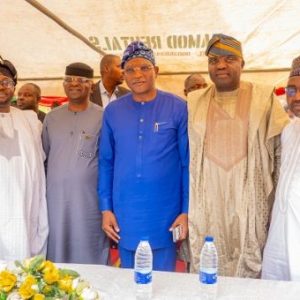
•CJN Justice Kudirat Kekere-Ekun, AGF Lateef Fagbemi (SAN), and Senate President Godswill Akpabio
As Nigerians await the signature of President Bola Tinubu on the four major tax Bills recently passed by the National Assembly, this piece explores what makes the Bills innovative and how they will affect the average Nigerian, reports Nigerian Tribune.
The National Assembly recently passed four major tax Bills that could change how the average Nigerian earns, spend and pay tax; these Bills are now waiting for the president to sign them into law.
The development according to lawmakers, are reforms meant to simplify the system, raise more money for government services and make tax collection fairer to all.
The move, described by the leader of the 10th Senate, Opeyemi Bamidele, as transiting from the archaic tax regime that has been retarding Nigeria’s collective prosperity to a progressive alternative that places businesses and people at the core of its general principles, has elicited debates at the National Economic Council (NEC), the National Assembly and diverse fora.
Taxation has long been a sensitive issue in Nigeria for decades as many fail to understand the nitty gritty of the system and usually consider it to be too complex, inefficient and inequitable; leaving poor Nigerians with additional burden and frustration, leading to tax evasion, poor compliance, and lack of trust in the system.
According to experts, this is about to be a thing of the past with the introduction of four tax reform bills: the Nigeria Tax Bill 2024, the Tax Administration Bill, the Nigeria Revenue Service Establishment Bill and the Joint Revenue Board Establishment Bill.
Speaking on the new Bills, a financial expert, Segun Onagoruwa, the Managing Partner at Vertex Consulting Limited, explained that the Bills are meant to create a tax system that works for everyone, adding that, “The new tax reforms represent a bold and comprehensive step toward creating a system that works for everyone.
“From individuals who benefit from higher allowances and lower tax burdens to businesses that receive support for growth and from the federal government’s potential to increase revenue to regions and local governments that are incentivised to develop economically, these reforms promise a more inclusive and progressive future.”
Answering questions on whether the Tax Reform Bills are truly regressive or antithetical to people’s aspirations, as some state governments have claimed, Bamidele said, “since the last democratic transition in May 2023, these are grim realities that we have been contending with or have to contend with not just as a government sworn in ‘to pursue the greatest amount of good for the greatest number of people,’ but as a people hungrily desirous of speedy socio-economic breakthrough. We are not supposed to play politics with such issues of significant public interest or prioritise parochial interests above people’s welfare. “Rather, we are under the obligation to address these stark socio-economic realities in the overall interest of our people with creative and innovative legislative proposals that can rejuvenate productive activities nationwide and take away undue burden off the shoulders of the masses and business owners.”
He added that the Tax Reform Bills, a set of four legislative initiatives were creatively designed to empower Nigerians across all strata and boost the country’s economic growth, adding that the bills are not a product of fiat but rooted in people’s aspiration for greater good and their quest for a federation that is built on equity, equality and justice which are the three key principles that define the health and life of every multicultural state like Nigeria.
Shedding light on the Tax Reform Bills 2024 which he said do not represent what some stakeholders have been painting in the public space, the Senate leader pointed at five factors to explain what they were designed to accomplish reiterating that they reflect a commitment to equity, efficiency and sustainable development by the present government.
“Why am I so convinced about the values the new tax initiatives will add once enacted? As people often say, books are judged by their contents and not by their covers. This dictum too applies directly to the proposals, which experts agree connote a set of ideas whose time has come.
“In the same way, my conviction is wrapped up in five takeaways I am sharing forthwith. The first takeaway specifically revolves around the review of the sharing formula of the value-added tax, VAT, accrued to all the federation. Under Section 77, the Nigeria Tax Administration Bill proposes a reduction of Value Added Tax distributable to the federal government from 15per cent to 10 per cent. The bill also concedes 55 per cent to state governments and 35 per cent to the local government councils,” he said.
Under Section 40, the 2004 Value Added Tax Act stipulated that a 20 per cent derivation shall be reflected in the distribution of the allocation amongst states and local governments but the reform bill under Section 22(12) recommended that a 60 per cent derivation shall be reflected in the sharing of Value Added Tax standing to the credit of states and local governments in the spirit of fairness and justice.
“The provision was introduced to dissuade some state governments from dropping litigation against the federal government with respect to Value Added Tax. Because Value Added Tax is considered a residual matter, some state governments challenged the power of the federal government to collect and administer Value Added Tax, and they won in the courts of first and second instances.
“But the need to prevent the cases of non-remittances inspired the federal government to step in and collect Value Added Tax on behalf of the federation. So, increasing the derivation from 20 per cent to 60 per cent will be motivation for the litigants to drop the suit,” he said.
He added that it also provides for boosting of the economic competitiveness of the sub-national entities, Section 22 (5-9) of the Nigeria Tax Administration Bill recommends zero Value Added Tax on exports and essential consumptions by the masses to boost the trade competitiveness of Nigeria on the global stage, crash the rising food prices and bring huge relief to 133 million citizens now classified as multi-dimensionally poor; all citizens, regardless of their social status or economic standing, will enjoy outright tax exemption on such essential items as food, education, and healthcare. Also Chapter 2 of the Nigeria Tax Bill sets a threshold that covers all employees earning N800,000 and below annually as well as all minimum wage earners or all low-income households within the threshold to enjoy outright exemption from personal income tax with a view to boosting their purchasing powers and de-escalating food inflation; it equally exempts small businesses from the payment of taxes and offers relief under Section 56 of the Nigeria Tax Bill via a significant reduction in company income tax rather than sticking to the subsisting regime that multiplies their tax obligations.
Nigeria’s new tax reform bills
The Nigeria Tax Bill 2025: This rewrites and combines most of Nigeria’s existing federal tax laws; income tax, VAT, capital gains tax, etc. into one single law in a bid to clean-up and update all messy and outdated tax rules. It affects everyone; salary earners and small business owners to big companies especially if you earn less than ₦800,000 per year because you won’t pay personal income tax; if you are laid off and severance pay is up to ₦50 million, it is tax-free.
Also, if you run a small business (turnover under ₦50 million), you don’t have to pay company income tax or withholding tax and there is no increase in VAT (still 7.5 percent) while basic stuff like food, rent, education and public transport stays VAT-free. However, big companies with ₦20 billion plus turnover must pay more if they’re underpaying tax.
Main changes reflected here are merges of all key tax laws into one, expansion of tax-free thresholds and exempts essentials from VAT, introduction of Development Levy (4per cent) to replace old levies like TETFund tax;this is also exempted for small businesses and capital gains will now be taxed at the same rate as company income.
The Nigeria Tax Administration Bill 2025: This creates a single national rulebook for how taxes are collected across federal, state, and local governments. It’s about making tax administration more consistent and technology-driven but it involves people now dealing with more digital tax processes like e-filing, e-invoicing and online portals.
However, the state and local government area of the individual will get a bigger share of VAT revenue based and there are clearer and stricter penalties for tax default.
The basic change is that it introduces a new VAT sharing formula; 55 per cent to states, 35per cent to LGAs and 10per cent to the federal government, tax is now allocated based on place of consumption where the goods/services are used,it mandates tech adoption: electronic invoicing, digital record-keeping, and data-sharing and closes loopholes.
The Nigeria Revenue Service (Establishment) Bill 2025: This scraps the Federal Inland Revenue Service (FIRS) and replaces it with a rebranded and restructured Nigeria Revenue Service (NRS) with new leadership, clearer roles, and more oversight.
It basically affects businesses as they are the ones who pay federal tax (apart from individuals who live in the FCT who pay federal tax). The basic change is that it introduces new leadership roles; executive vice chairman and an independent board), FIRS becomes NRS with a broader national mandate, reduced admin cost: NRS will keep 2 per cent of collected taxes instead of 4 per cent and gives more power to support or partner with state tax offices.
The Joint Revenue Board (Establishment) Bill 2025 establishes the Joint Revenue Board (JRB); a national body to coordinate taxes across all levels of government and resolve disputes between taxpayers and tax authorities.
This gives two options for tax complaints: the Tax Appeal Tribunal which is stronger and independent and brand new Tax Ombudsman who helps resolve disputes or unfair treatment. This allows for better coordination between the federal, state and LGA tax offices and aids reduction in multiple taxation.
Under this law, the old Joint Tax Board is upgraded to the Joint Revenue Board with more power, the Tax Appeal Tribunal already existed but now has a stronger legal foundation and broader powers as it can hear more types of disputes, not just federal tax, the Tax Ombudsman is new; it is an independent office where you can complain if you are being treated unfairly and federal and state tax agencies can now officially collaborate and support each other.
New or update of existing law?
The Nigeria Tax Bill, 2025 is mostly an update but it is a big one. It simplifies and modernises old laws, adds clearer rules and closes loopholes.
The Nigeria Tax Administration Bill 2025 is a brand new law which creates a national system to manage all taxes consistently.
The Nigeria Revenue Service (Establishment) Bill 2025 is an enhancement because it is still the tax office but with a new name and new structure.
The Joint Revenue Board (Establishment) Bill 2025 is a mixture of both the old and the new; the tribunal existed before but it’s now stronger while the Tax Ombudsman is completely new.
These new laws basically translates to more money in your pocket if you earn less or run a small business, no new taxes and essentials stay tax-free, clearer, fairer processes with ways to challenge bad tax treatment and better funding for your state and local government through smarter vat sharing.
These reforms, according to experts, offer real benefits to everyday Nigerians but while many Nigerians will see their tax burdens ease, high-income earners may not fare as well. The new progressive taxation system means that wealthier individuals will contribute a larger share. However, low- and middle-income earners stand to gain the most.
According to Onagoruwa, “The tax reforms aim to alleviate the burden on low and middle-income earners by raising the tax threshold and introducing progressive income tax rates. With the introduction of a new tax band and increased personal allowances, more Nigerians will be taxed less or not at all, leading to greater disposable income and financial relief.”
He said the tax reform bill could help reduce the everyday costs for average Nigerians as one of the main changes is that more essential items will be exempt from VAT (Value Added Tax).
This is a major win for families, especially those on low budgets. Also, locally made goods may become more affordable due to tax reliefs, encouraging citizens to buy Nigerian products.
A boost in local production can stabilise prices, reduce import dependency and support job creation, indirectly benefiting households while tax breaks on locally produced products will encourage Nigerians to buy more local goods and consequently boost local industries, reduce reliance on imports and create jobs.
The reforms also bring good news for small and medium-sized businesses (SMEs). A key part of the reforms is the increase in the turnover threshold for Corporate Income Tax (CIT) exemptions. Businesses with turnovers below ₦50 million (up from ₦25 million) will be exempt from CIT.
A panacea to Nigeria’s problems?
Whether the tax reforms are the solution to Nigeria’s challenges is mainly be dependent on how effectively they are implemented though it has the potential to improve everyday life for Nigerians if they lead to increased government revenue, which is then properly allocated.
If well-executed, the reforms could lay a foundation for long-term economic stability and reduced costs. However, without mitigating measures, they risk exacerbating financial pressures on Nigerians, particularly the poor and middle class.
According to Taiwo Oyedele, the Chairman, Presidential Fiscal Policy and Tax Reforms Committee said this is the tax reform that will favour all Nigerians; individuals, small businesses, businesses and investments as well as sub-national government. He said, for households and individuals including the youth, there is complete exemption of low-income earners up to N1m p.a. (about N83k per month) from PAYE, reduced PAYE tax for those earning a monthly salary of N1.7m or less, zero (0%) VAT on food, healthcare, education, electricity generation and transmission, VAT exemption on transportation, renewable energy, CNG, baby products, sanitary towels, rent and fuel products, tax break for wage award and transport subsidy to low-income earners, tax incentives for employers to hire more people incrementally than in the previous three years, exemption of stamp duties on rent below N10m, PAYE tax exemption for other rank and armed forces fighting insecurity, friendly tax rules for remote workers and digital nomads and clarity on taxation of digital assets to avoid double taxation and allow deduction for losses
And for small businesses, there is increase in tax exemption threshold for small businesses from annual turnover of N25m to N50m, exemption from company income tax for small businesses (tax at 0 percent), no withholding tax deduction on business income of small businesses, exemption from the requirement to deduct and account for tax on payments to vendors, simplified statement of accounts attested to by small business owner for tax returns in place of audited financial statements, outlaw cash payment and physical roadblocks imposing burden on businesses and attractive tax regime to encourage formalisation of business and facilitate growth
And as the bills await the president’s signature and stakeholders’ look forward to the effectiveness of the implementation, the agreed consensus is that there is something in the tax bills for everyone.