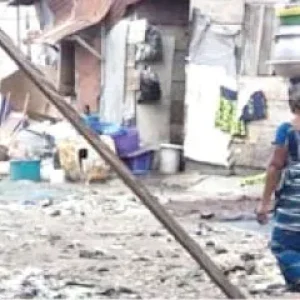
•Young girls in IDP camp
Every morning, as Maiduguri wakes to the hustle and bustle of traffic and business activities, a group of people wake up to a different reality, where what reigns supreme now in the IDP camp is the growing sex-for food crisis most teenage girls in the camp are now engaged in.
Teenage girls trading sex for food is a form of survival sex driven by extreme poverty, food insecurity, and humanitarian crises, a norm often reported in conflict zones, and occasionally within impoverished communities. This phenomenon forces young girls to engage in sexual activity to meet basic nutritional and comfort needs for themselves or their families, Weekend Trust reports on the deteriorating situation amongst teenage girls in Borno IDP camp.

Waking up not to constant discomfort and pain in makeshift structures built from trampoline, zinc and thatched roofs at temporary locations, a place allien to what they once were used to, they live off the streets in EYN Internally Displaced (IDP) Camp, an unofficial camp located in the Jerusalem area of Maiduguri, the Borno State capital.
For them, the makeshift structures are not just shelters, but the last remaining symbol of privacy and dignity they have, after years of losing everything to insurgents that struck their villages and displaced them.
For them, sleeping in the makeshift or open space feels safer than sleeping with one eye closed in their troubled villages in Gwoza LGA, where they face frequent Boko Haram attacks.
Unfortunately, instead of feeling safe and finding comfort in the makeshift arrangement provided by the government and good Samaritans, their children, especially their teenage daughters, have become prey for men and paedophiles, who take advantage of their vulnerable situation in the camp.
Ironically, aside from the despair and frustration that come with these distressing stories and the helpless situation most displaced persons have found themselves in, the trauma has pushed many fathers into a coma and left most mothers depressed and hypertensive.
In the Camp, hot and dust-laden summer winds have made the conditions more dire for the old, children and adults who have consistently strived to survive the increasingly harsh conditions.
Speaking with our correspondent, the camp chairman, Mr John Gwoma, displaced from Ngoshe fourteen years ago, noted that they have been living in temporary shanties since then.
“Throughout these years, life has been a daily struggle for us here. These fragile structures only provide little protection against harsh weather. Many families are exposed to the extreme heat, rain, cold and hunger,” he said.
He said, amidst struggles for survival, an increasingly troubling development that has continued to give the camp leadership sleepless nights is unwanted pregnancies by teenage girls, and most times, underaged girls too.
Sadly, he notes that the rate of abortion, which is most times unsafely done is scary.
According to him, following the withdrawal of food support by the UN agencies and other donor organisations, their children have become targets of paedophiles from the town.
“Life is tough; finding food, water, and a little comfort has become very hard. So, these minors and innocent girls are quietly selling sex, getting pregnant and aborting their pregnancy in the camp in exchange for food.
“Men from the town come in luxury cars, take these young girls, take advantage of them and impregnate them. As a result, we now have cases of unsafe abortions in this camp.
“The female toilets have turned into butchery-like hubs, frequently covered with blood. These girls terminate pregnancy and leave the foetus in the toilets. Some give birth to the babies and abandon them in the camp,” he lamented.
Walking inside the camp, our reporter observed a cluster of women sitting under a giant tree, which provided shade and a comfortable space for both the aged and the young to relax and chat.
One of them, Surayya John, a mother and a housewife, speaking to Weekend Trust, said she spent over a decade in the camp, but the recent rise in the immoral behaviour of their children costs them sleepless nights, which leads to deaths of most parents in the camp.
She said the situation is increasingly resulting in a health crisis that has left many husbands and breadwinners paralysed and mothers battling depression.
“The majority of us are hypertensive, our husbands have no jobs, and we have no means of supporting them. Our children don’t go to school either, and at some point, we lost control over them.
“Our female children no longer respect us because we cannot feed them or pay their school fees. Here, you can most times find a family here where they haven’t cooked any food for three days.
“These young girls go out to spend the night with their boys, and when scolded, they turn to us and ask what have we you provided for them. They also tell us we have failed in our responsibility as parents, which is why they have found themselves in such a situation.”
She notes that the immorality amongst young girls isn’t the only issue bedevilling the camp, as that once known well knitted family bond is daily being threatened and being eroded.
“If the husband can’t provide food for his family, even the wife wouldn’t listen to him. Most times we see couples fighting in the camp over food every day.
“Teenage girls are misbehaving, selling sex, which is morally and religiously wrong, but we can’t talk to them, because they will look us straight in the face and say, ‘allow us to fend for ourselves if you can’t provide’,” she said.
She said that parents in the camp are frustrated by the way poverty and hunger are forcing their children, especially their teenage girls, into the trade of being call girls, even though some joined the trade by choice.
“Some of the girls get pregnant and come back to the camp to abort the fetus. Very few decide to give birth to the babies.
“To make matters worse, some of these girls abandon the newborn baby immediately after delivery and flee. Aside from being homeless and displaced, we now have abandoned babies that we struggle to feed, and the mothers are not even around to help us trace their biological fathers,” she said.
She noted that the teenage girls have grown thick skin and become so stubborn and do not listen to advice from elders anymore, noting that at the end of the day, the elderly and mothers are left to bear the brunt of their teenage girls’ misbehaviour.
She said that girls’ pregnancy, unsafe abortions and other challenges like feeding and inability of parents to send children to school, amongst other challenges, take a severe toll on their health.
“Many of us, especially the men, are hypertensive now. Some were diagnosed with chronic heart conditions, paralysis, leading to their premature death,” she said.
She, however, pleaded with the government and the elites in the society to visit the camp, assess their condition, and provide jobs for their husbands, to help them support their children’s education.
She revealed that what pressured the teenage girls into prostitution was the inability of their parents to provide them with basic hygiene items and cosmetics.
“They have no access to sanitary pads, panties, soap, powder, and lipsticks for make-up. The parents couldn’t provide that, and they were influenced into the dirty business by bad friends,” she said.
For Markus Danadu, a father who lives with his family in the camp, he said he used to have five bulls, 20 goats and harvests at least 60 bags of guineacorn every season.
“Today I have nothing. Our wives and children no longer respect us in the camp because we can’t provide anything for them, especially food or pay their school fees. They don’t listen to us anymore, our children are into prostitution, we all know, but there is nothing we can do as our hands are tied,” he said.
He called on the government to provide them jobs to enable them to take care of their families.
Obviously burdened by the situation most parents are faced with in the camp, he says, “most times, I can’t sleep at night. I wake in a jolt from sleep and just keep thinking about these problems until the break of dawn. I’m appealing to the government to provide us with jobs or make our communities safe for us to go back home, because farming is the only occupation we know and are best at,” he said.
John Ashika, a father who has lived in the camp for 14 years, said they were faced with a serious problem in the camp.
“There is hunger and the lack of money to send our children to school, which causes serious decay in our children’s character.
“Each time we approach these kids to advise them, they ask us without fear, ‘What do we give them?’ And to be honest, we don’t give them anything.
“You see them with valuables that we can’t afford or buy, but can’t ask questions. A major reason many parents die from cardiac arrest because of the bad behaviour of these children,” he said.
Jummai Markus, older sister to one of the teenage girls who fled and abandoned her one- week-old infant in the camp, said the situation is traumatic.
“I advised her when she started seeing men, but she didn’t take me seriously until someone impregnated her. I’m not married, but for four years, I have been taking care of her daughter, whom she abandoned at birth. Many have accused me of pushing her into prostitution, and I keep wondering how I did.
She notes that no matter what, she will keep praying for her sister to have a change of mind and return to take care of her child and turn a new leaf.
“I will continue to pray for her. I was told by someone that she’s now into drugs and doesn’t care to check on her daughter,” she said.
Narrating her story, Markus said they once lived peaceful lives in Ngoshe before Boko Haram struck, killed their father and burnt their family house.
“We came to the camp in 2014, and since then our mother has been ill, with no one to help us. We barely have one square meal to eat a day. It’s hunger that pushed my sister into this act, that I believe without a doubt.
“Our mother always prays for my sister to repent, return home and live a normal life with us. We don’t even know where she is now,” she cried.
71-year-old Nase James said there are many complaints in this camp, especially concerning the teenage girls.
“We are tired of what they are doing. Their bad behaviour is denying us sound sleep day and night; many of us have high blood pressure. Whenever we speak to them, they ask for money to pay their school fees, else they will not stop what they are doing,” she said
She called on the government to intervene because what is happening in the camp would have broader implications.
“If the society neglected us and took advantage of our children, the same IDP children will introduce their children into the system, because promiscuity is infectious,” she said
Why we engage in sex for trade – Victims
One of the girls who aborted her pregnancy, simply gave her name as Sera, said they usually abort their pregnancy to avoid stigma and their obvious inability to care of the children.
“I got pregnant by mistake, not by choice. Many of us were caught in the act by circumstance and not because we were wayward. We need money to take care of ourselves and our family.
“In a society like this, it’s a taboo for a woman to give birth out of wedlock. In fact, we can’t even face our parents with shame, that was why I quietly got a traditional concoction and aborted the pregnancy at an early stage.
She noted that abortion at a government hospital was safe but strict, which was why she opted for the traditional method.
“The traditional method is unsafe but affordable compared with the cost at the secret clinics,” she added.
Though not her choice to get pregnant as she claimed, she shared her sorrowful story of how she was raped by someone who promised to finance her education after she passed her WAEC examination.
“Every evening, girls gather under that tree to play, and a lot of men come from town with all sorts of foods and drinks to share with us freely.
“I started relating with a particular man, who became very cordial with me, and we became very close. He bought me snacks, food and a lot of gifts. I felt safe with him, and he provided for my needs. One day, he invited me to his place and forcefully had his way with me.
“He pacified me when I started crying, and promised to sponsor my higher education, also promising to marry me after I graduated.
“Months later, he abandoned me. Frustrated at life, that was how my sex escapade with various men began and escalated just to have something to eat. I have aborted multiple pregnancies. He ruined my life. This wasn’t the path I planned for myself,” she said soberly.
14-year-old Ata Philmont noted that life in the camp was difficult, which has pushed girls her age into illegal activities and immoral acts.
“Most families in the camp eat once a day, and drink water for the rest of the day. Some of my peers who can’t bear the suffering choose the wrong way. They’re now involved with old men for money, and it’s destroying their lives. They don’t listen to their parents anymore,” she said
Philmont said her parents enrolled her into Jajeri Secondary School, Baga road, but she most times missed classes due to a lack of transport fare and food for breakfast.
“I promised my parents that I’ll resist any temptation to engage in any immoral act and be of good behaviour. I’ve seen how they suffered to ensure we’re comfortable,” she said.
Philmon appealed to the state and federal governments to end the insecurity bedevilling their communities and relocate them back to their respective villages, where they can live better and independent lives.
Similarly, another girl aged 17, who prefers to remain unnamed due to stigmatisation, noted that poverty pushed her into the sex trade.
“Life has been very difficult for us in the camp; we can’t find food to eat, and our parents have no work to do. Some of them are sick, and we were left with the burden of taking care of our aged parents and siblings.
“I have one boyfriend who takes care of me. He gives me upkeep money and buys food for my family. He helped me take care of my paralysed father and siblings.
She explained that people in the camp cared less about her father’s health and condition, talked behind her back, not giving a thought about the circumstances that pushed her into the sex trade.
“I wasn’t like this before, but the situation forced me into this. I can’t afford to see my father suffering; that was why I compromised my dignity,” she said.
She also hoped that one of the several relationships she has would lead them to marriage one day.
“I cannot let my father know about the many relationships I am engaged in because most of these guys I’m intimate with would hardly marry us. I always pray that the relationship would one day lead to marriage, because of the several abortions we have done,” she said.
‘Mothers enablers of trend’
Dr Zaynab Abdallah, a human rights lawyer in Borno State, told our correspondent that juvenile sex trade and feticide are flourishing not only in EYN camp but in other slum areas of Maiduguri.
She said some of the teenage girls and young women engaged in prostitution to raise money to feed their families.
“Parents should fear God. Most of them are fully aware of what their children do, but they stay quiet due to the material gains they get from these young girls.
“Aside from the economic hardship, sex has become part of these young girls’ lives, and you can’t stop them, no matter how hard you try. When they get pregnant, they abort it quietly to avoid stigma,” she said.
She noted a particular location in the old city of Maiduguri, a popular place where mothers forcefully send their daughters to go out and get food for the family by all means.
“These things are happening right before us. You can’t imagine a mother telling her daughter not to return home until she finds or gets something to feed the family with.
“It’s the mothers encouraging the children to sell sex for food or money, this is how bad the society has become these days,” she said.
However, sources in the camp say that the officials of the National Agency for the Prohibition of Trafficking in Persons (NAPTIP) had visited the camp months ago.
“NAPTIP officials come here for an awareness campaign. Some parents silently complained about the situation, but unfortunately, the same parents are afraid of their daughters and their boyfriends, so they don’t write or make a formal complaint to such organisations,” he added.
We can’t speak on issue – NAPTIP
When contacted on whether NAPTIP is aware of the situation in the camp, the Head of Public Enlightenment of NAPTIP, Hajia Zaina Abba Bashir, said she wasn’t allowed to speak on the issue until she rgets clearance for the headquarters.
“I cannot speak to you on this issue until I seek clearance from our headquarters,” she said.
When contacted to speak on the matter, a director of the Ministry of Women Affairs, Hajia Aisha Shettima, said they weren’t aware that such activities take place in the IDP camp.
“Nobody reported it to us, but now that I’m aware, we all take action. I will visit the camp and organise sensitisation for both parents and children.
“And, God willing, we will find lasting solution to the problems,” she said.