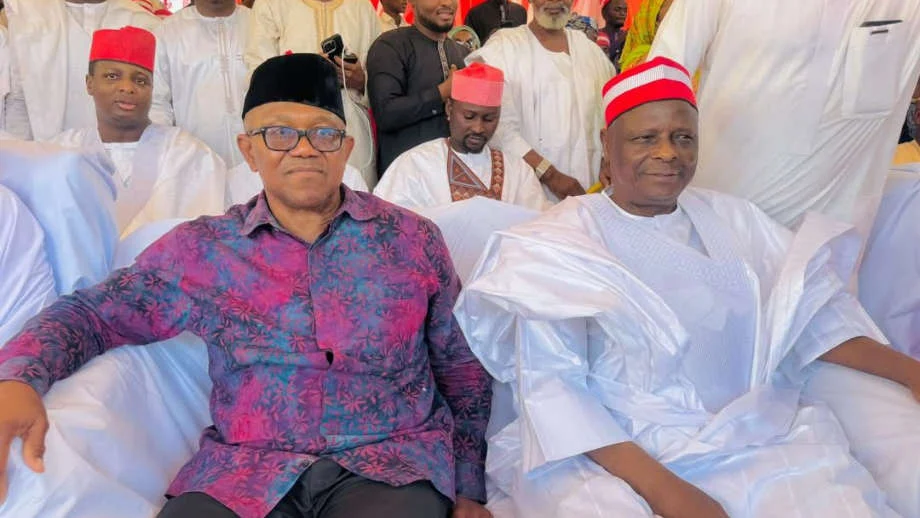
•Peter Obi and Rabiu Kwankwaso
As the 2027 presidential and National Assembly campaigns formally opened, the presidential candidate of the Labour Party, Peter Obi, has declared that Nigeria stands at a defining crossroads, insisting that the country must break free from poverty, insecurity and economic paralysis.
Obi, who spoke in an address marking the commencement of the campaign season, said the moment had presented Nigerians with another opportunity to interrogate the records, ideas and capacity of those seeking their mandate to lead the country.
He said he considered himself privileged to be among those asking Nigerians for their support, stressing that his campaign would be anchored on one conviction: “Nigeria can work, and Nigeria must work,” reports Saturday Independent.
The former Anambra State governor, however, painted a grim picture of the country’s socioeconomic condition, warning that the challenges confronting Nigeria had assumed proportions too serious to be ignored.
According to him, the International Monetary Fund estimates that 63 per cent, representing more than 140 million Nigerians, live at or below the national poverty line, while humanitarian agencies project that about 35 million people would require food assistance during the 2026 lean season.
He added that approximately 3.6 million Nigerians remained internally displaced, largely as a consequence of conflict and insecurity, even as millions of young Nigerians enter the labour market every year without finding productive opportunities.
Obi said weak infrastructure, unreliable electricity, insecurity and the prohibitive cost of doing business were steadily tightening the economic noose around households and businesses.
“These are more than statistics,” he said, arguing that the figures represented the daily struggles of Nigerian families, farmers, workers, students and entrepreneurs.
But rather than surrender to the weight of the crisis, Obi said Nigeria possessed the humanT capital, natural resources, market, talent and entrepreneurial energy required to reverse its fortunes.
What was missing, he maintained, was the discipline and leadership necessary to transform those assets into security, productivity and shared prosperity.
The former Anambra governor said his experience in the private sector, academic exposure to policy and business matters and years in public office had given him a practical understanding of what effective governance demands.
According to him, government must manage public resources responsibly, establish measurable priorities and constantly assess the consequences of its decisions.
“Public office is not a reward; it is a responsibility to the people,” he declared.
Obi pointed to his tenure in Anambra, where he said his administration concentrated on education, healthcare, infrastructure, fiscal discipline and institutional capacity as the foundations for sustainable development.
While admitting that his administration was not perfect, he challenged Nigerians to independently assess its record and determine whether it offers lessons for the future.
He also highlighted the governing experience of his presidential running mate, Senator Rabiu Musa Kwankwaso, former governor of Kano State, describing their experiences as different but complementary.
Obi said Kwankwaso’s administration placed considerable emphasis on education, technical training, scholarships, infrastructure and human-capital development.
According to him, the investments demonstrated an understanding that the most valuable long-term resource of any state is its people.
“Our experiences are different, but our conclusion is the same: Nigeria must invest in its people and manage public resources with discipline,” Obi said.
Obi argued that Nigeria could no longer afford a succession of reactive economic measures without a clear strategy for improving the lives of ordinary citizens.
He said the central questions before the country should be whether Nigerians were better off than they were four years ago, whether families could afford food, education and healthcare, and whether businesses could produce, expand and create jobs.
He further questioned whether young Nigerians could find productive employment, whether farmers could work safely and whether agricultural produce could reach markets without being destroyed by insecurity and failing infrastructure.
For Obi, those questions represent the real test of governance as the 2027 election battle gathers momentum.
He therefore urged Nigerians to look beyond political rhetoric and judge candidates by their records, competence, ideas and capacity to deliver measurable results.
With the campaign season now officially underway, Obi’s message places the economy, security, human capital and responsible management of public resources at the heart of his bid for the presidency.