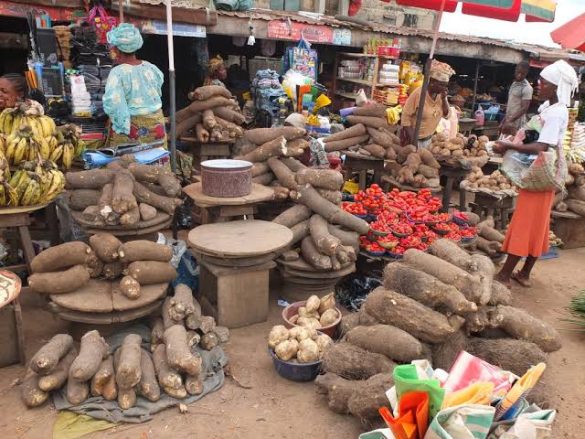
•Open foodstuffs market
Nigerians are grappling with rising food prices even as inflation shows signs of moderating, with stakeholders pointing to seasonal shortages, unstable transport costs, and deep structural challenges as key drivers of the surge.
While headline inflation shows modest moderation, stakeholders in separate interviews with our correspondent agree that the surge in food prices is driven more by structural supply constraints than temporary shocks, reports Daily Independent.
They pointed out that without addressing these underlying issues, Nigerians may continue to face rising food costs and prolonged pressure on household incomes and business sustainability.
On the surface, Austine Gbenga Ad-eniba, Chief Operating Officer, Eliakim Integrated Services Ltd, attributed part of the pressure to fluctuations in petrol prices and transport costs.
“The increasing petrol price is responsible, and the cost of transportation is not stable,” he said, noting that logistics remains a major factor in food pricing. He said that weather patterns are also playing a role.
“We are in the dry season; rainfall should have been more prominent now for maize to have been coming out,” he explained.
For Adeniba, the situation ultimately reflects basic economics: “The forces of demand and supply rule the market.
Demand is currently greater than supply.” This aligns with broader stakeholder views that supply constraints are at the heart of the current food inflation trend.
Oyewole Okewole, Senior Associate Consultant at FutuX Agri-consult Limited, noted that the period marks the lean season for staple crops, when supplies typically fall short of demand.
“Stored products are degrading rapidly ahead of the harvest, while demand remains high.
“Rising fuel prices — nearly double in recent times — have further increased transportation and logistics costs, feeding directly into retail food prices. In addition, the high cost of imported agricultural inputs continues to push up the final price of commodities.”
Staples such as beans, cassava, and yam flour have seen notable increases. Okewole explained that these foods are widely consumed with little or no substitutes, meaning demand remains strong even as prices rise.
Weak infrastructure for post harvest handling and inefficient supply chains, according to him, worsen the situation, while increases in staple prices ripple across related products like gari, foofoo, and bean flour.
Evidence from a February 2026 food inflation brief reinforces these observations, showing a sharp rise in food inflation from 8.89 percent in January to 12.12 percent in February.
The surge reflects tightening food supply conditions, rising production costs, and inefficiencies across Nigeria’s agricultural value chain.
Declining post-harvest stocks have reduced market availability, while higher fuel prices continue to drive up transportation and distribution costs.
Currency depreciation has made imported inputs more expensive, and insecurity in food-producing regions has further constrained output. The brief also highlights high input costs — including fertiliser, labour, and agro-input inflation— as major barriers to production.
Rising prices of staples such as beans, cassava, and yam flour point to broad supply shortages, demand spillover effects as consumers switch between foods, and weak storage and buffer systems.
Market inefficiencies, including hoarding and post-harvest losses, compound the challenge, indicating that the inflation surge is not limited to a single commodity but reflects system-wide constraints. Regional disparities add another layer to the problem.
Okewole explained that food prices tend to be lower in northern production zones but higher in southern consumption centres due to transportation costs.
Security challenges in some areas reduce farming activities and create localised shortages, while urban areas experience stronger demand pressures compared to rural communities.
Factors such as proximity to production zones, infrastructure quality, and the number of intermediaries in the supply chain all influence regional price variations.
Sani Danladi, National Secretary of the National Tomato Growers, Processors and Marketers Association of Nigeria (NATPAN), pointed to past market conditions as a warning sign.
“The slight increase in prices now is partly because supply is low at this non-harvest period, and many commodity dealers did not stock last season,” he said. He explained that poor prices during the last harvest discouraged both traders and farmers, leading to reduced stocking and, in some cases, farmers pulling back from production.
He warned that without intervention, the country could see a repeat of the high food prices experienced two years ago. Data from the Centre for the Promotion of Private Enterprise (CPPE) paints a mixed inflation picture.
While headline inflation eased slightly to 15.06 percent year-on-year in February 2026 from 15.10 percent in January, month-on-month inflation accelerated to 2.01 percent, with food inflation rising sharply to 4.69 percent.
The report notes that food, transport, and energy costs continue to erode purchasing power, particularly for vulnerable and urban households, while businesses face rising operating costs and shrinking margins. Global energy dynamics are further intensifying domestic pressures.
Geopolitical tensions in the Middle East have pushed crude oil prices above $100 per barrel, translating into higher fuel costs, increased logistics expenses, and rising production costs in Nigeria.
These factors ultimately feed into higher food prices. Dr. Muda Yusuf, CPPE Chief Executive Officer, emphasised that structural weaknesses amplify these shocks.
“Nigeria’s heavy reliance on petrol and diesel for power generation means energy price increases quickly translate into higher production and transport costs, feeding directly into food prices,” he said.
He noted that unreliable electricity imposes trillions of naira in annual economic losses and forces households and businesses to rely heavily on costly generators.
Beyond the immediate pressures, the food inflation trend carries broader national implications. High-cost urban markets are driving overall inflation averages, while inter-state food movement spreads price increases across regions.
Supply shocks in key food-producing areas reduce national availability, deepening food insecurity and cost-of-living challenges. At the same time, stakeholders say the situation highlights potential investment opportunities in agriculture and food systems.