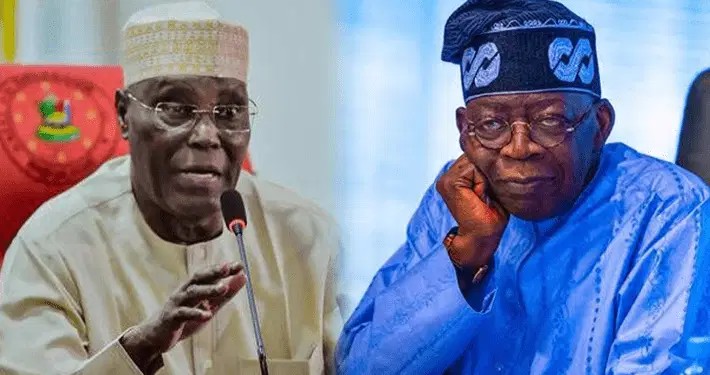
•Atiku and Tinubu
Former Vice President Atiku Abubakar has accused President Bola Tinubu of shifting responsibility for Nigeria’s troubled petroleum refineries to previous administrations, saying the current government must account for the billions of naira committed to the facilities under its watch.
Meanwhile, Nigerians from different sectors of the economy have expressed divergent views over the federal government’s plan to revive the state-owned refineries following Tinubu’s assurance that the nation’s refineries would resume operations, reports The Guardian.

He gave the assurance when he received the Executive President of the Nigeria Union of Petroleum and Natural Gas Workers (NUPENG), Mr Salimon Oladiti, and members of the union at the Presidential Villa, Abuja.
Atiku, in a statement yesterday by his Senior Special Assistant on Public Communication, Phrank Shaibu, said the Tinubu administration could no longer blame inherited liabilities after over three years in office.
He anchored his criticism on financial figures contained in the records of the Nigerian National Petroleum Company Limited (NNPCL) which, according to him, showed that the combined obligations of the Port Harcourt, Warri and Kaduna refineries to NNPCL rose from about N4.52 trillion in 2023 to N8.67 trillion in 2024.
The increase of approximately N4.15 trillion in one year, Atiku argued, raises questions about the financial commitments made to the refineries and the returns that Nigerians received from them.
The African Democratic Congress (ADC) presidential candidate also commented on a recent admission by NNPCL Group Chief Executive Officer, Bayo Ojulari, that the state-owned refineries had been operating at a “monumental loss” and that continuing their operations under the existing arrangement was destroying value.
Ojulari disclosed in February 2026, during a fireside chat at the Nigeria International Energy Summit in Abuja, that NNPCL had halted operations after an internal assessment found low utilisation, a lack of a credible path to profitability, and continued financial losses.
Atiku said the admission had exposed what he described as a contradiction in the federal government’s earlier presentation of the refinery rehabilitation programme.
“President Tinubu cannot have it both ways. When the cameras were rolling in November 2024, his government told Nigerians that the Port Harcourt Refinery was back,” the statement partly read.
“NNPCL announced that it was operating at 70 per cent capacity and expressly presented it as an achievement under President Tinubu’s leadership.
“Now that the celebration has turned into embarrassment, the same administration wants Nigerians to believe that the refineries are merely liabilities inherited from previous governments.”
The NNPCL had indeed announced on November 26, 2024, that the old 60,000-barrel-per-day Port Harcourt Refinery had resumed processing and that trucks had begun loading petrol, diesel and kerosene. The company said at the time that the facility was operating at 70 per cent of installed capacity, with plans to increase utilisation to 90 per cent.
Atiku challenged Tinubu to take ownership of both the successes and failures recorded by his administration, saying, “Mr President, you claimed the refinery when you thought it was working. You cannot disown it now that the smoke has cleared.”
The ADC candidate asked the federal government to explain how the refinery obligations increased by over N4 trillion in a single year and what Nigerians obtained from the expenditure.
“Nigerians deserve answers. If the combined obligations of these refineries jumped by over N4 trillion naira in 2024 alone, what exactly did Nigerians receive in return? Where did the money go? Where are the products? Where are the savings Nigerians were promised? And where is the refinery your government celebrated before television cameras?”, Atiku asked.
The controversy comes against the backdrop of years of unsuccessful attempts by successive administrations to revive Nigeria’s state-owned refineries.
The Port Harcourt Refinery rehabilitation was presented by NNPCL in November 2024 as a major step towards restoring domestic refining capacity. NNPCL said the old refinery was producing petroleum products and described its restart as a significant milestone for Nigeria’s energy security.
However, questions persisted over the commercial viability and sustained operation of the government-owned facilities. By February 2026, NNPCL management said an assessment had established that continuing to operate the refineries under the prevailing structure would result in further losses, prompting the temporary shutdown of the state-owned plants.
Atiku said the development was particularly troubling because Nigerians were still paying high prices for petroleum products despite the huge sums committed to restoring domestic refining capacity.
“Think about what N4 trillion could do for Nigeria,” he said, pointing to universities, hospitals, roads, electricity and potable water as areas that could have benefited from such resources.
“Yet, trillions accumulate around refineries that the government itself now effectively acknowledges have been haemorrhaging public resources.”
He described the situation as “an unforgivable failure of stewardship” and accused the administration of taking credit for projects when they appear successful while blaming predecessors when problems emerge.
“You cannot spend three years claiming credit for everything that appears to work and blaming your predecessors for everything that fails. Leadership does not work that way,” Atiku said.
The former vice president further argued that “President Tinubu’s scorecard after over three years is increasingly a story of fire and smoke – enormous expenditure, extravagant announcements and very little Nigerians can hold in their hands,” he said.
In another development, however, Nigerians in separate interviews yesterday in Lagos expressed their views. According to the former President, Nigerian Institution of Electrical and Electronic Engineers (NIEEE), Mr Adekunle Makinde, urged the president to undertake a comprehensive technical and economic assessment of the facilities before committing more resources to their rehabilitation, arguing that refineries are important national assets that should be preserved.
“Let’s do a deep dive. Let’s understand the fundamentals concerning these refineries and what exactly is required. These are not modern-day or state-of-the-art refineries,” he said.
“So, we need to determine how maintainable and sustainable they are before deciding whether to revive the old refineries or build new ones.”
He said the outcome of such studies would help the government determine the most economically viable option.
However, a former chairman of the Nigerian Bar Association, Badagry Branch, Mr Mohammed Shodipo, expressed reservations about continued investment in the old refineries.
Shodipo said successive governments had committed substantial funds to rehabilitating and revitalising the facilities without achieving sustainable results. He argued that directing such funds toward new refinery projects could provide better value for taxpayers’ money.
“The government of the day should be more proactive and result-oriented rather than just doing things for the sake of doing them,” he said.
“The present Nigerian economy requires prudent management of resources, making it important for government to ensure that every major project is economically viable, productive and sustainable.”
For the Lagos Headquarters Scout Commissioner, Grassroots Development, Mr Mustapha Ademola, the plan to revive the refineries was welcome and a necessary step.
Ademola, however, said Nigerians expected transparency, accountability and measurable results from the initiative.
According to him, “every Nigerian wants the refineries to work. The concern is that billions of dollars have reportedly been committed to rehabilitation over the years, yet the expected results have not been sustained.”
He urged the government to disclose the amount already spent on each refinery, their current condition, the cost and scope of the proposed rehabilitation, contractors involved, timelines and independently verifiable milestones.
Also, the Chief Executive Officer, Abolusodun Nigeria Ltd., Taoheed Asimi, advocated a strategic partnership with private investors to improve the management and operation of the refineries.
Asimi urged the federal government to consider selling a 50 per cent stake in the refineries to a Chinese company or another multinational operating in Nigeria. According to him, such an arrangement would enable the government to retain a 50 per cent stake while the strategic investor would hold the remaining 50 per cent.