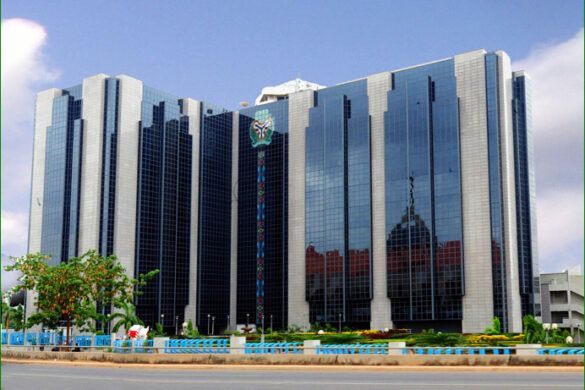
•CBN headquarters, Abuja
With barely three weeks left before the deadline for Nigeria’s banking recapitalisation exercise, tension and anticipation are building across the financial industry as regulators, investors and customers await the final shape of the country’s banking landscape.
The recapitalisation programme introduced by the Central Bank of Nigeria (CBN) has triggered one of the most significant transformations in the sector since the landmark consolidation exercise of 2004, reports Daily Independent.

As the countdown enters its final stretch, analysts say the exercise is likely to reshape the competitive structure of the banking industry, deepen capital buffers and potentially trigger a wave of mergers and acquisitions.
For many Nigerians, the question now is not just whether banks will meet the new capital thresholds, but what the sector will look like when the exercise finally closes.
The Push For Stronger Banks
The recapitalisation policy was introduced by the CBN to ensure that Nigerian banks have stronger balance sheets capable of supporting economic growth, financing large-scale projects and withstanding global financial shocks.
Under the framework unveiled by Olayemi Cardoso, the apex bank’s governor, banks were given a defined timeframe to raise fresh capital to meet higher minimum requirements based on their operating licences.
International commercial banks are required to meet the highest capital thresholds, followed by national and regional banks.
The regulator argues that the move is necessary to align the banking sector with Nigeria’s long-term economic ambitions, especially as the country seeks to build a $1 trillion economy within the next decade.
Stronger banks, policymakers say, will be better positioned to finance large infrastructure projects, support corporate expansion and deepen financial inclusion.
Banks Race To Raise Capital
Over the past year, Nigerian banks have embarked on aggressive capital-raising programmes through public offers, rights issues, private placements and strategic investor partnerships.
Some lenders have successfully raised hundreds of billions of naira from the capital market, while others have opted to restructure their operations or explore merger opportunities.
Large tier-one institutions— often referred to as the “FUGAZ” banks—have generally moved quickly to strengthen their capital positions, leveraging strong investor confidence and established market reputations.
Several mid-tier banks have also successfully tapped the market, though analysts note that smaller institutions have faced more challenges in attracting investors.
For many banks, the final weeks of the recapitalisation exercise will determine whether they can independently meet the required thresholds or whether consolidation becomes inevitable.
Mergers And Acquisitions Loom
One of the most anticipated outcomes of the recapitalisation programme is the possibility of renewed consolidation in the sector.
Analysts say some banks that struggle to meet the capital requirements may pursue mergers or acquisitions as a strategic solution.
Such consolidation could reduce the number of banks operating in Nigeria, while creating larger institutions with stronger capital bases.
Industry observers believe that this development could mirror aspects of the 2004 banking consolidation, which reduced the number of banks in Nigeria from 89 to 25.
However, analysts note that the current exercise is less about crisis management and more about positioning the banking sector for future growth.
“This recapitalisation is fundamentally different from the 2004 exercise,” said one Lagos-based financial analyst. “The banking system today is more stable and better regulated. What we are seeing now is an effort to scale up the industry to match the size of the economy.”
What Nigerians Expect
For ordinary Nigerians, the recapitalisation exercise carries significant implications.
Many depositors are hopeful that stronger banks will translate into safer deposits and improved financial stability.
Public confidence in the banking system has grown over the years, but memories of past bank failures still shape perceptions among some customers.
By increasing capital buffers, regulators aim to reduce the likelihood of bank distress and enhance the resilience of the financial system.
Customers also expect the recapitalisation drive to encourage banks to expand lending to businesses, particularly small and medium-sized enterprises (SMEs), which remain the backbone of Nigeria’s economy.
Access to affordable credit has long been a major challenge for businesses, and analysts believe stronger banks could play a critical role in bridging that financing gap.
Impact On The Economy
Economists say the recapitalisation exercise could have far-reaching implications for Nigeria’s economic growth.
Banks with larger capital bases will have greater capacity to finance large-ticket transactions, including infrastructure development, energy projects and industrial expansion.
This is particularly important as Nigeria seeks to diversify its economy beyond oil and strengthen sectors such as manufacturing, agriculture and technology.
Stronger banks are also expected to play a key role in attracting foreign investment.
Global investors typically prefer financial systems with well-capitalised institutions capable of supporting large-scale transactions and managing risk effectively.
As Nigeria seeks to position itself as a leading investment destination in Africa, the strength of its banking sector will remain a critical factor.
Analysts Predict A More Competitive Sector
Market analysts expect the recapitalisation exercise to produce a more competitive and technologically advanced banking sector.
Over the past decade, Nigerian banks have increasingly invested in digital banking platforms, fintech partnerships and innovative financial products.
The recapitalisation programme could accelerate these trends, as larger and better-capitalised banks compete for customers through improved technology and service delivery.
Analysts also expect stronger regional expansion by Nigerian banks across Africa.
Several leading institutions have already established significant footprints across the continent, and improved capital positions could enable further expansion into new markets.
Possible Short-Term Pressures
Despite the long-term benefits, analysts warn that the recapitalisation process could create short-term pressures for some institutions.
Raising fresh capital can dilute existing shareholders and increase competition among banks seeking investor funds.
Smaller banks may also face strategic decisions about whether to maintain their current licences, downgrade their operations or pursue partnerships with larger institutions.
For investors, the coming weeks could present opportunities as banks conclude capital-raising exercises and reposition for growth.
Final Stretch
As the recapitalisation deadline approaches, the Nigerian banking industry is entering a decisive phase.
Regulators, investors and customers are closely watching how banks navigate the final stretch— whether through successful capital raises, strategic alliances or industry consolidation.
What is increasingly clear, however, is that the exercise is set to redefine the structure of Nigeria’s financial system.
When the recapitalisation programme concludes, the country is likely to emerge with fewer but stronger banks, improved financial stability and a sector better equipped to support economic transformation.
For Nigeria’s banking industry, the next two weeks may mark the end of the recapitalisation process—but they could also signal the beginning of a new era of scale, resilience and global competitiveness.