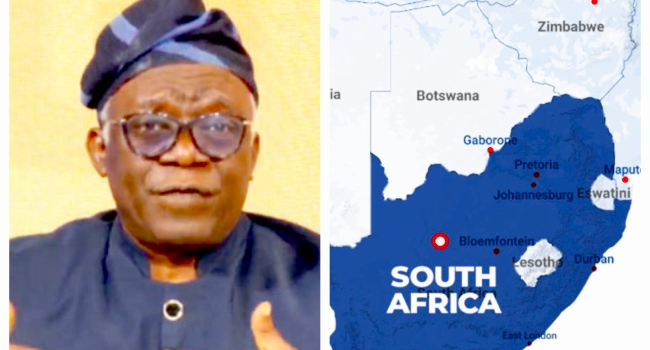
•Falana and map of South Africa
Senior Advocate of Nigeria Femi Falana has petitioned the African Commission on Human and Peoples’ Rights over “the persistent and escalating threats to the safety and security of Nigerians and other African nationals in the Republic of South Africa.”
In the communication submitted pursuant to the African Charter on Human and Peoples’ Rights, Falana called on the Commission “to urgently intervene and refer the matter to the African Court on Human and Peoples’ Rights for binding adjudication”, reports Channels TV.

In the petition sent to the African Commission, he highlighted “a pattern of widespread and recurring xenophobic violence, including killings, physical assaults, arbitrary arrests, torture, looting of businesses, and forced displacement”.
Falana said that the attacks were neither isolated nor sporadic but reflected a systemic failure to protect foreign nationals.
“There remains a persistent, widespread, and well-documented pattern of xenophobic violence, intimidation, and discrimination against Nigerians and other African nationals in the Republic of South Africa.
“These violations are neither isolated nor sporadic; rather, they reflect a recurring cycle of attacks marked by killings, physical assaults, arbitrary arrests, torture, looting, destruction of businesses, forced displacement, and sustained threats to life and personal security.
“Recent incidents further underscore the gravity and continuity of these violations. According to the Nigerian Consulate-General in Johannesburg, two Nigerian nationals—Amaramiro Emmanuel and Ekpenyong Andrew—were killed in April 2026 in separate incidents involving personnel of the South African National Defence Force (SANDF),” it read in part.
“Mr. Andrew reportedly died following his arrest in Pretoria after an altercation with law enforcement officials, with his body later discovered in a mortuary. Mr. Emmanuel similarly died from injuries allegedly inflicted by security personnel.
“These incidents have caused widespread shock within the Nigerian community and raise serious concerns about the conduct and accountability of state actors. In addition to these killings, there has been a resurgence of violent mob attacks against African migrants.
“Videos widely circulated in May 2026 show groups of South Africans assaulting Black foreign nationals, issuing threats, and demanding that they leave the country,” it added.
The lawyer further stated that “in several instances, individuals were beaten with sticks, harassed, and subjected to degrading treatment, accompanied by inflammatory rhetoric targeting foreigners.
The incidents, he said, had been reported across multiple locations, including Gauteng Province, Durban, Cape Town, East London, and parts of KwaZulu-Natal and the Eastern Cape.
“Diplomatic missions, including the Nigerian High Commission, have issued security advisories warning of planned protests and violent demonstrations targeting foreign nationals. Similarly, other African governments, including Ghana, have raised concerns about the safety of their citizens, describing the attacks as deeply disturbing and calling for urgent intervention.
“Reports also indicate that over 130 Nigerian nationals have requested evacuation due to fears for their safety. These incidents occur against a broader backdrop of entrenched hostility toward foreign nationals, fuelled in part by public rhetoric, socio-economic tensions, and inadequate state response,” he added.
The senior lawyer further lamented that “migrants are frequently subjected to profiling, harassment, and exclusion, with limited access to effective remedies. Women and children are disproportionately affected, experiencing heightened vulnerability to violence, exploitation, and displacement”.
“By 2019, 127 Nigerians had been killed in South Africa. There were protests by the youths who called for the nationalisation of South African companies in Nigeria. To assuage the feelings of the Nigerian people, the Government of South Africa apologised to the Government of Nigeria over the xenophobic attacks.
“On several occasions, xenophobic attacks have been recorded in public hospitals where doctors have been forced by members of violent groups to discharge Nigerians and other foreigners receiving treatment. Sometime in 2022, President Ramaphosa condemned such xenophobic attacks in public hospitals.
“However, instead of directing the security forces to arrest and prosecute the ongoing xenophobic attacks, President Cyril Ramaphosa has asked African migrants to respect the laws, tradition and customs of South Africa,” Falana stated.
“It is curious to note that President Cyril Ramaphosa has since turned round to deny the xenophobic attacks unleashed on African migrants.
“This communication also seeks urgent intervention by the Commission and, in particular, requests the referral of this matter to the African Court on Human and Peoples’ Rights (“the Court”) pursuant to Articles 5(1)(a) and 6(1) of the Protocol to the African Charter on the Establishment of the African Court on Human and Peoples’ Rights.
“Given the persistent nature of the violations and the absence of effective remedies, this matter warrants immediate consideration and escalation,” he added.
The lawyer further stated that despite the repeated xenophobic attacks on African migrants, “there has been a consistent failure on the part of the Government of South Africa to exercise due diligence in preventing these attacks, protecting affected individuals, conducting prompt and impartial investigations, prosecuting perpetrators, and providing effective remedies to victims”.
“This failure has fostered a climate of impunity, emboldening perpetrators and perpetuating cycles of violence.”
“The cumulative effect of these acts constitutes continuing violations of the provisions of the African Charter, engaging the responsibility of the State for both acts and omissions, including the failure to protect individuals within its jurisdiction from harm by state and non-state actors alike,” he added.
Falana, therefore, urged the Commission to conduct a thorough and independent investigation into ongoing xenophobic violence affecting Nigerians and other African nationals, and, among others, make a declaration of violations, adequate compensation and reparation for victims, guarantees of non-repetition, structural and institutional reforms.
Nigeria had on May 4, 2026 called for a thorough investigation and full autopsy reports following the killing of two Nigerians in South Africa.
It said that the killings had heightened tension within the Nigerian community in South Africa, prompting the Nigerian government to demand full autopsy reports on the deceased as well as access to relevant case files.